
An SEO career gives you something most digital roles don't: clear, measurable outcomes, genuinely transferable skills, and work that compounds over time. In Singapore, SEO professionals earn between SGD 3,000 and SGD 8,000 per month depending on specialisation and experience. Demand is rising, remote work is common, and you can start learning today with no degree required.
This guide covers every job title in the SEO industry, what each role actually does, what the Singapore job market looks like, how to get certified, and whether you can build an SEO career by teaching yourself.
Key Takeaways
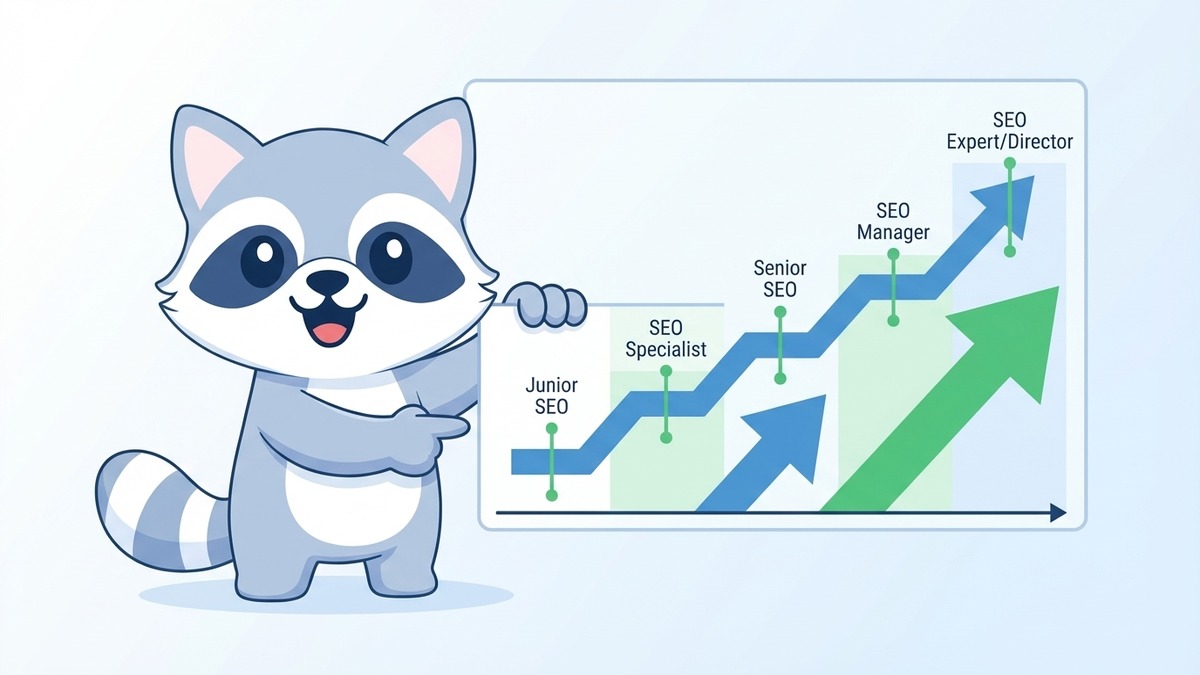
- SEO jobs span five main tiers: analyst, specialist, strategist, manager, and director or consultant
- Singapore SEO salaries range from SGD 3,000 (entry level) to SGD 10,000+ (senior/consultants)
- SEO jobs are in demand and frequently remote-friendly
- You can learn SEO on your own. It takes 6 to 12 months of consistent practice to become job-ready
- Google, HubSpot, and Semrush offer the most respected free certifications in 2026
- The single most valuable thing you can do early on is build and rank your own website
What Does an SEO Professional Actually Do?
SEO stands for Search Engine Optimisation. At its core, an SEO professional's job is to help websites rank higher in Google (and increasingly in AI-generated search results). But the work itself varies enormously depending on the role and company.
On any given day, an SEO might be:
- Researching keywords that potential customers type into Google
- Auditing a website to find technical issues blocking search rankings
- Writing or briefing content designed to rank for specific queries
- Building relationships with publishers to earn backlinks
- Analysing ranking data and traffic trends in Google Search Console
- Reporting results to clients or internal stakeholders
If you want to understand what SEO actually involves before choosing it as a career, read how SEO actually works. It walks through the full search engine process from crawling to ranking.
SEO sits at the intersection of technology, content, and data. That's exactly why it appeals to people with varied backgrounds, from developers and writers to analysts and marketers.
The SEO Job Titles Explained
The SEO industry has a relatively clear title hierarchy, though job descriptions vary between companies and agencies.
SEO Analyst
The entry-level role. An SEO analyst collects and interprets data. Day-to-day tasks typically include keyword research, ranking tracking, competitor analysis, and producing weekly or monthly reports.
You don't need prior experience to land an analyst role. Most employers want to see that you understand how search engines work, can use tools like Google Search Console and Semrush, and can present findings clearly.
SEO Specialist
The practitioner tier. An SEO specialist executes optimisation work across a website. This means writing title tags and meta descriptions, fixing technical issues, optimising page content, and building internal links.
Specialists are the engine room of any SEO operation. This is where most people spend two to four years before moving up.
SEO Strategist
Strategists zoom out. They develop keyword strategies, content plans, and link-building roadmaps. The work is more creative and consultative than tactical. You're deciding what to prioritise and why, not just executing tasks.
To move into strategy, you need a track record. You need to have ranked pages and driven measurable traffic.
SEO Manager
Managers lead teams. They oversee analysts and specialists, manage client relationships (in agency settings), and translate SEO strategy into business outcomes. Communication and project management skills matter as much as technical SEO knowledge at this level.
In Singapore, SEO manager roles at agencies typically sit in the SGD 5,500 to SGD 7,500 range.
SEO Director / Head of SEO
Senior leadership role. The Head of SEO sets the overall strategy across a portfolio of clients or a large website. They report to C-suite, manage budgets, and make hiring decisions.
This is a five-to-eight year career milestone for most people.
Freelance SEO Consultant
Many experienced SEO professionals go independent. Consultants charge on a retainer or project basis. Rates in Singapore typically range from SGD 800 to SGD 3,000 per month per client, depending on scope.
Consultants need strong self-management skills and the ability to sell their own services. The earning ceiling is high: a consultant with five retainer clients at SGD 2,000 each earns SGD 10,000 per month.
SEO Salaries in Singapore: What You Can Actually Expect
Singapore is one of Southeast Asia's most competitive digital markets. Google's advertising ecosystem is well-established here, which means businesses understand the value of organic search and are willing to pay for it.
Based on job postings across LinkedIn, JobStreet, and MyCareersFuture in early 2026:
| Role | Typical Monthly Salary (SGD) |
|---|---|
| SEO Analyst (0-2 years) | 3,000 - 4,200 |
| SEO Specialist (2-4 years) | 4,000 - 5,500 |
| SEO Strategist (3-5 years) | 5,000 - 7,000 |
| SEO Manager (4-7 years) | 5,500 - 8,000 |
| Head of SEO / Director (7+ years) | 8,000 - 12,000 |
| Freelance Consultant | 800-3,000+ per client/month |
Can SEO make you rich? The short answer is yes, if you pair the skill with entrepreneurship. Consultants, agency owners, and affiliate marketers who build their own SEO-powered income streams regularly earn six figures annually. The skill itself is a vehicle. What you do with it determines your ceiling.
The Skills Every SEO Professional Needs
SEO spans multiple disciplines. Here's what you need to develop, split by category:
Technical Skills
- Google Search Console and Google Analytics 4
- Keyword research tools (Semrush, Ahrefs, or Google Keyword Planner)
- Basic HTML and understanding of how websites are built
- Site speed and Core Web Vitals troubleshooting
- Understanding of crawling, indexing, and robots.txt
- Schema markup basics
Content Skills
- Writing and editing for web audiences
- Keyword mapping and content briefs
- On-page optimisation (title tags, headings, internal links)
- Content gap analysis
Analytical Skills
- Reading and interpreting ranking reports
- Traffic trend analysis
- Conversion rate awareness
- Competitor benchmarking
Soft Skills
- Communicating complex ideas to non-technical stakeholders
- Project management (especially in agencies)
- Staying curious: SEO changes constantly, and self-learning is a permanent requirement
You don't need all of these on day one. Build depth in one area first (most people start with either technical or content), then expand.
For a practical guide to the SEO glossary terms you'll encounter on the job, bookmark the SEOExpert glossary so you're not lost in jargon when you start.
The Best SEO Certifications in 2026
Certifications won't get you a job on their own. But they demonstrate initiative, structure your learning, and give you something to show employers before you have a portfolio.
The most respected options in 2026:
Google Digital Garage: Fundamentals of Digital Marketing
Cost: Free
Time: ~40 hours
Best for: Complete beginners. Covers SEO basics alongside broader digital marketing fundamentals. Recognised by Google and widely accepted in Singapore.
HubSpot SEO Certification
Cost: Free
Time: ~4 hours
Best for: Content-focused SEO learners. Strong on topic clusters, pillar pages, and on-page optimisation.
Semrush Academy: SEO Fundamentals
Cost: Free
Time: ~5 hours
Best for: Those planning to use Semrush professionally. Teaches you the tool alongside the concepts.
Ahrefs Academy
Cost: Free
Time: ~7 hours
Best for: Technical and link-building tracks. Ahrefs is the tool of choice for many senior SEO practitioners.
Yoast SEO Training
Cost: Freemium
Time: Several courses available
Best for: WordPress-specific SEO implementation.
Which SEO certification is best? Start with Google Digital Garage for the foundation, then layer in Semrush or Ahrefs depending on which tool your target employer uses. In Singapore, most agencies use Semrush as their primary platform.
Can You Learn SEO on Your Own?
Yes. In fact, most working SEO professionals are self-taught in significant parts of the discipline. SEO has no formal degree path, no accreditation body, and no licensing requirement. The barrier to entry is entirely about demonstrated skill.
Here is the realistic self-learning timeline:
Months 1-2: Learn the fundamentals. What search engines do, how pages rank, keyword research basics, on-page optimisation. Our complete on-page SEO guide is a solid reference for this phase. Read Google's own Search Central documentation alongside reputable blogs.
Months 3-4: Build something. Register a domain, launch a WordPress site, and try to rank it for low-competition keywords. This is where real learning happens.
Months 5-6: Go deeper on technical SEO. Set up Google Search Console and Google Analytics 4. Learn to read crawl reports. Fix actual problems on your own site.
Months 7-9: Study link building. Understand why backlinks matter, how to earn them legitimately, and what to avoid. Our article on backlinks as your secret SEO weapon is a good starting point.
Months 10-12: Document your results. By now your test site should show some rankings and traffic movement. Screenshot everything. These become your portfolio.
By month 12, you have: certifications, a live site with measurable results, and hands-on tool experience. That is a competitive entry-level candidate in Singapore.
Are SEO Jobs in Demand in Singapore?
Yes. And the demand is growing, not shrinking.
A few signals from the Singapore market in early 2026:
- Digital marketing roles are consistently among the top 10 in-demand jobs on MyCareersFuture
- Singapore's internet penetration rate is approximately 96%, meaning the entire addressable consumer base is online and searchable
- E-commerce growth has driven a significant increase in demand for SEO specialists with product page and technical e-commerce experience
- The rise of AI-generated search results (Google AI Overviews, Perplexity, ChatGPT) has created a new subspecialty: Generative Engine Optimisation, or GEO. Professionals who understand both SEO and GEO are particularly sought after
Remote work is also well established in SEO. Many Singapore-based SEO professionals work for Australian, UK, or US companies on a remote contract basis. This expands your earning potential significantly beyond local rates.
A Day in the Life of an SEO Specialist
To make this concrete, here is what a typical day looks like for a mid-level SEO specialist at a Singapore agency.
9:00am: Check overnight ranking movements in the rank tracker. Flag any significant drops for investigation.
9:30am: Review Google Search Console for the client whose audit lands this week. Export crawl coverage issues for the report.
10:00am: Write three optimised blog post briefs based on keyword research completed last week.
12:00pm: Lunch. The SEO never stops: you'll probably notice something about a competitor's site during a Google search.
1:30pm: Client call to present last month's performance report. Rankings are up 18 positions for the target keyword. Client is happy.
2:30pm: Technical audit work: fix duplicate title tag issues flagged in the crawl, update canonical tags on paginated product pages.
4:30pm: Link prospecting. Find five relevant Singapore-based websites for an outreach campaign for next month.
5:30pm: Done. SEO rarely involves crunch time the way dev or design does. It's a measured, analytical discipline.

SEO Career Paths: Where Can You Go From Here?
SEO is not a dead-end job. The skills you build transfer in multiple directions:
Path 1: Agency Leadership
Analyst to Specialist to Manager to Head of SEO at an agency. You manage a team, service multiple clients, and potentially move into agency ownership.
Path 2: In-House Senior SEO
Join a large e-commerce brand, media company, or SaaS business as their internal SEO lead. Often higher salary stability than agency work.
Path 3: Freelance Consultant
Five to seven years in, go independent. Control your own schedule, client mix, and rates. The ceiling is high.
Path 4: Broader Digital Marketing
SEO knowledge translates into content strategy, digital PR, product marketing, and growth roles. Many CMOs at Singapore tech companies have SEO backgrounds.
Path 5: Entrepreneurship
Build SEO-powered content sites that generate passive income through affiliate commissions or display advertising. This is the "can SEO make you rich?" path. It is absolutely possible with patience and skill.
What Singapore Employers Actually Want
Looking at active SEO job listings in Singapore in early 2026, here are the most frequently required skills:
- Google Analytics 4 and Google Search Console proficiency
- Semrush or Ahrefs (one or both)
- WordPress experience (most Singapore SME sites run WordPress)
- On-page SEO implementation experience
- Content writing ability (a differentiator: many SEO candidates can't write)
- Client communication skills (especially for agency roles)
- Understanding of technical SEO basics (crawlability, site structure, page speed)
Bonus skills that make you stand out in Singapore specifically:
- E-commerce SEO (Shopify, WooCommerce)
- Local SEO knowledge (Google Business Profile, local pack rankings)
- Bilingual capability (English and Mandarin expands your client reach significantly)
- GEO awareness (understanding how to appear in AI-generated search answers)
SkillsFuture and SEO Training in Singapore
Singapore residents can use their SkillsFuture Credit to fund digital marketing courses that include SEO modules. Several SkillsFuture-approved providers run SEO-specific training in Singapore, typically at a cost of SGD 500 to SGD 2,000 before subsidy.
The IMDA Digital Industry Singapore programme also funds digital marketing skills development for Singaporeans looking to enter or upskill in the tech and media sectors.
If you're already working and want to upskill, check whether your employer qualifies for SkillsFuture Enterprise Credit, which subsidises external training costs for employees.
Is SEO the Right Career for You?
SEO suits people who:
- Like data but also enjoy creative work
- Are comfortable with ambiguity (Google doesn't share all its ranking signals)
- Can think long-term. SEO results take months, not days
- Enjoy continuous learning. Algorithm updates and platform changes are constant
- Like seeing the direct results of their work in measurable rankings and traffic
SEO is not ideal if you:
- Need instant gratification. Your first few months will be slow
- Dislike writing or technical problem-solving
- Want a career where the rules don't change. SEO shifts significantly every year
The professionals who thrive long-term in SEO are curious, analytically minded, and genuinely interested in how the web works.
Your First 30 Days in an SEO Career
Whether you land a job or start freelancing, here's what to focus on in your first month:
- Set up Google Search Console and GA4 on a live site (your own or your employer's)
- Run a full site crawl using Screaming Frog (free up to 500 URLs)
- Do a keyword gap analysis against one competitor
- Write and publish one fully optimised blog post targeting a low-competition keyword
- Study one Google algorithm update from the past 12 months and understand who it affected
These five tasks will teach you more than any course can.
Ready to Work With SEO Experts?
If you're a business owner rather than a career seeker, and you want results without the 12-month learning curve, we can help. Our team at SEOExpert has built rankings for Singapore businesses across industries, and we're transparent about what we do and what you can expect.
Get in touch with our team to find out what an SEO services in Singapore engagement looks like for your business.