
SEO (Search Engine Optimisation) is the practice of making your website rank higher on Google. GEO (Generative Engine Optimisation) is the practice of making your content get cited by AI tools like ChatGPT, Perplexity, and Google's AI Overviews. In 2026, a smart digital presence requires both. They're not the same thing, but they reinforce each other.
If you've been hearing "GEO" thrown around and wondering what it actually means for your Singapore business, this article gives you a complete picture.
Key Takeaways
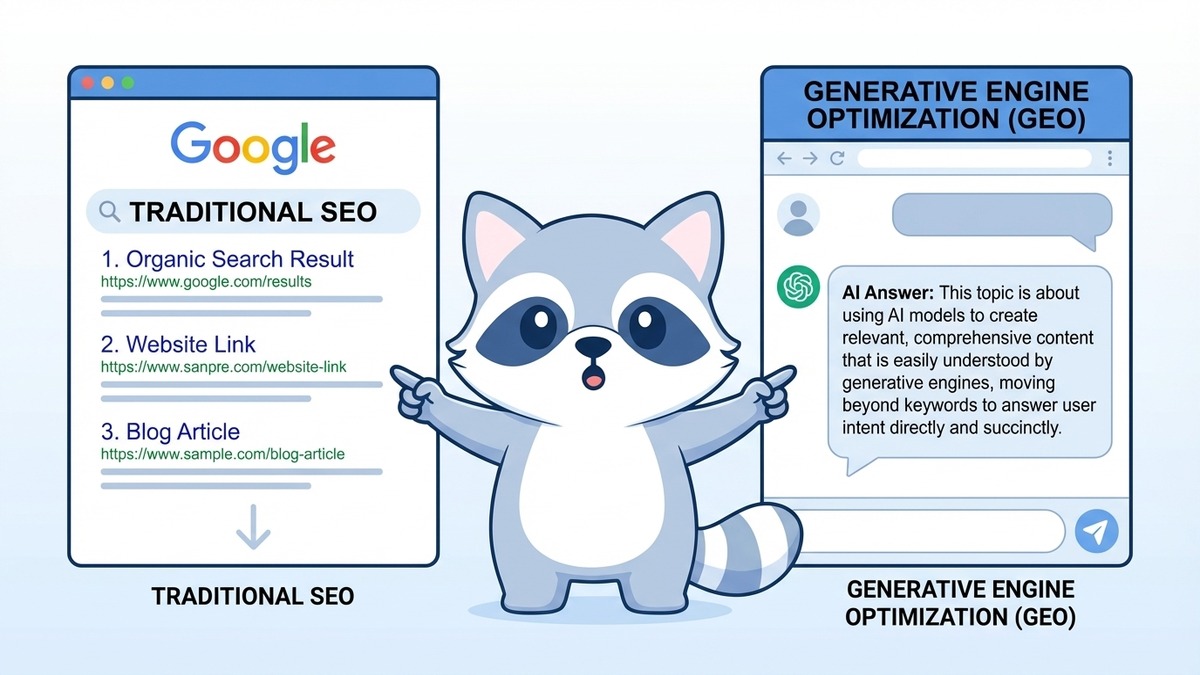
- SEO focuses on Google rankings. GEO focuses on AI-generated answers
- Both disciplines share the same foundation: high-quality, well-structured, authoritative content
- Singapore businesses are increasingly being researched via AI tools, especially for B2B services
- GEO is an early-mover opportunity right now. Most local businesses haven't started optimising for it
- You don't have to choose between SEO and GEO. The best strategy works both simultaneously
- Businesses that ignore GEO risk being invisible when potential customers ask AI tools for vendor recommendations
What Is SEO?
SEO is the process of optimising a website so it appears prominently in search engine results pages (SERPs). When someone types "best accounting software Singapore" into Google, the results that appear are heavily influenced by SEO.
The three pillars of SEO are:
Technical SEO: Ensuring your website is structured in a way that Google can crawl and understand. This includes site speed, mobile-friendliness, URL structure, and removing crawl errors.
On-Page SEO: Optimising the content on each page to match what people are searching for. This means keyword research, writing well-structured content with proper headings, and making sure meta titles and descriptions are accurate.
Off-Page SEO: Building authority through backlinks. When reputable websites link to yours, Google treats your site as more credible and trustworthy.
SEO is not new. It has been around since the late 1990s, and Google has dominated the search landscape since the early 2000s. For a fuller grounding in what SEO involves, read our SEO explained in 5 minutes overview.
The end goal of SEO is visibility: being present when your target customer searches for something relevant to what you offer.
What Is GEO?
Generative Engine Optimisation (GEO) is the practice of optimising content so it gets surfaced by AI-powered answer engines. These include:
- Google AI Overviews (the AI-generated summaries at the top of some Google search results)
- Perplexity AI (a popular AI search engine that cites sources)
- ChatGPT with web search (the search-integrated version of OpenAI's chatbot)
- Microsoft Copilot / Bing Chat
- Claude and other AI assistants when users ask them factual questions
When someone asks Perplexity "which SEO agency in Singapore should I hire", the AI generates an answer and cites specific sources. GEO is about making your content one of those cited sources.
GEO is still an emerging discipline. The academic term "Generative Engine Optimisation" was formally introduced in a research paper in 2024, and the practice is still evolving. But the early-mover advantage is real: businesses that structure their content for AI citation now will have a head start that is very difficult to overcome later.
How Are SEO and GEO Different?
Here's a clear comparison:
| Factor | SEO | GEO |
|---|---|---|
| Target platform | Google, Bing, search engines | ChatGPT, Perplexity, Google AI Overviews |
| Goal | Rank in position 1-10 of SERPs | Get cited or quoted in AI-generated answers |
| Key signals | Backlinks, content quality, technical health | Content authority, factual accuracy, direct answers |
| Measurement | Keyword rankings, organic traffic | AI citations, brand mentions in AI answers |
| Content style | Comprehensive, keyword-targeted | Direct, definitive, citable statements |
| Timeline | 3-12 months to see results | Faster if content is already high-quality |
| Maturity | Established discipline, 25+ years old | Emerging, significant flux |
The most important thing to note in this table: SEO and GEO are not in opposition. The content qualities that make pages rank well on Google (accurate, authoritative, well-structured, comprehensive) are largely the same qualities that make content get cited by AI tools.
Think of GEO as an extension of SEO, not a replacement. You're not starting over. You're building on what you've already done.
Why Singapore Businesses Need to Pay Attention to GEO Now
Singapore has one of the highest AI adoption rates in Southeast Asia. Tools like ChatGPT and Perplexity are widely used among professionals, particularly in B2B categories.
Here's a scenario playing out right now across Singapore: a marketing manager at a Singapore company is evaluating digital agencies. Rather than Googling "SEO agency Singapore" and browsing ten different websites, they open Perplexity and ask: "Which SEO agencies in Singapore have good reputations?"
Perplexity generates a response. It cites two or three agencies it has pulled from content across the web. If your agency appears in that answer, you get a phone call. If you don't appear, you don't exist for that buyer.
This is why GEO services have become a serious offering for forward-thinking Singapore businesses. The buyers are already using AI to research vendors. The question is whether you show up when they do.
The categories most affected right now:
- Professional services (legal, accounting, consulting, marketing)
- Technology and SaaS
- Finance and insurance
- Healthcare and wellness
- Higher education
If you operate in any of these sectors in Singapore, GEO should already be on your radar.
How to Optimise for GEO: The Core Principles
GEO is still evolving, but several clear principles have emerged from research and practice:
1. Write Direct Answer Paragraphs
AI tools are trained to extract clear, direct answers to questions. If your content buries the answer in paragraph 8, the AI is likely to pull from a competitor who answered in paragraph 1.
Structure every major section of your content around a question. Answer that question directly and definitively in the first sentence. Then provide supporting detail.
Example structure:
- Question: What is GEO?
- Direct answer: GEO (Generative Engine Optimisation) is the practice of optimising content to appear in AI-generated answers.
- Supporting detail: How it works, why it matters, what to do.
2. Use Structured, Citable Formats
AI tools prefer structured content: numbered lists, comparison tables, clearly defined headings. These formats are easy for AI to parse, quote, and attribute.
If your content is written as dense paragraphs with no structure, it's hard for an AI to extract a clean citation. Break your content into scannable, structured sections.
3. Include Specific, Verifiable Statistics
AI tools cite sources that contain specific, verifiable claims. "SEO is important" is not citable. "According to BrightEdge research, organic search drives 53% of all website traffic" is citable.
Include real statistics with clear attribution wherever possible.
4. Build Topical Authority
AI tools tend to cite sources they recognise as authorities on a given topic. This is built through:
- Consistent publishing on a topic over time
- Earning backlinks from other reputable sources
- Being cited and mentioned by other content across the web
This is exactly what a well-executed SEO strategy does. Which brings us back to why SEO and GEO reinforce each other.
5. Ensure Technical Quality
AI tools can only cite content they can access and read. Technical SEO basics apply here too: fast loading speed, clean HTML structure, and proper indexing are prerequisites for AI visibility as much as they are for Google rankings.
The Overlap: What Works for Both SEO and GEO
If you're already doing good SEO, you're already doing a significant portion of GEO work:
- High-quality, well-researched content: check for both
- Clear heading structure (H1, H2, H3): check for both
- Fast, mobile-friendly pages: check for both
- Authoritative backlinks: check for both
- Consistent topical coverage: check for both
Where GEO adds new requirements beyond SEO:
- Direct answer formatting (first-paragraph answers optimised for extraction)
- More emphasis on specific statistics and citable claims
- Brand mentions on external sites (not just links, but name mentions)
- Structured data markup (schema) to help AI parse your content
The incremental investment in GEO on top of a solid SEO foundation is relatively modest. The upside is access to a fast-growing segment of the discovery journey.
Can AI Actually Replace SEO?
This is a question we addressed in depth in our article on whether SEO is dead. The short version: no.
Google processes over 8.5 billion searches per day. AI chatbots process vastly fewer queries. The total search volume moving through AI tools is a supplement to traditional search, not a replacement.
What AI search has done is create a new discovery surface. Smart businesses optimise for both. The businesses that declare SEO obsolete because of AI and stop investing in rankings are the ones who will struggle most when they eventually discover that AI answers are largely built from well-optimised web content.
What This Means for Your Singapore Business
If you currently have an SEO strategy:
- Good news: you're already building the foundation for GEO visibility
- The adjustment needed is mostly in content formatting (adding direct answers, structured data, specific statistics)
If you don't currently have an SEO or GEO strategy:
- You're behind on two compounding curves simultaneously
- The window for early-mover GEO advantage is open right now, but it won't stay open indefinitely
The right move in 2026 is to treat SEO and GEO as an integrated strategy. Build authority through quality content and legitimate backlinks. Structure that content for AI citability. Measure both traditional organic traffic and AI brand mentions.
We offer both SEO services and GEO services as part of an integrated approach built specifically for Singapore businesses navigating the new search landscape.
Want to see what that looks like for your business? Get in touch with our team and we'll walk you through exactly where you stand.