

Picture a Singapore worker on a Wednesday evening, sitting on the MRT, scrolling through her phone. She has a cashflow problem she can't bring to family, and she needs to know which licensed money lenders near her are legitimate, what the rules are around interest rates, and which one looks trustworthy enough to walk into tomorrow. She opens Google. What she sees in the next 30 seconds will decide who gets her business. There's no Facebook ad waiting to catch her, no Instagram retargeting, no SMS blast, no flyer in her mailbox. Under Singapore's Moneylenders Rules, none of that is legal for a licensed money lender. The only marketing channel waiting for her is the search results page. And if your LML isn't on that page, you don't exist to her.
Key Takeaways
- Licensed money lenders in Singapore are restricted by MinLaw to three advertising channels: their business premises, their consumer-facing website, and approved consumer business directories.
- This restriction makes search visibility (SEO) one of the very few legal marketing channels available, and probably the highest-leverage one.
- Borrowers researching loans are deeply intent-driven, comparing licensing status, rates, location, and reviews before they walk in.
- A clean, compliant website with strong technical SEO, transparent licensing info, and a well-maintained Google Business Profile is the foundation.
- Trust signals (MinLaw licence number prominently displayed, schema markup for LocalBusiness, Google reviews, branch info) directly affect both rankings and conversions.
- Borrowers cross-check against MinLaw's Registry of Moneylenders. Make verification easy, not awkward.
The MinLaw Reality That Changes Everything
Most Singapore businesses can mix their channels. They run Meta ads. They blast WhatsApp broadcasts. They send promotional SMSes to past customers. They pay influencers. None of that is open to a licensed money lender.
The Moneylenders Act and Rules, enforced by the Ministry of Law's Registry of Moneylenders, restrict where and how an LML can advertise. The permitted channels are, in plain terms:
- Advertisements on the licensee's business premises.
- The licensee's own consumer-facing business website.
- Consumer-directed business directories (in print or online).
That's the list. SMS solicitation is out. Cold calling is out. Social media advertising is out. Flyers in HDB lift lobbies are out. Influencer posts are out. Paid Google search ads to consumers are, in practice, out as well, because Google's own policies and Singapore's regulatory environment combine to block them for moneylending.
Some LMLs try to sidestep these limits by spinning up separate aggregator or comparison sites, often under a different business name, that rank for queries like "best licensed money lender Singapore" and route borrowers back to themselves. It's a regulatory grey area MinLaw has grown more attentive to, and the more durable path remains building authority on your own properly identified site.
The strategic implication is uncomfortable for some LMLs and exciting for others. If almost every other channel is closed, organic search visibility (SEO) becomes the marketing strategy. Your website, your Google Business Profile, and your listings in approved directories are not "part of the mix." They are the mix.
This is where investing seriously in SEO services in Singapore stops being optional and starts being the entire growth engine.
How Borrowers Actually Search
Before deciding what to fix on your website, understand how borrowers find you. Real Singapore search behaviour for licensed money lender queries falls into a few common patterns:
Verification searches. "Is [company name] a licensed money lender?" or "[company name] MinLaw registry." Borrowers are pre-screening you before they walk in. If your website doesn't immediately make your licence visible, you lose them.
Location searches. "Licensed money lender Jurong East," "moneylender Tampines," "licensed money lender near me." Hyperlocal, high intent. The local pack on Google Maps dominates these results.
Use-case searches. "Personal loan Singapore foreigner," "fast cash loan Singapore," "licensed money lender for low income." Borrowers are looking for someone who specifically serves their situation.
Education searches. "Maximum interest rate licensed money lender Singapore," "is moneylender SMS legal," "licensed vs unlicensed money lender." Borrowers want to understand the rules before they commit.
Comparison searches. "Best licensed money lender Singapore," "top moneylenders SG," and similar. These produce mostly aggregator and directory pages, which is where directory listings matter.
Each search type needs a different page. A homepage doesn't rank for all of them. A homepage rarely ranks well for any of them.
Your Website Is Your One Sales Floor
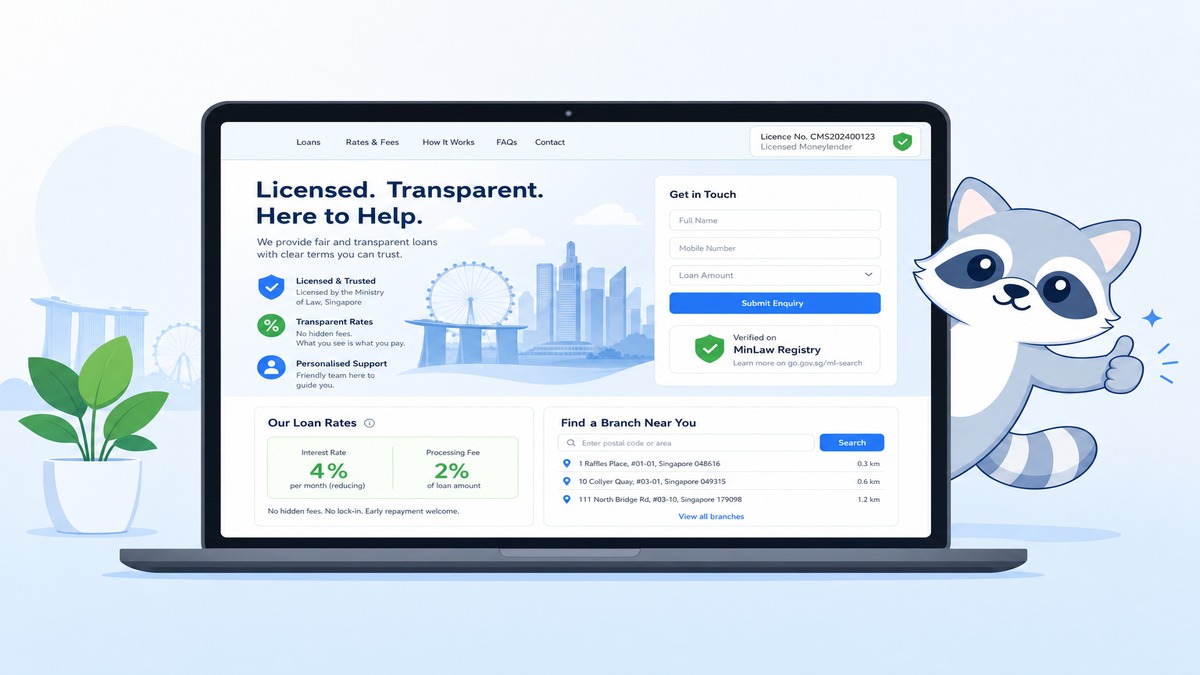
Because the legal restrictions push everything onto your website, that site has to do the job of multiple channels at once: brand awareness, trust building, comparison, conversion, and customer service. Yet most LML websites we audit are still doing the bare minimum.
The non-negotiables for a Singapore LML website in 2026:
Your full registered name and licence number on every page. Header or footer is fine, but it must be visible without hunting. Borrowers will cross-check this against the MinLaw Registry of Moneylenders before deciding to trust you.
A clear "About / Licensing" page that states your registered business name, licence number, registered office address, and a direct link to the MinLaw Registry of Moneylenders so visitors can verify you themselves. This is one of the strongest trust signals you can build, and it costs nothing.
Branch information for every physical location. Each branch should have its own page with the address, opening hours, phone number, and a Google Map embed. Multi-location LMLs benefit enormously from this kind of structured branch content.
Transparent loan information within the limits of what MinLaw allows you to publish. The legal interest rate cap, the late fee cap, the late interest cap, the administrative fee cap, all of it should be findable on your site. Borrowers value this transparency, and so does Google when ranking informational queries.
A Privacy Policy and Terms of Use that match your actual practices. These are basic, but missing or template-grade legal pages erode trust.
Schema markup. LocalBusiness schema on branch pages, FinancialService where appropriate, and Organization schema sitewide. Done right, schema gives Google a clean structured view of who you are, where you operate, and what you do. Our guide on schema markup for SEO goes deeper on how to implement it without breaking anything.
Google Business Profile: Your Branch Visibility Engine
For an LML with one or more branches, your Google Business Profile optimisation is the single highest-leverage channel inside the Google ecosystem.
When someone searches "licensed money lender Bedok" on their phone, what they see first is the Google Map pack: usually three branches with reviews, hours, and a directions button. If you're not in that pack, you don't get the walk-in.
For Singapore LMLs specifically:
- Set the primary GBP category to "Loan agency" or the most accurate equivalent. Add secondary categories if relevant (Financial institution, etc.).
- Use your exact registered business name, the one that appears on the MinLaw Registry. Do not stuff keywords into the name. That breaks Google's guidelines and is a credibility issue regardless.
- Fill every field: address, hours (including public holiday adjustments), phone, website, services, attributes.
- Upload genuine photos of your physical branch: exterior signage, the reception or service counter area, your team in professional dress (with consent). Borrowers want to see what walking in will feel like.
- Encourage genuine reviews from customers who had a good experience. A consistent flow of recent, thoughtful reviews is one of the strongest local ranking signals in Singapore, and our Google review link generator makes it trivial for customers to leave one.
- Respond to every review. Especially negative ones. Professional, polite, factual responses to negative reviews often convert hesitant readers more than a wall of five-star ratings.
The mechanics of getting into the local pack are covered in our guide on ranking on Google Maps in Singapore. The same principles apply to LMLs, with a sharper emphasis on visible licensing.
Multi-Branch LMLs: Geographic Coverage Done Right
If your LML operates multiple branches across Singapore, you have a structural advantage that a lot of operators waste.
Each branch should have:
- Its own dedicated landing page on your website, not a shared "Locations" page with a long list.
- A consistent NAP (Name, Address, Phone) block matching your GBP listing for that branch exactly.
- A unique branch-specific title and meta description targeting "[service] [neighbourhood]" queries.
- Embedded Google Map, transit information (nearest MRT or bus stop), and parking notes where relevant.
- Branch-specific reviews and team photos where possible.
Done well, this builds geographic coverage that ranks for dozens of hyperlocal queries simultaneously. Done badly (duplicate content across branch pages with only the address swapped), it triggers Google's thin-content and duplicate-content filters and ranks for nothing.
For more on doing this without tripping over yourself, our multi-location SEO guide covers the structural patterns that work.
Local Citations and Approved Directories
Because MinLaw permits advertising on consumer-directed business directories, getting your LML accurately listed in the right directories isn't just good for SEO. It's one of your three legal channels.
The directories worth being on, broadly:
- Google Business Profile (already covered).
- Bing Places for Business.
- Apple Maps via Apple Business Connect.
- Reputable Singapore business directories used by consumers.
- Where appropriate, comparison platforms aimed at consumers (be careful here, some platforms blur the line into solicitation; check before listing).
Across every listing, your NAP must match exactly. Inconsistent names, addresses, or phone numbers across directories confuse Google's understanding of your business and weaken your local rankings. Our piece on local citations in Singapore covers how to audit and clean up inconsistencies.
Compliant Content That Still Ranks
Here's where many LMLs stall. They want to publish content to attract organic traffic, but they're (rightly) cautious about what they can legally say. The good news: there's plenty of room for compliant content that ranks well.
Compliant content categories that work:
Borrower education. "How licensed money lenders are regulated in Singapore," "What's the maximum interest rate a licensed money lender can charge," "How to verify a money lender is licensed." Borrowers actively search these terms, and content that answers them straightforwardly builds trust and ranks well.
Loan use-case explainers. "What is a personal loan used for," "Bridging loans explained," "Foreigner loan rules in Singapore." Each of these targets distinct search intent and supports natural internal linking.
Process content. "What documents do you need to apply for a loan with a licensed money lender," "What happens during a loan consultation," "How long does approval take." Process clarity reduces friction and improves conversion.
Comparison content. "Licensed money lender vs unlicensed money lender (loan shark): how to tell the difference." This is unusually valuable in the Singapore context because borrower confusion about legitimacy is a real issue. A clear, well-written comparison ranks for high-intent queries and protects borrowers.
This playbook is similar to what we've covered for other regulated Singapore industries. The principles in our piece on how aesthetic clinics in Singapore win patients through search translate surprisingly well to moneylending: compliance-aware content, treatment-or-service-specific pages, transparent pricing within the rules, and a heavy lean on Google Business Profile for branch visibility.
What you cannot do is publish content that effectively solicits. Avoid promotional headlines, urgency triggers ("apply now and get cash today"), and anything that crosses from informational into advertising-by-stealth on third-party platforms. Within your own website, you have more freedom, but even there, restraint reads as professionalism.
For a deeper view of how to put information into a structure Google can index and rank, our on-page SEO guide covers the basics that every page on your site should follow.
Trust Signals: The Compounding Asset
In a regulated, sensitive industry like moneylending, trust signals are the difference between a borrower clicking "contact" and bouncing to the next result.
Build these systematically:
- Visible licence number on every page.
- Direct link to the MinLaw Registry of Moneylenders entry, where users can verify you in one click.
- Real photos of the actual branch and the actual team (with consent).
- A consistent stream of genuine, recent Google reviews.
- An "About" page that includes the human story: who founded the business, how long it has operated, what the team looks like.
- A clear, plainly-written FAQ covering the questions borrowers actually ask.
- HTTPS everywhere, no mixed-content warnings, no broken pages. Borrowers checking a moneylender's website for security issues are not unusual.
These are not separate from SEO. They are SEO. Google's quality systems, including the criteria broadly known as E-E-A-T, weigh trust heavily in finance-related queries. Combined with strong technical foundations and the right kind of content, they compound into rankings that competitors with weaker trust profiles cannot easily displace.
Why an Audit Comes First
If you've read this far and recognised a few issues on your own site, the right next move is not to immediately rewrite everything. The right next move is a clean audit.
A proper SEO audit for an LML covers:
- Technical health: crawlability, indexation, page speed, Core Web Vitals.
- On-page structure: titles, meta descriptions, headings, internal links, schema.
- Local presence: GBP completeness, citation consistency across directories, branch page quality.
- Content gaps: which high-intent queries you're missing, which compliant content topics you haven't covered.
- Trust signal completeness: licensing visibility, review velocity, About page, branch transparency.
Without this baseline, content production and link building become guesswork. Our guide on why SEO audits matter walks through what a useful audit looks like in practice.
The AI Search Angle
One last point that's becoming more important every quarter. Borrowers are increasingly using AI tools (ChatGPT, Perplexity, Google's AI Overviews) to research and shortlist moneylenders before they even reach a traditional search results page. They ask questions like "What's the best licensed money lender in Singapore for a small personal loan?" and the AI answers with a short list.
If your business isn't represented in those answers, you're invisible in a growing channel. Showing up in AI-generated answers depends on a mix of strong traditional SEO, structured data, and brand presence across the wider web. Our work as a Singapore GEO agency focuses exactly on this, helping clients in regulated industries earn citations in AI-driven results where the rules are still being written.
Don't ignore this channel because it feels new. Borrowers are already using it.
Ready to Be the LML Borrowers Find First?
Search visibility for licensed money lenders in Singapore isn't a nice-to-have. With most advertising channels closed off by regulation, ranking on Google for the queries your borrowers are typing is close to the only marketing channel you legally have. The LMLs that take this seriously over the next 12 to 24 months will dominate borrower acquisition. The ones that don't will watch their walk-in numbers fade.
If you're ready to build that kind of visibility the right way (compliant, durable, trust-driven), speak with SEOExpert. We've worked with over 20 licensed money lenders in Singapore, so we know exactly what MinLaw allows, what actually moves rankings in this category, and how to grow without crossing lines.