
SEO (Search Engine Optimisation) works by helping search engines find, understand, and trust your website so they rank it higher than your competitors when someone searches for what you offer. It is not magic. It is not a hack. It is a structured process of making your site technically sound, your content genuinely useful, and your reputation online credible. Get those three things right, and Google rewards you with traffic.
If you want a broader foundation, start with our post on what SEO is before diving in here.
Key Takeaways
- SEO works through 3 stages: crawling (Google finds your site), indexing (Google stores your pages), and ranking (Google decides your position in results)
- Google uses 200+ ranking factors to determine where pages appear. No single factor dominates
- The 3 pillars of SEO are technical SEO, on-page SEO, and off-page SEO. All three must work together for strong rankings
- Most businesses see meaningful results within 3 to 6 months; competitive industries can take 6 to 12 months
- Singapore businesses need a mobile-first approach. Google indexes the mobile version of your site first, making mobile performance a direct ranking factor
- SEO is an ongoing programme, not a one-time project. Consistent effort compounds results over time
Step 1: Google Finds Your Website (Crawling)
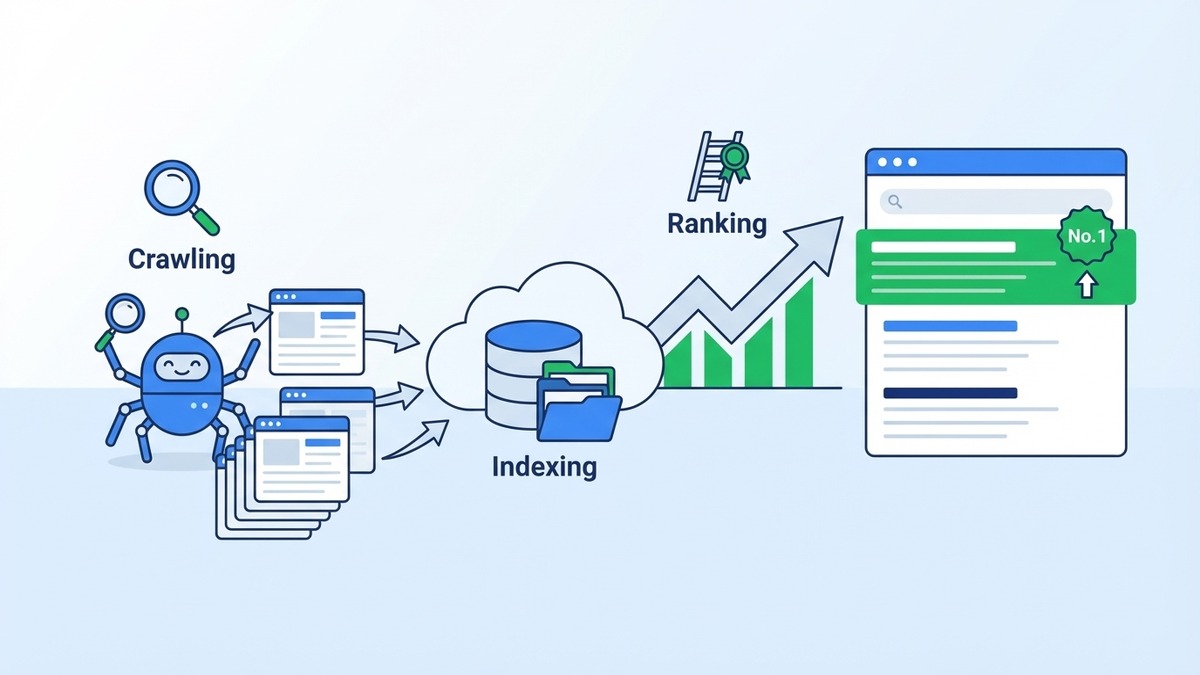
Before you can rank for anything, Google has to know your site exists.
Google uses automated bots called "crawlers" (also called Googlebot or spiders) to browse the web. These bots follow links from page to page, moving across the entire internet collecting information. Think of it like a librarian scanning every book in an infinite library.
When a crawler visits your site, it reads the content on your pages, follows your internal links to discover other pages, and checks your technical setup: how fast your pages load, whether they work on mobile, whether there are errors blocking access, and how your site is structured.
What you can do at this stage:
- Submit a sitemap to Google Search Console so crawlers find all your pages
- Fix broken links and crawl errors
- Avoid blocking important pages in your robots.txt file
- Improve page speed (Google's Core Web Vitals are a direct ranking factor in 2026)
Step 2: Google Stores Your Pages (Indexing)
Once Google crawls a page, it decides whether to add it to its index. The index is essentially Google's database of all the web pages it considers worth showing in search results.
Not every page gets indexed. Thin content, duplicate pages, pages blocked by noindex tags, or pages that load too slowly may be excluded. If a page is not in the index, it will never appear in search results, no matter how good your content is.
What you can do at this stage:
- Write original, substantive content (not copied from elsewhere)
- Use canonical tags to tell Google which version of a page is the "main" one
- Avoid creating hundreds of near-identical pages
- Check Google Search Console regularly to confirm your key pages are indexed
Step 3: Google Decides Where You Rank (Ranking)
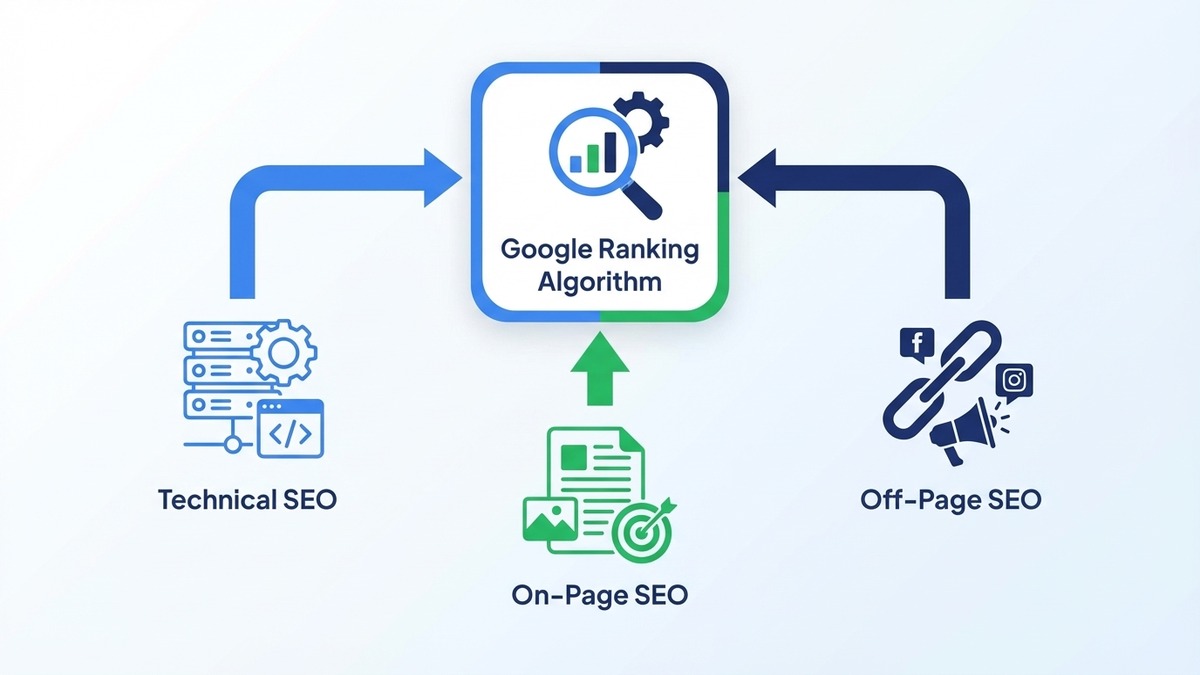
This is where it gets interesting. Google's ranking algorithm processes over 200 signals to decide which page deserves position 1, position 2, and so on for any given search query. No one outside Google knows the exact formula, but years of testing and Google's own public documentation give us a clear picture of what matters most.
The ranking factors cluster into three pillars:
Pillar 1: Technical SEO
This is the foundation. If your site has technical problems, the other pillars will not save you.
Technical SEO covers:
- Page speed: Google measures Core Web Vitals (Largest Contentful Paint, Interaction to Next Paint, Cumulative Layout Shift). Slow sites rank lower.
- Mobile-friendliness: Google indexes the mobile version of your site first (mobile-first indexing).
- HTTPS: Secure sites (SSL certificates) have been a ranking signal since 2014.
- Site architecture: Clear, logical URL structures and internal linking help Google understand your site hierarchy.
- Structured data (schema markup): Helps Google understand the context of your content, enabling rich results like star ratings or FAQ boxes in the SERPs.
Pillar 2: On-Page SEO
On-page SEO is about making each page as relevant and useful as possible for a target keyword.
This includes:
- Title tags and meta descriptions: Your title tag is the single most important on-page signal. It should include your primary keyword and clearly describe the page. Use our SERP simulator to preview how your titles and descriptions will appear in Google results.
- Headers (H1, H2, H3): Organise your content logically. Your H1 should contain your primary keyword.
- Content quality: Google's Helpful Content system (updated repeatedly through 2025 and 2026) demotes content written primarily for search engines rather than for real people. Write for humans first.
- Keyword placement: Use your primary keyword naturally in the first 100 words, in headers, and throughout the body. Do not stuff it.
- Internal linking: Linking between your own pages distributes "authority" across your site and helps users navigate.
Good SEO copywriting ties this all together: content that satisfies searcher intent while sending the right signals to Google.
Pillar 3: Off-Page SEO (Backlinks and Authority)
Google's original breakthrough insight was that a page others link to is likely more trustworthy than one no one links to. That logic still holds in 2026.
Backlinks are votes of confidence from other websites. But quality matters far more than quantity. A single link from a respected news outlet or industry publication outweighs dozens of links from spammy directories.
Off-page signals include:
- Backlink profile: Number of linking domains, their authority, relevance to your industry
- Brand mentions: Even unlinked mentions of your brand name online contribute to your authority
- Reviews and citations: Especially important for local SEO, where Google Maps rankings depend heavily on review volume, recency, and your NAP (name, address, phone) consistency across directories
How SEO Works Step by Step: The Full Process
Here is how SEO is done in practice, from start to results:
- Keyword research: Find the search terms your target audience uses. Prioritise by search volume, commercial intent, and competition level.
- Technical audit: Check for crawl errors, speed issues, mobile problems, and indexation gaps.
- On-page optimisation: Update or create pages targeting your chosen keywords. Optimise title tags, headers, content, and internal links.
- Content creation: Publish in-depth, helpful content that answers the questions your audience is actually searching for.
- Link building: Earn backlinks through outreach, digital PR, guest posting, and creating content worth linking to.
- Monitoring and iteration: Track rankings, traffic, and conversions in Google Search Console and Analytics. Identify what is working and double down. Fix what is not.
SEO is not a one-time project. It is an ongoing programme. The answer to why you should invest in SEO is clear: compounding organic traffic that does not disappear the moment you stop paying for it.
How SEO Works in Digital Marketing
SEO does not operate in isolation. It sits within a broader digital marketing mix alongside PPC (pay-per-click advertising), social media marketing, email, and more.
The key difference: SEO builds long-term, compounding organic traffic. PPC delivers immediate traffic but stops the moment your budget runs out. Smart businesses use both: PPC for fast results and testing, SEO for sustainable growth.
In Singapore, organic search remains one of the highest-converting traffic channels. According to Statista, organic search accounts for a significant share of website traffic across all industries. Businesses investing in SEO services in Singapore consistently see stronger ROI over a 12-month horizon than those relying purely on paid channels.
For businesses with AI-generated search results becoming a bigger part of the SERP landscape, GEO services (Generative Engine Optimisation) are also worth understanding: these help your brand appear in answers generated by AI platforms like Google's AI Overviews, ChatGPT, and Perplexity.
How Long Does SEO Take?
Honest answer: most websites see meaningful ranking improvements within 3 to 6 months. Competitive industries (finance, law, e-commerce) can take 6 to 12 months. New domains with no history take longer than established sites.
The variables that affect timeline:
- Domain age and existing authority: An established site ranks faster than a brand-new one
- Competition level: Ranking for "coffee shop Singapore" is harder than "specialty Ethiopian coffee Singapore Tiong Bahru"
- Content output: Sites publishing consistently useful content progress faster
- Technical health: A technically broken site moves slower until issues are fixed
For online stores, e-commerce SEO involves additional considerations: product page optimisation, category structure, and managing large volumes of near-duplicate content.
A Note on Singapore SEO in 2026
Singapore's search landscape has a few local nuances worth knowing:
- English dominates but bilingual content (English and Mandarin) can reach broader audiences
- Mobile-first is non-negotiable: Singapore has one of the highest smartphone penetration rates in Asia
- Local intent is high: Searches like "SEO agency Singapore" or "best [service] near me" are high-intent and worth targeting with local SEO strategies
- Google is the dominant search engine with over 95% market share in Singapore, so optimise for Google first
For a full glossary of SEO terms referenced in this article, visit our SEO glossary.
Ready to Put This Into Practice?
Understanding how SEO works is step one. Executing it consistently, over months, across technical, content, and authority dimensions, is where most businesses struggle.
That is where we come in. As a digital marketing agency based in Singapore, we handle the full SEO process: audits, strategy, content, link building, and ongoing optimisation. Whether you are a local business looking to dominate Google Maps or a SaaS company targeting regional organic traffic, our SEO services are built to deliver compounding results.
Get in touch with our team for a free SEO consultation. No jargon. No BS. Just a clear plan to get you ranking.