

Quick answer:
A local business can run on a Google Business Profile alone while customers choose by distance and reviews, and it needs a website once customers want to compare prices, process and proof before they get in touch.Key Takeaways
- A complete Google Business Profile, paired with WhatsApp or Instagram, can bring in steady work for a small local service business.
- A listing works best when customers choose by distance and reviews, as they usually do with plumbers and cleaners.
- A listing has no space to explain your process or pricing, so reviews become the main way customers tell similar businesses apart.
- Google can suspend a Business Profile that breaks its guidelines, and getting it back means filing an appeal and waiting for a decision.
- AI assistants such as ChatGPT describe a business using what they can read about it, and a listing gives them only a short description, opening hours and reviews.
- A website of four or five pages is enough for most local businesses once customers start comparing before they call.
Plenty of local businesses run without a website. They have a Google Business Profile, an Instagram page and a WhatsApp number, and their calendars are full.
Not every business needs a website yet. Whether yours does depends on how your customers choose, and that is quick to check.
When a listing is enough
Many local customers choose straight from the map. Someone who needs their aircon serviced compares three nearby businesses, reads a few reviews and calls one of them.
If your customers buy this way, the listing does the job a website would do. Ranking on the map depends on different work from ranking in the ordinary results, as our comparison of local pack and organic results explains.
Most of these jobs are booked over WhatsApp, because customers prefer a quick message to a contact form. For example, a cleaner who replies within a few minutes often gets the booking before a slower competitor has read the message.
This setup suits a one-van plumber, a home baker or a tutor whose timetable is already full. The profile costs nothing, and setting it up properly takes an afternoon.
Setting it up properly means listing every service, keeping opening hours current, adding new photos regularly and replying to every review. For a business without a website, that upkeep is the whole marketing job.
What a listing cannot do
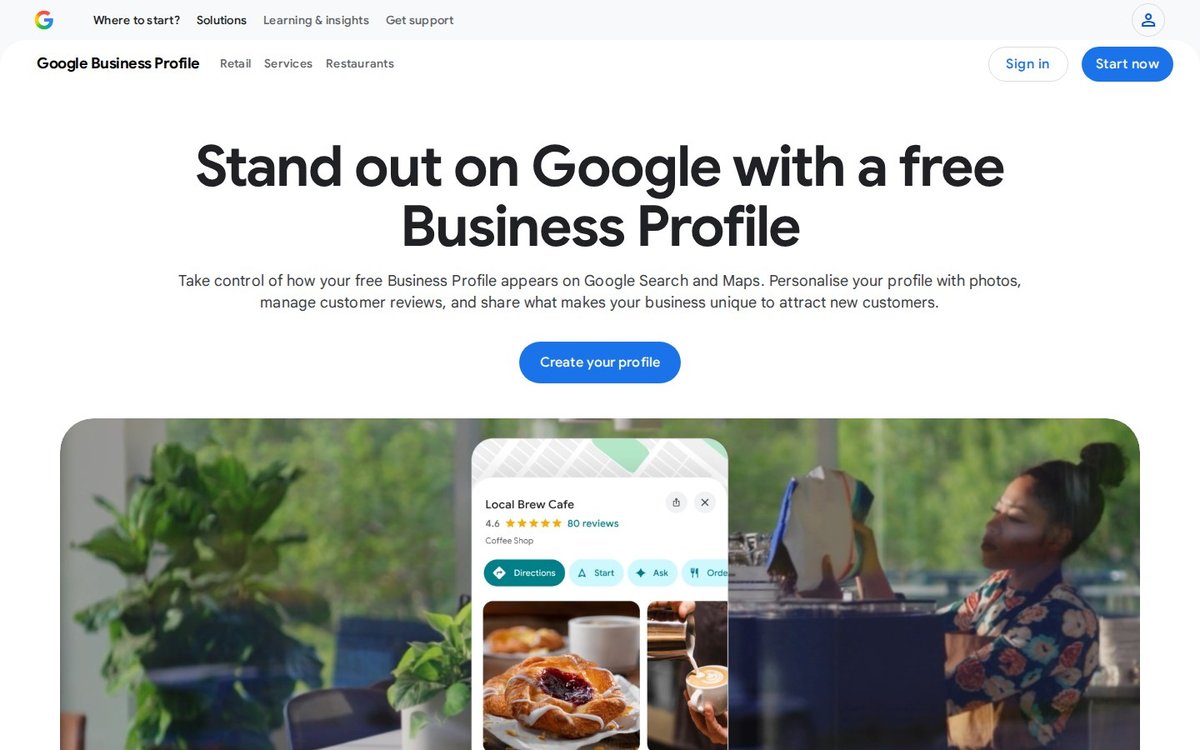
Screenshot from the Google Business Profile official site.
A complete profile can bring in a large share of new work. One business owner quoted on Google's own page for the product puts it this way:
"Our Google Business Profile is one of the main places where people find us, with over 40% of our leads coming directly through there."
The main limit is space. A listing has no room to describe how you work, show what a typical job costs or explain why you charge more than the cheapest option nearby.
That leaves reviews as the main way to tell similar businesses apart. A Google review link generator makes them easier to collect, but two shops rated 4.8 still look almost the same to a customer.
You also do not control the listing. Google's help page on suspended profiles sets out the rule:
"We may suspend or disable Business Profiles that don't follow our guidelines."
To get a suspended profile back, the owner files an appeal and waits for Google to reply by email. A business that relies only on its listing has no other page to send customers to in the meantime.
What a website adds
A website gives customers the answers they look for before they call. Most want to know what a job costs, how long it takes and what can go wrong.
Written once, those answers work for every future customer who searches for them. They also give you pages that can rank for searches the map does not show, such as "how much does it cost to rewire a flat".
AI assistants are the other reason. When someone asks ChatGPT to compare local providers, it describes businesses using what it can read about them, and a listing offers only a short description, opening hours and reviews.
Some businesses are already recommended by ChatGPT without seeing it in their analytics. A service page that sets out prices and process gives an assistant something specific to quote.
Which setup fits your business
| Your situation | What you need | Why |
|---|---|---|
| A plumber, cleaner or tutor serving one area, mostly booked through referrals | Listing only | Customers choose by distance and reviews, and WhatsApp closes the booking. |
| Renovation, tuition or any service where customers compare quotes | Listing plus website | Comparing quotes raises questions that need pages to answer. |
| Deliveries or services across a whole city | Listing plus website | Map results favour businesses close to the person searching. |
| Planning Google or Facebook ads | Listing plus website | Ads need a page to send clicks to and a way to track which clicks become enquiries. |
| Selling products or taking bookings online | Listing plus website | Customers need pages to browse, book and pay without calling. |
The website can stay small. Four or five pages covering your services, examples of past work and contact details are enough for most local businesses.
Pick the platform with care, because moving later takes real work. Our comparison of WordPress, Wix, Shopify and Squarespace sets out the differences.
Run the listing and website together
Once you have both, give each one a job. The listing catches people who are ready to book nearby, and the website answers the questions of people who are still comparing.
Link each listing to its matching service page, and keep the business name, hours and address identical in both places. For example, a clinic with two branches should link each branch listing to that branch's own page.
The website also shows you more about where enquiries come from. Profile insights report searches, calls, direction requests and messages, and website analytics add which pages and services lead to an enquiry.
Keep both up to date, because photos from three years ago make customers wonder whether you are still open. Who handles that upkeep is a separate decision, and our guide to hiring a freelancer, agency or in-house covers the options.
The bottom line
A busy local business serving a small area can stay listing-only for now. Complete every field of the profile, reply to every review and check again in six months whether customers are asking questions the listing cannot answer.
Build the website when customers start picking competitors who have one. A few lost jobs usually cost more than a five-page site.
We quote website builds separately from SEO work. Once the site is live, our SEO services help it get found, Google Business Profile optimisation keeps the listing complete, and our GEO work checks whether AI assistants describe you accurately.
Tell us what you sell and where your customers come from. An SEO consultant on our team will tell you whether the listing is enough, and as a Singapore SEO firm we will say so when you do not need a website yet.