

Editor's Note: Updated 9 June 2026. Now covers how Google Ask Maps changes local discovery.
Every day, thousands of Singaporeans open Google Maps and type in exactly what you sell. The businesses that appear in the top three results, the coveted "Local Pack," get the bulk of calls, directions, and foot traffic. The rest get scrolled past. Here is what separates the businesses that rank at the top from those stuck on page two.
Key Takeaways
- Google Maps ranking is determined by three core factors: relevance, distance, and prominence
- Proximity to the searcher matters, but it is not the only factor. Prominence can overcome distance
- Your Google Business Profile is the foundation, but your website, reviews, and citations all contribute
- Review velocity (getting new reviews consistently) is one of the fastest-ranking levers you can pull
- Building local citations across Singapore directories strengthens your prominence score
- Link building and local SEO signals from your website reinforce your GBP ranking
Understanding How Google Maps Ranking Works
Google's local algorithm considers three factors when deciding which businesses to show:
Relevance: Does your business match what the searcher is looking for? This is determined by your GBP categories, services, business description, and the content of your website.
Distance: How close is your business to the searcher, or to the location they specified in their query? This is partly why a coffee shop in Bukit Timah will not always appear for searches happening in Tampines.
Prominence: How well-known and trusted is your business online? This includes your review count and rating, your number of local citations, links from other websites to yours, and how established your GBP profile is.
The key insight here is that prominence can offset distance. A highly prominent business in Bishan can outrank a less-optimised business closer to the searcher in Ang Mo Kio. This means you have real leverage.
One more layer sits on top of all this now. Google's Ask Maps feature lets people ask Maps full conversational questions instead of single keywords, and it draws answers from the same relevance and completeness signals above. The more accurate and complete your profile, the more of these conversational queries you can win. See our breakdown of how Ask Maps changes local discovery.
If you are building from scratch and want to understand the broader framework, our guide on setting up your Google Business Profile covers the foundation before you start chasing rankings.
Optimise Your GBP for Relevance
The first place to improve your relevance signals is your Google Business Profile:
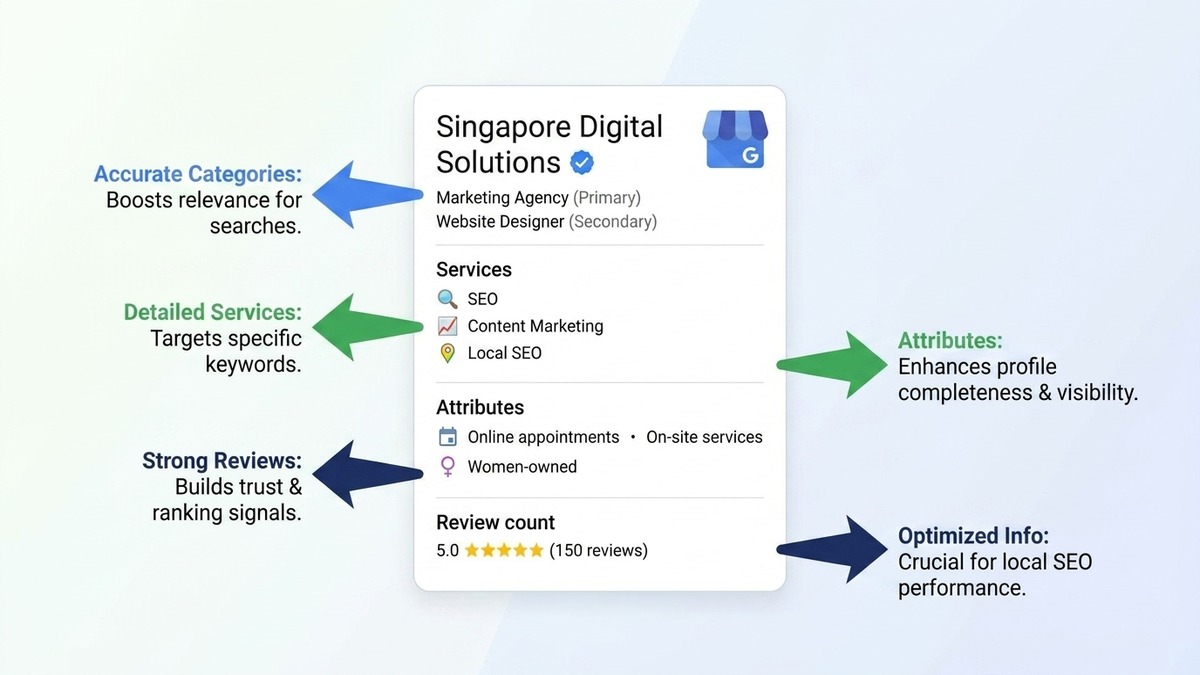
Primary category: This is the single most important relevance signal. Be as specific as possible. "Physiotherapy clinic" ranks better for physiotherapy searches than the generic "Health and wellness."
Services section: List every service you offer with descriptions. If a searcher types "sports massage Clementi" and you have that service listed, you have a much higher chance of appearing.
Business description: Naturally include the services and neighbourhoods you serve. Do not stuff keywords. Write for humans, but be specific about what you do and where.
Attributes: Google offers business-specific attributes (e.g. "women-led business," "free Wi-Fi," "wheelchair accessible"). Fill in every attribute that applies. These help you show up in filtered searches.
Build Prominence With Reviews
Reviews are the most visible signal of business quality on Google Maps, and they directly influence ranking. Here is what matters:
Total review count: More reviews generally means better ranking, all else being equal.
Average star rating: Businesses with below 4.0 stars often struggle to rank in competitive categories.
Review recency: A business that received 50 reviews three years ago and none since will lose ground to a competitor getting 5 reviews a month. Google favours current relevance.
Review content: Reviews that mention your services and location (e.g. "best roti prata in Jalan Kayu") act as additional keyword signals.
Your responses: Responding to reviews signals engagement and builds trust. Use natural language, and occasionally reference your business type and location in your response.
Building a review system is one of the highest-ROI activities for any local business. Use our free Google review link generator to make it easy for customers to leave reviews with one click.
Optimise Your Website for Local Signals
Your website is not separate from your Maps ranking. Google uses it as a supporting signal. Here is how to reinforce your local relevance through your site:
Include your full address on every page (typically in the footer). Use the exact same format as your GBP.
Create location-specific landing pages if you serve multiple areas. A plumbing company that serves Woodlands, Yishun, and Sembawang benefits from separate pages for each area with locally relevant content.
Use schema markup (specifically LocalBusiness schema) to formally tell Google your business name, address, phone number, opening hours, and service area.
Internal linking from relevant blog content to your service pages helps signal what your site is about. For example, a guide on dental hygiene linking to your dental clinic's service page.
Need a refresher on how on-page signals work? Our on-page SEO guide covers the essentials.
Build Local Citations Across Singapore Directories
Citations are mentions of your business name, address, and phone number (NAP) on other websites. Google uses the consistency and volume of these mentions to assess how established and trusted a business is.
For Singapore businesses, key citation sources include:
- Singapore Yellow Pages (yellowpages.com.sg)
- Yelp Singapore
- Foursquare
- HungryGoWhere (for food businesses)
- Carousell (for retail)
- Industry-specific directories
Consistency is critical. If your GBP says "Blk 123 Tampines St 11, #01-23" but your Yellow Pages listing says "123 Tampines Street 11," that inconsistency weakens your citation signals.
Earn Local Backlinks
Links from other Singapore websites to your site are a strong prominence signal. Focus on:
Local media coverage: A mention in The Straits Times, TimeOut Singapore, or a popular food blog carries significant weight.
Association memberships: Singapore Business Federation, SCCCI, or industry associations often provide member listings with a link.
Sponsorships and partnerships: Sponsoring a community event, school fair, or local sports team often earns a backlink from their website.
Guest content: Contributing an article to a Singapore industry publication gets you a link and exposes your brand to a new audience. Good SEO copywriting here goes a long way.
Use Google Posts to Signal Activity
Google Posts (short updates published directly to your GBP) are a lightweight way to signal that your business is active. Post weekly. Share promotions, new products, or helpful tips relevant to your area.
Active profiles tend to rank better than dormant ones. This is a simple habit that many competitors neglect, giving you an easy edge.
Track Your Rankings and Iterate
Google Maps rankings are not static. They fluctuate based on algorithm updates, competitor activity, and your own profile signals. Track your rankings regularly using tools like BrightLocal or Whitespark, which let you check your local pack position from specific Singapore postcodes.
Monitor your GBP Insights for trends in search impressions, direction requests, and website clicks. These numbers tell you whether your optimisation is working. For a fuller picture of which metrics matter, our guide to SEO metrics worth tracking is a useful reference.
When to Bring In Professionals
If you are in a competitive category (healthcare, legal, finance, F&B in high-footfall areas) or if you operate across multiple locations, getting your Maps ranking right requires systematic work. Our GMB optimisation service is built specifically for Singapore businesses that want to dominate their local area.
Our GEO agency also provides comprehensive SEO services in Singapore that combine Maps optimisation with broader search strategy, so your business appears wherever your customers are searching.
Ready to rank higher on Google Maps? Get in touch and we will show you exactly where you stand versus your local competitors.