
What Is Schema Markup, Exactly?
Schema markup is a standardised code vocabulary that you embed in your webpage to describe your content to machines. It tells Google: this text block is the name of a business, this number is a review rating, this list is a set of steps in a process. Instead of Google inferring meaning from context, you state meaning directly.
The Schema.org vocabulary is maintained by a consortium that includes Google, Microsoft, Yahoo, and Yandex. It covers hundreds of content types, from simple things like a person's name to complex objects like a medical condition or a financial product. For most businesses, you only need to know about eight to ten types.
The three ways to add schema to a webpage are:
- JSON-LD: A JavaScript snippet in the
<head>or<body>. This is what Google recommends and what most developers prefer, because it doesn't interfere with your visible HTML - Microdata: HTML attributes added directly to your content elements. Older and harder to maintain
- RDFa: Similar to Microdata. Used on some large platforms but rarely the right choice for a standalone site
This guide focuses on JSON-LD throughout.
Why Schema Matters More in 2026 Than It Ever Did Before
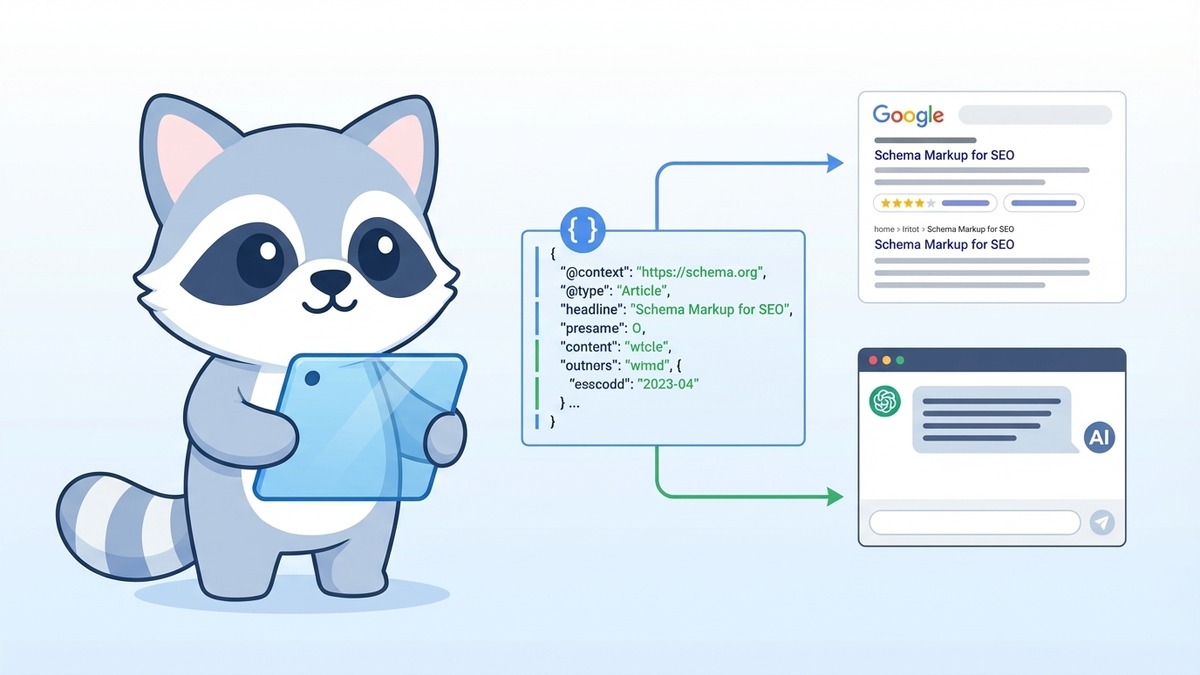
Schema markup has traditionally been used to earn Google rich results: the star ratings, FAQ dropdowns, and recipe cards you see in search. That benefit still exists. But there is now a second, arguably more important reason to implement schema.
AI search engines, including Google AI Overviews, Perplexity, ChatGPT with web browsing, and Microsoft Copilot, use structured data to extract verified facts about your business, content, and offerings. When an AI system is assembling an answer about "best accounting firms in Singapore", it doesn't just read paragraph text. It pulls structured signals: business name, address, review score, service area, credentials.
Research published in 2024 and 2025 on Generative Engine Optimisation consistently shows that pages with complete schema markup receive 30-40% higher citation rates in AI-generated answers compared to equivalent pages without structured data. This is because AI systems are essentially doing what Google has always done, just faster and with less tolerance for ambiguity.
If you want a fuller picture of how AI search engines work and why they behave differently from traditional Google, our Google AI Overviews guide covers the mechanics in detail.
The Schema Types That Actually Matter
Article
Use this on every blog post and news article. It signals to Google and AI systems that this page is a piece of editorial content, who wrote it, when it was published, and when it was last updated.
{
  "@context": "https://schema.org",
  "@type": "Article",
  "headline": "Schema Markup for SEO: Make Google (and AI) Actually Understand Your Site",
  "author": {
    "@type": "Person",
    "name": "Berenice S."
  },
  "publisher": {
    "@type": "Organization",
    "name": "SEOExpert.sg",
    "logo": {
      "@type": "ImageObject",
      "url": "https://seoexpert.sg/logo.png"
    }
  },
  "datePublished": "2026-03-15",
  "dateModified": "2026-03-15",
  "image": "https://seoexpert.sg/blog/schema-markup-seo-og.jpg",
  "description": "Schema markup is structured data that tells Google and AI search engines exactly what your content means.",
  "mainEntityOfPage": "https://seoexpert.sg/blog/schema-markup-seo"
}
FAQPage
FAQPage schema can earn you expanded FAQ dropdowns in Google results, which dramatically increase your occupied real estate on the SERP. More importantly, FAQ content in structured form is highly extractable by AI systems looking for direct question-answer pairs.
{
  "@context": "https://schema.org",
  "@type": "FAQPage",
  "mainEntity": [
    {
      "@type": "Question",
      "name": "What is schema markup in SEO?",
      "acceptedAnswer": {
        "@type": "Answer",
        "text": "Schema markup is structured data added to your HTML that tells search engines the meaning of your content, not just the words. It uses the Schema.org vocabulary to label content types like articles, products, reviews, and businesses."
      }
    },
    {
      "@type": "Question",
      "name": "Does schema markup improve rankings?",
      "acceptedAnswer": {
        "@type": "Answer",
        "text": "Schema markup does not directly improve rankings, but it improves click-through rates through rich results and significantly increases visibility in AI-generated answers."
      }
    }
  ]
}
HowTo
HowTo schema is used for step-by-step guides. It can earn you a rich result showing numbered steps directly in Google search. It also makes your how-to content highly machine-readable, which AI systems use when answering procedural questions.
{
  "@context": "https://schema.org",
  "@type": "HowTo",
  "name": "How to Add Schema Markup to a Website",
  "step": [
    {
      "@type": "HowToStep",
      "position": "1",
      "name": "Choose your schema type",
      "text": "Identify which Schema.org type matches your content: Article, Product, LocalBusiness, FAQPage, etc."
    },
    {
      "@type": "HowToStep",
      "position": "2",
      "name": "Write your JSON-LD",
      "text": "Create a script block with your structured data. Use Google's Structured Data Markup Helper or write it manually."
    },
    {
      "@type": "HowToStep",
      "position": "3",
      "name": "Add to your page",
      "text": "Paste the JSON-LD script into the head or body of the relevant page."
    },
    {
      "@type": "HowToStep",
      "position": "4",
      "name": "Validate with Rich Results Test",
      "text": "Run the URL through Google's Rich Results Test to confirm the schema is error-free."
    }
  ]
}
Organization
Organization schema goes on your homepage. It establishes the facts about your business that Google and AI systems will use when your brand is mentioned anywhere online. Think of it as your machine-readable business profile.
{
  "@context": "https://schema.org",
  "@type": "Organization",
  "name": "SEOExpert.sg",
  "url": "https://seoexpert.sg",
  "logo": "https://seoexpert.sg/logo.png",
  "description": "SEO and GEO agency in Singapore helping businesses rank on Google and get cited by AI.",
  "sameAs": [
    "https://www.linkedin.com/company/seoexpert-sg",
    "https://www.facebook.com/seoexpert.sg"
  ],
  "contactPoint": {
    "@type": "ContactPoint",
    "contactType": "customer service",
    "email": "hello@seoexpert.sg"
  }
}
LocalBusiness (with Singapore-Specific Fields)
For Singapore businesses, LocalBusiness schema is one of the highest-value schema types you can implement. It directly feeds Google Maps, local search results, and AI answers to location-based queries.
Singapore-specific considerations:
- Use
addressCountry: "SG"andaddressRegionfor district (e.g., "Central Region") - Include your UEN (Unique Entity Number) in the
identifierfield where applicable - List your primary service areas using
areaServed
{
  "@context": "https://schema.org",
  "@type": "LocalBusiness",
  "name": "SEOExpert.sg",
  "image": "https://seoexpert.sg/logo.png",
  "url": "https://seoexpert.sg",
  "telephone": "+65-XXXX-XXXX",
  "priceRange": "$$",
  "address": {
    "@type": "PostalAddress",
    "streetAddress": "1 Raffles Place",
    "addressLocality": "Singapore",
    "postalCode": "048616",
    "addressRegion": "Central Region",
    "addressCountry": "SG"
  },
  "geo": {
    "@type": "GeoCoordinates",
    "latitude": 1.2847,
    "longitude": 103.8510
  },
  "openingHoursSpecification": [
    {
      "@type": "OpeningHoursSpecification",
      "dayOfWeek": ["Monday", "Tuesday", "Wednesday", "Thursday", "Friday"],
      "opens": "09:00",
      "closes": "18:00"
    }
  ],
  "areaServed": ["Singapore", "Central Business District", "Orchard", "Raffles Place"],
  "identifier": {
    "@type": "PropertyValue",
    "name": "UEN",
    "value": "202XXXXXXX"
  }
}
Review and AggregateRating
If your site displays customer reviews or aggregate star ratings, this schema earns the gold star ratings in Google results. These click-through rate improvements are consistently measured at 15-30% above unrated listings.
{
  "@context": "https://schema.org",
  "@type": "LocalBusiness",
  "name": "SEOExpert.sg",
  "aggregateRating": {
    "@type": "AggregateRating",
    "ratingValue": "4.9",
    "reviewCount": "87",
    "bestRating": "5",
    "worstRating": "1"
  }
}
BreadcrumbList
Breadcrumb schema tells Google the navigational hierarchy of your page. It replaces the URL in search results with a cleaner breadcrumb trail: Home > Blog > Schema Markup. It also helps AI systems understand where a page sits within your site architecture.
{
  "@context": "https://schema.org",
  "@type": "BreadcrumbList",
  "itemListElement": [
    {
      "@type": "ListItem",
      "position": 1,
      "name": "Home",
      "item": "https://seoexpert.sg"
    },
    {
      "@type": "ListItem",
      "position": 2,
      "name": "Blog",
      "item": "https://seoexpert.sg/blog"
    },
    {
      "@type": "ListItem",
      "position": 3,
      "name": "Schema Markup for SEO",
      "item": "https://seoexpert.sg/blog/schema-markup-seo"
    }
  ]
}
ItemList
ItemList schema is used for listicle-style content: "Top 10 SEO tools", "Best restaurants in Singapore CBD", comparison pages. When AI systems synthesise answers from multiple sources, well-structured list content with ItemList schema is far more likely to be extracted correctly.
{
  "@context": "https://schema.org",
  "@type": "ItemList",
  "name": "Most Important Schema Types for SEO",
  "itemListElement": [
    { "@type": "ListItem", "position": 1, "name": "Article" },
    { "@type": "ListItem", "position": 2, "name": "FAQPage" },
    { "@type": "ListItem", "position": 3, "name": "LocalBusiness" },
    { "@type": "ListItem", "position": 4, "name": "Organization" },
    { "@type": "ListItem", "position": 5, "name": "HowTo" }
  ]
}
How to Validate Your Schema
Once you've added schema to a page, you need to verify it's error-free before Google attempts to index it.
Google's Rich Results Test (search.google.com/test/rich-results) is the primary tool. Enter any URL and it shows which schema types are present, which are valid, and which have errors or warnings. It also shows a preview of how your rich result will appear in Google. Run this any time you add or edit schema.
Schema.org Validator (validator.schema.org) validates against the full Schema.org specification rather than just Google's subset. Useful for catching structural errors that the Rich Results Test might not flag.
Google Search Console shows schema errors at scale under the Enhancements section. If a schema type is failing across multiple pages, it appears here as a coverage issue you can investigate and fix.
Common Schema Mistakes
Marking up content that isn't on the page. Google's guidelines explicitly prohibit adding schema for information that isn't visible to the user. If your LocalBusiness schema lists a phone number that doesn't appear anywhere on the page, that's a violation that can lead to a manual penalty.
Using the wrong schema type. A blog post is not a WebPage, it's an Article. A step-by-step tutorial is not a BlogPosting, it should use HowTo. Using the closest-seeming type instead of the correct one reduces the clarity you gain from adding schema at all.
Mixing multiple unrelated types in one block. Keep each schema type in its own separate JSON-LD script block. Combining Organization and FAQPage in the same object creates parsing confusion.
Setting the same schema on every page without customising it. Your homepage schema and your product page schema should be different. Templated schema where the headline, description, and content fields are identical across hundreds of pages provides no value.
Forgetting dateModified on articles. AI systems and Google use freshness signals heavily in 2026. An article without a dateModified field may be treated as stale even if the content is recent.
How Schema Helps AI Search Engines Specifically
Traditional SEO schema benefits were mostly about rich results: better-looking listings in Google. AI search changes the value proposition significantly.
When Perplexity assembles an answer to "best SEO agencies in Singapore", it needs to identify candidate businesses and verify their credentials. If your Organization schema includes your service area, your founding date, your description, and your areas of specialisation, that information is trivially easy to extract. If it's buried in paragraph text, the AI has to infer it, and it may get it wrong or skip you entirely.
Similarly, when Google AI Overviews answers "what is schema markup", it looks for sources that have the clearest, most machine-readable answer. An Article with a well-structured description field and an FAQPage with direct question-answer pairs is categorically easier for the AI to cite than a wall of prose with no structural labels.
The research on getting cited by AI search is consistent on this point: structured content gets cited more often, and schema markup is the most direct form of structure you can add to any page.
For a broader look at how AI visibility fits into your overall search strategy, our piece on AEO vs SEO vs GEO breaks down how these three disciplines overlap and where they diverge.
Schema is also part of a larger E-E-A-T signal. AI systems trying to evaluate source quality look for structured proof of expertise: who wrote this, when, for what organisation, with what credentials. Article schema with a verified author and a credible publisher is a machine-readable experience and trustworthiness signal.
Schema Implementation for Singapore Businesses: The Priority Order
If you're implementing schema for the first time, do it in this sequence:
| Priority | Schema Type | Who Needs It |
|---|---|---|
| 1 | Organization | Every business website |
| 2 | LocalBusiness | Any business with a physical location or local service area |
| 3 | BreadcrumbList | Any site with more than one level of navigation |
| 4 | Article | Any site publishing blog posts or news |
| 5 | FAQPage | Any page with Q&A content |
| 6 | AggregateRating | Any site that collects or displays reviews |
| 7 | HowTo | Any tutorial or step-by-step guide pages |
| 8 | ItemList | Any listicle or comparison content |
For e-commerce businesses, add Product schema immediately. For service businesses using landing pages, Service schema can label specific offerings.
This is not optional detail. It is how you make your site machine-readable for the generation of search engines that now operates alongside Google. If you need help auditing what schema your site currently has and implementing the gaps, our SEO services in Singapore include structured data as a standard deliverable.
Making Your Content Structure AI-Ready Beyond Schema
Schema markup is the most direct signal you can send to AI search systems, but it works best alongside content that is already well-structured in its prose. Clear headings, direct answers in opening sentences, and specific data points all compound the effect of schema.
Schema without good content is a label on an empty box. Good content without schema is a full box with no label. You need both. Our SEO copywriting services handle the content side while implementation handles the technical layer.
Start with Schema, Then Layer Up
Schema markup is one of the few SEO tactics where the gap between "sites that do it" and "sites that don't" is still enormous. Most small and medium businesses in Singapore have no structured data at all. The businesses that implement even basic Organization and LocalBusiness schema stand out in both Google's understanding of their site and in AI-generated answers about their industry.
It takes less than a day to implement the core schema types for most websites. The returns, in both traditional rich results and AI visibility, compound over time as search engines build a more complete picture of who you are and what you offer.
If you want structured data implemented correctly across your site, with validation, monitoring through Google Search Console, and ongoing updates as Schema.org evolves, talk to us about our SEO services.
Ready to make your website truly machine-readable? Our team at SEOExpert Singapore implements schema markup as part of a complete technical SEO package. Get in touch with our AEO agency to find out what your site is missing and how quickly we can close the gap.