
Editor's Note: Updated 9 June 2026. Now covers what Google Ask Maps means for multi-location profiles.
You have put in the work to grow your business to multiple locations. Now comes the challenge most multi-outlet Singapore operators do not see coming: getting each location to rank on its own, without your outlets competing against each other and without Google treating your brand as a single blurry entity. Multi-location SEO is a different discipline from single-location local SEO, and the businesses that get it right enjoy compounding advantages that are very difficult for single-location competitors to replicate.
Key Takeaways
- Each physical location needs its own Google Business Profile, managed under one account
- Separate location pages on your website prevent internal cannibalisation and give each branch a ranking surface
- Consistent but location-specific NAP data across all profiles and directories is non-negotiable
- Review management becomes a centralised operation when you have multiple outlets
- Franchise-specific considerations include whether franchisees manage their own profiles or whether the brand manages centrally
- Getting this architecture right from the start saves enormous remediation work later
- Local SEO services specifically designed for multi-location businesses deliver far better results than a one-size-fits-all approach
Why Single-Location SEO Thinking Does Not Scale
A business with one outlet has a single GBP, one set of NAP data to maintain, and one location page to optimise. Multiply that by five, ten, or thirty locations and every variable multiplies with it.
The typical multi-location mistakes we see in Singapore:
Consolidating all locations under one GBP listing: A bubble tea chain with 12 outlets that uses a single GBP listing gets one Google Maps pin for the entire brand. Customers searching near each outlet location get no results or are sent to the wrong branch. This also wastes every location's proximity advantage.
Identical location pages: Copy-pasting the same content across location pages with only the branch name swapped creates thin, duplicate content. Google devalues these pages, and none of them rank competitively.
Unmanaged citation fragmentation: Each outlet accumulated directory listings independently over time. Now the brand has three different address formats, two different phone number styles, and four different brand name variations scattered across the web.
No review strategy per location: All reviews funnel to one profile (if there is even a consolidated one), making it impossible to see which outlet is performing well and which has a customer service problem.
If you are newer to how local search works, our guides on building your Google Business Profile and managing local citations give the single-location foundation that multi-location strategy builds upon.
Step 1: Set Up Individual GBPs for Every Location
Every physical location needs its own Google Business Profile. Manage all of them from a single Google account using the bulk location management feature available to businesses with ten or more locations.
For each location:
- Use the same primary business name followed by a location identifier where needed (e.g. "The Sandwich Shop - Tanjong Pagar" vs "The Sandwich Shop - Novena")
- Use the precise address for that branch
- Use a direct phone number for that branch, not a central hotline where possible (customers and Google both prefer it)
- Set the correct operating hours for that specific outlet (which may differ from others)
- Upload photos specific to that branch
Categories should be consistent across all locations unless a specific outlet genuinely offers different services. A spa chain where one outlet offers medical aesthetics and others do not should reflect that difference in their categories.
This per-location discipline matters even more with Google's Ask Maps. Each branch's profile feeds Ask Maps independently, so a conversational query like "which of your outlets is open now and has parking" is answered branch by branch. One outlet with stale hours or missing attributes quietly drops out of those answers. More on the stakes in our guide to Ask Maps and your business profile.
Step 2: Create Dedicated Location Pages on Your Website
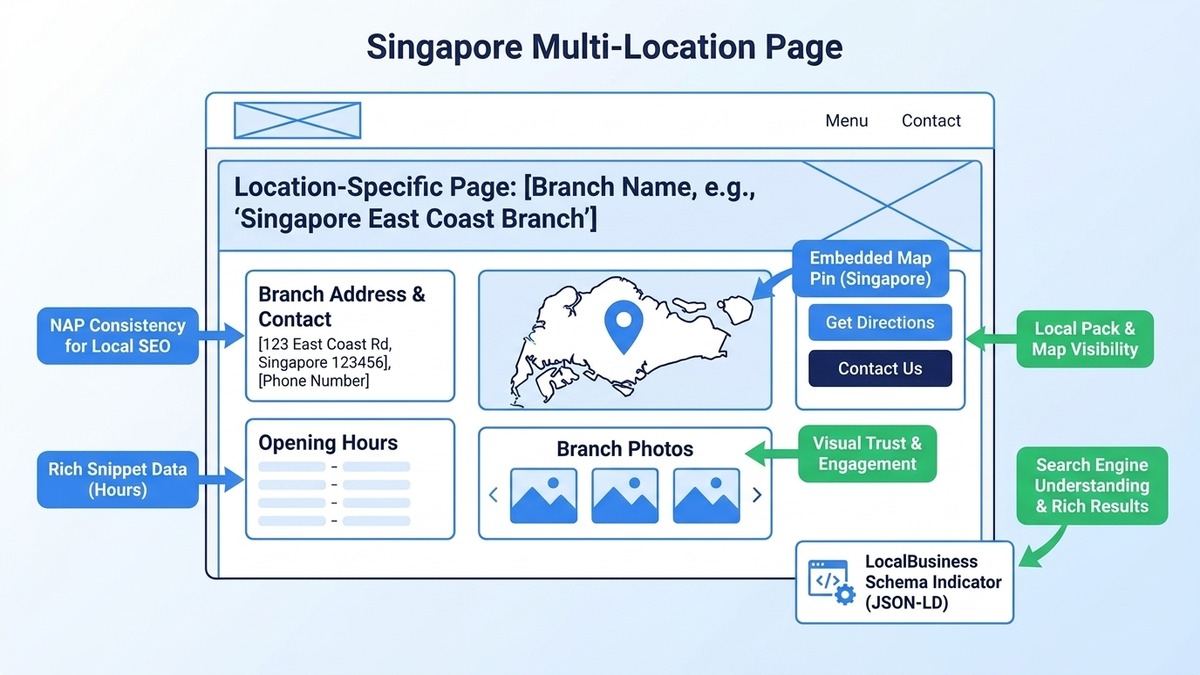
Each GBP should link to a dedicated location page on your website, not your homepage. A location page for your Tampines outlet is the natural partner to your Tampines GBP listing.
A well-structured location page includes:
- The branch address, phone number, and opening hours (matching the GBP exactly)
- An embedded Google Map showing the specific branch
- A description of what this location offers, written specifically for that area
- Nearby landmarks or transport links (e.g. "5 minutes walk from Tampines MRT, next to NTUC FairPrice")
- Branch-specific photos
- Reviews or testimonials from customers of that specific branch
- Schema markup using LocalBusiness structured data
The content on each location page should be substantively different from other location pages. Reference local landmarks, describe the specific neighbourhood, mention any branch-specific offerings. This is not just for SEO, it helps customers confirm they have found the right branch.
Step 3: Build a Scalable URL Structure
Your website architecture for multi-location SEO should follow a logical, consistent pattern:
yourbusiness.com.sg/locations/tampines
yourbusiness.com.sg/locations/novena
yourbusiness.com.sg/locations/jurong-east
Or for franchises operating in different cities (useful if you expand regionally):
yourbusiness.com.sg/singapore/tanjong-pagar
yourbusiness.com.sg/singapore/orchard
Avoid creating location pages as subdomains (e.g. tampines.yourbusiness.com.sg) unless you have a very specific reason. Subdomains are treated as separate sites by Google, which splits your domain authority rather than consolidating it.
A parent page at /locations/ that lists all branches with links to each location page also helps users and creates a natural internal linking structure. Strong on-page SEO principles apply at every level of this architecture.
Step 4: Manage Citations Centrally
With multiple locations, citation management cannot be manual. One person updating 12 outlets across 15 directories is a recipe for inconsistency.
Use a citation management tool like BrightLocal or Yext to push consistent NAP data to directories in bulk. These tools also monitor for incorrect listings created by third parties and alert you when data changes.
For each location, maintain a master NAP record:
- Exact trading name (with or without location suffix, consistently applied)
- Exact address in one format
- Direct phone number
- Specific URL for that branch's location page
Every directory listing for that branch should match this master record precisely. For a deeper dive into which Singapore directories matter most, our guide to local citations for Singapore businesses has the full list.
Step 5: Build a Review System Per Location
At scale, you need a systemised approach to review collection. Manual follow-up calls or ad hoc WhatsApp messages do not work across 10+ outlets.
Options for Singapore businesses:
QR codes at point of sale: Print unique QR codes for each branch that link directly to that branch's GBP review link. Place them on receipts, table cards, or at the cashier counter.
Post-visit email/SMS sequences: If you collect customer contact details (common in F&B with booking systems, or in service businesses), automate a follow-up message 24-48 hours after the visit asking for a review.
Staff incentive programmes: Train staff at each outlet to request reviews as part of their customer farewell routine.
Use our Google review link generator to create a unique direct review link for each branch. Track review count and average rating per location monthly. Branches with declining ratings need intervention before the problem compounds.
Handling the Franchise-vs-Brand Control Question
If you operate a franchise model, decide early whether franchisees manage their own GBPs or whether the brand office manages centrally.
Central management (recommended for brand consistency):
- Brand controls all GBP logins
- Ensures consistent categories, descriptions, and visual identity
- Allows brand-wide responses to reviews using consistent tone
- Prevents franchisees from accidentally damaging brand reputation
Franchisee management:
- Allows faster local responsiveness
- Franchisees can post locally relevant updates and offers
- Requires a strong brand guidelines document and ongoing training
- Higher risk of inconsistency
Many Singapore franchise brands use a hybrid: brand office owns the GBP logins and controls core information, but franchisees have posting access for Google Posts and can respond to reviews using brand-approved templates.
Tracking Performance Across Locations
With multiple locations, your SEO metrics reporting needs to aggregate and compare across locations simultaneously. Monitor per-location:
- Google Maps impressions and ranking positions
- Direction requests and calls from GBP
- Website visits from each location page
- Review count, average rating, and review velocity
Set up monthly comparison reports. Which branches are growing in impressions? Which are declining? Use the data to prioritise where to focus citation building, review campaigns, or content updates.
Multi-Location SEO and Paid Search
Local SEO and PPC work particularly well together for multi-location businesses. Google Ads location targeting lets you run branch-specific campaigns with ads and extensions pointing directly to each branch's location page.
When both your organic Maps listing and your paid ad appear for a local search, you occupy more screen real estate and your click-through rate across both channels improves. This is especially valuable in competitive Singapore categories like F&B, beauty, and fitness.
Getting the Architecture Right From the Start
Multi-location SEO is significantly easier to build correctly from the start than to remediate after the fact. If you are opening your second or third outlet, now is the time to put the right structure in place.
Our GMB optimisation and SEO services are built to handle multi-location complexity. Our AI SEO agency has helped Singapore chains across F&B, healthcare, education, and retail build scalable local search strategies that grow with each new outlet.
Contact our team to get a multi-location SEO audit and a clear roadmap for making every branch visible in local search.