

Editor's Note: Updated 18 August 2026. Now includes coverage of Search Console's Generative AI performance report.
You worked hard for that ranking. Position 3 on Google, consistent for months. And yet your organic traffic is down. Not a little down. Noticeably down. What's happening?
The answer, increasingly, is zero-click search. It's one of the most significant shifts in how search works, and it's quietly draining traffic from websites across every industry. Understanding it, and adapting to it, is no longer optional for businesses that rely on organic search.
Key Takeaways
- Zero-click searches happen when users get their answer directly on the search results page, without visiting any website.
- In 2024, 65% of Google searches end without a click (Semrush / SparkToro data).
- AI Overviews are accelerating this trend significantly, especially for informational queries.
- Informational, definitional, and simple factual queries are the hardest hit.
- Transactional, local, and complex decision-making queries still drive clicks.
- The new goal is not just ranking, but getting cited and mentioned in AI answers.
- Singapore businesses need to reframe success metrics and diversify beyond organic traffic.
What Is Zero-Click Search?
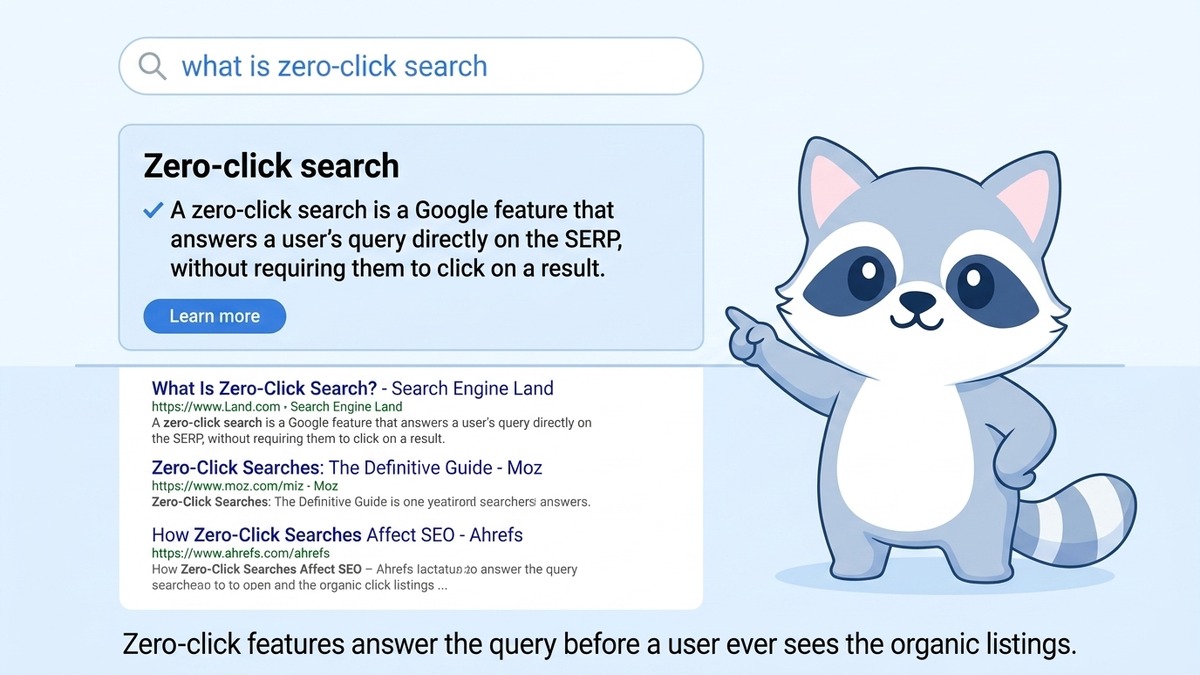
Zero-click search refers to any Google search where the user finds their answer directly on the search results page and leaves without clicking through to any website. This can happen via featured snippets, knowledge panels, People Also Ask boxes, calculators, or AI-generated summaries. The user gets what they need. You get nothing.
It sounds frustrating because it is. But it's also the natural result of Google doing exactly what it was always designed to do: answer questions as quickly as possible.
The types of SERP features that create zero-click outcomes include:
- Featured snippets (the answer box at the top of results)
- Knowledge panels (entity information on the right sidebar)
- People Also Ask dropdowns
- Google AI Overviews (AI-generated summaries with cited sources)
- Local packs (though these still drive clicks for nearby intent)
- Calculators and converters (currency, unit, time zone tools built into Google)
- Direct answers (weather, sports scores, flight info)
Each of these features was introduced to improve the user experience. The side effect is that fewer users ever reach your website.
The Numbers: How Big Is This Problem?
According to research by SparkToro and Semrush, 65% of all Google searches in 2024 ended without a single click. That's nearly two out of every three searches. And with AI Overviews now active across more markets, including Singapore, the proportion is expected to rise further in 2025 and 2026.
This is not a new trend. Zero-click rates have been climbing steadily since Google introduced featured snippets around 2014. But the pace has accelerated dramatically:
- 2019: roughly 49% of searches were zero-click (SparkToro)
- 2022: estimated 57-58%
- 2024: 65% across all devices (Semrush data, desktop and mobile combined)
- Mobile searches see even higher zero-click rates, often exceeding 70%
AI Overviews, rolled out broadly from 2024 onward, have become the most significant new driver. When Google generates an AI summary at the top of the results page, users often read the answer there and move on. Even when AI Overviews include citations and source links, the click-through rate on those links is significantly lower than traditional organic results.
For context on how AI Overviews work and how to appear in them, see our deep dive on Google AI Overviews.
Why Your Traffic Is Dropping Even With Good Rankings
You can hold a strong ranking position and still see organic traffic decline because ranking position no longer guarantees visibility or clicks. When zero-click features appear above your result, your listing may not be seen at all. When AI Overviews summarise your content, users get the answer without the visit.
This is the disconnect that confuses many business owners and marketers right now. The ranking report looks fine. Traffic analytics tells a different story.
Several things are happening simultaneously:
SERP features push organic results down. A page that ranks position 1 organically may actually appear as the fifth or sixth element a user sees on the page, below ads, an AI Overview, a featured snippet, and a People Also Ask section. Fewer users scroll that far.
Answer intent is being fulfilled earlier. If someone searches "how many calories in an egg," Google answers that before showing any organic results. There's simply no reason to click.
CTR data confirms the squeeze. Average click-through rates for position 1 have dropped year-over-year across most categories. Google Search Console data from multiple studies shows the decline is most severe for queries where SERP features are present.
AI Overviews create a new ceiling. For queries where an AI Overview appears, organic CTR can drop by 20-60% compared to the same query without an AI Overview (data from various SEO studies, 2024). The effect is strongest for informational queries.
You can monitor this in your own Google Search Console data. Filter by query type, and look for queries where impressions are stable or growing but clicks are declining. That's zero-click in action on your specific site.
Search Console's Generative AI report narrows it further, naming which of your pages appear in AI Overviews and AI Mode, though it withholds the clicks. For a framework on tracking these patterns, see our guide on AI search visibility tracking.
Which Queries Are Most Affected
Informational queries, definitions, and simple factual questions are the categories most likely to end in zero clicks. If someone can read an answer in 10-15 words, Google will often provide that answer on the SERP. Any content that primarily targets these query types will face the steepest traffic declines.
Queries that are high zero-click risk:
- Definitions ("what is [term]")
- Factual lookups ("when was [thing] founded", "how tall is [person]")
- Simple how-to questions with short answers ("how to restart a router")
- Unit conversions and calculations
- Weather, time, currency, scores
- Medical symptom lookups
- Recipe ingredient substitutions
For businesses that have built their content strategy around top-of-funnel informational content, this is a meaningful challenge. A glossary of SEO terms, for example, is highly vulnerable. So is a blog that primarily answers basic industry questions.
This is not to say informational content is worthless. It still builds brand awareness and is essential for AI citation (more on that shortly). But it should no longer be measured purely by organic traffic volume.
Which Queries Still Drive Clicks
Transactional queries, local intent searches, and complex decision-making queries still generate strong click-through rates because users need more than a quick answer. When someone is ready to buy, compare options, or find a specific local service, a SERP summary is not enough. They click.
The queries least affected by zero-click:
- Transactional and commercial queries: "buy [product] Singapore", "best [service] plan", "[brand] pricing"
- Local intent: "SEO agency near me", "restaurant Tanjong Pagar", service queries with location modifiers
- High-consideration decisions: Queries where the user needs to evaluate options, read reviews, or make a complex choice
- Navigational queries: When someone wants to reach a specific website
- Sensitive or nuanced topics: Health decisions, financial advice, legal questions where users want full context, not a summary
- Current events and news: Time-sensitive content where freshness matters
- Product and service reviews: Comparison content where the detail is the value
The practical implication: if your SEO strategy skews heavily toward informational content and has historically relied on featured snippet wins, you need to rebalance toward commercial and local keywords where clicks still flow.
Our SEO services in Singapore are built around this kind of intent-based content architecture.
The Shift From "Get Clicks" to "Get Cited"
The emerging success metric for search visibility in the AI era is not clicks. It's citations. When your brand, data, or expertise appears in an AI Overview or AI chatbot answer, users see your name even if they don't visit your site. That brand exposure builds trust and drives intent at a later stage.
This is a fundamental mindset shift, and it matters for how you measure and invest in content.
Getting cited by AI systems like Google AI Overviews, ChatGPT, Perplexity, and Claude requires a different approach to content:
- Be the primary source: Create original research, data, and statistics that others cite. AI systems pull from the most-cited, most-authoritative sources.
- Write with clarity and specificity: AI systems prefer content that makes direct, unambiguous claims. Vague or hedged content is less likely to be cited.
- Use structured formats: Lists, tables, step-by-step guides, and clearly delineated sections are easier for AI to extract and surface.
- Build topical authority: Covering a topic comprehensively across multiple pieces signals expertise to both Google and AI systems.
This is the domain of GEO services (Generative Engine Optimisation), which focuses specifically on making your content visible in AI-generated answers. For a deeper look at how GEO differs from traditional SEO, see what is GEO.
Practical Strategies to Adapt Your SEO
1. Audit Your Traffic by Query Type
Go into Google Search Console and segment your top queries. Identify which are informational (vulnerable to zero-click) versus transactional and local (more protected). Prioritise the protected categories.
2. Double Down on Bottom-of-Funnel Content
Content that targets users close to a decision, comparisons, pricing pages, case studies, service landing pages, is less likely to be answered by a snippet. These pages also tend to have higher conversion value.
3. Optimise for AI Citation on Informational Content
Even if your informational content isn't driving direct clicks, it can still drive brand impressions through AI citation. Structure content to answer questions directly, use statistics with sources, and build the kind of topical depth that AI systems reward. Getting cited in an AI Overview is the new featured snippet.
4. Invest in Brand Search
When users see your brand mentioned in AI answers, many will search your brand name directly. Branded search is protected from zero-click because users navigating to you directly won't be satisfied by a summary. Build brand recognition through PR, thought leadership, and consistent visibility.
5. Diversify Traffic Sources
Organic search should not be the only source of website traffic. Email newsletters, social platforms, direct referral traffic, and paid campaigns all provide diversification. If one channel suffers from structural changes like zero-click, others compensate.
6. Measure Conversion, Not Just Traffic
A drop in traffic is only a problem if it correlates with a drop in leads and revenue. Tighten your analytics to track not just visits, but what those visits do. Often, the traffic that survives zero-click is higher intent and converts better. Track that.
Our SEO copywriting services include content structures designed specifically to perform in both traditional and AI-driven SERPs.
How Singapore Businesses Should Adapt
Singapore businesses face a compounded version of this challenge. The local market is small, competition is high, and many queries have strong local intent. The good news is that local and transactional queries, which make up a significant portion of Singapore search activity, are among the most click-through-friendly query types.
Specific considerations for Singapore:
- Local SEO remains highly click-driven: Searches like "accountant in Bukit Timah" or "renovation company Jurong" still send users to websites. Invest in local SEO services to capture this traffic.
- Singapore-specific content is less likely to be zero-clicked: Google's AI-generated answers for hyper-local Singapore queries are less comprehensive than for generic global topics. There's an opportunity to dominate locally-specific informational content.
- Language and dialect nuance: Singapore search behaviour includes English, Mandarin, Malay, and mixed language queries. Optimising for this full range creates differentiation that a generic AI answer cannot replicate.
- B2B decision-making is longer and more research-intensive: Singapore's B2B market does extensive research before purchasing. Content that serves this deeper evaluation process is less susceptible to zero-click.
Working with a digital marketing agency in Singapore that understands how zero-click dynamics apply specifically to this market matters. Generic advice built for US or UK contexts doesn't always translate.
Zero-Click Doesn't Mean Zero Value
Zero-click searches are not a dead end for your brand. When your content appears in a featured snippet, AI Overview, or knowledge panel, users see your brand name, your URL, and in many cases a preview of your content. That visibility builds familiarity and trust, even without a click. Brand recall from zero-click impressions influences future behaviour.
Think of it this way: a billboard doesn't send people through your door immediately, but it builds the mental availability that makes people choose you when they're ready.
Research suggests that users who see a brand cited in AI Overviews are more likely to search for that brand directly later. The click doesn't happen in the moment. It happens downstream, as a branded search or a direct visit.
The content that earns these zero-click citations is also the content that builds long-term topical authority, which improves performance across all search surfaces over time.
Zero-click is not the end of SEO. It's a recalibration. The businesses that adapt, moving from a pure traffic metric to a visibility and citation model, are the ones that will outperform competitors who are still chasing clicks at any cost.
Where to Go From Here
Zero-click search is one part of a larger shift in how search works in the AI era. Understanding it alongside related changes, like how AI Overviews select their sources and how generative search engines differ from traditional ones, gives you a more complete picture.
For more on building the kind of content that gets cited by AI systems, read our guide on how to get cited by AI. For the technical side of tracking your brand's visibility across AI-powered search surfaces, revisit AI search visibility tracking.
Ready to adapt your SEO strategy to the zero-click era? Our team works with Singapore businesses to build search visibility that performs in AI-driven SERPs, not just traditional rankings. Talk to SEOExpert Singapore about your SEO strategy.