

Every few weeks a client asks us some version of the same question: "Should I buy a domain with my keywords in it? Will it help me rank?" Sometimes the message comes with a link to a domain marketplace where something like best-aircon-servicing-singapore dot com is going for a four-figure price, plus a hopeful "worth it?"
We have an unusually good answer to this one, because we own seoexpert.sg, which is about as keyword-loaded as a Singapore domain gets. We also have the receipts showing exactly how much that name did for us on its own: nothing, for seven straight months.
So this is the honest, no-jargon version of how much your domain name matters for SEO.
Key Takeaways
- A keyword in your domain gives you a small nudge, mostly with humans. It is not a ranking guarantee, and Google has said so repeatedly.
- Google ran an update back in 2012 specifically to stop low quality exact-match domains from ranking on the name alone.
- Our own exact-match domain sat at Domain Authority 1 for seven months, because SEOExpert had not launched yet. The climb only started when we officially opened shop in March 2026 and the real work began.
- A name people genuinely search is a real long-term asset, but only when paired with work, and only if you check the search volumes first. That is keyword research, not luck.
- Grab, Carousell, Lazada and Mothership have zero keywords in their names. They dominate their categories anyway.
- Pick a name you can build a brand on, keyword or not. Then earn your rankings with content, links and technical health.
What a Domain Name Actually Does
A domain name is an address. It tells people where to find you. It does not tell Google you deserve the penthouse view on page one.
That said, the name is not worthless. A relevant domain quietly helps in three real ways:
People trust the match. Someone searching "seo expert singapore" who sees seoexpert.sg in the results makes the connection instantly. That means more clicks, and clicks are real visitors.
Your brand mentions do double duty. When someone writes about us and links to seoexpert.sg by name, the words "seo expert" ride along naturally. A tiny bonus, and it only gets earned when the mention happens.
Nobody forgets what you do. For a services business, being instantly legible can justify the name all by itself.
Notice what is missing from that list: "Google sees the keyword and ranks you higher." That effect is somewhere between microscopic and mythical. Yet plenty of smart people are certain it exists, and one of them left the perfect specimen under our Reddit post.
The Misconception That Refuses to Die
When we shared how we grew our Domain Authority from 1 to 25 in a post on Reddit, one commenter summed up the myth perfectly:
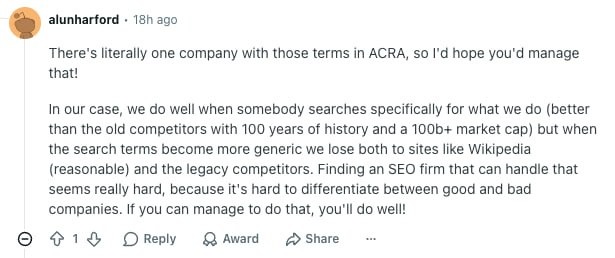
The logic: the keywords are in your own brand name, so naturally you would rank for them. Own the name, own the search results.
Except Google does not check ACRA before handing out rankings. If registering the right words were all it took, someone would have incorporated "Property For Sale Pte Ltd" years ago and outranked PropertyGuru by now. People searching "SEO expert Singapore" are not looking for a registry entry. They want an actual SEO expert, and Google ranks whoever proves they are one.
As for the second half of that comment, winning specific searches while losing the broad ones to Wikipedia and the big names: real pattern, different disease. That one is about topical authority, not your domain name.
Still, claims are cheap. We happen to own the perfect test case, so here is the proof.
Our Perfect Domain Did Nothing for Seven Months
We bought seoexpert.sg in August 2025, back when this whole agency was still a "should I quit my job?" daydream. The daydream got noticeably more vivid every time the old boss launched into another rambling monologue about AI or hinted at pulling everyone back into the office

The domain sat there, fully registered, while the day job carried on. By keyword domain theory, that is a winning lottery ticket: the exact service and the exact country, sitting right there in the name.
The payout:
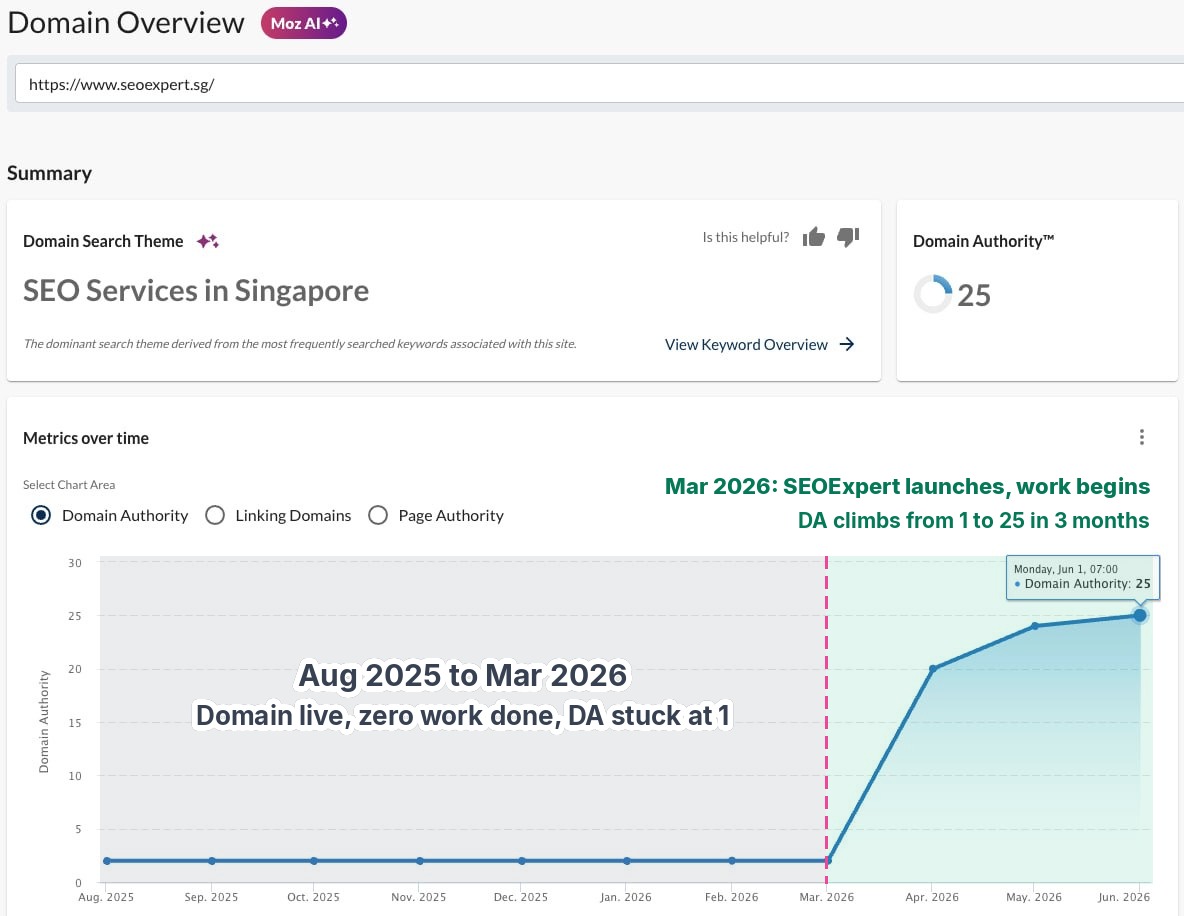
Domain Authority 1, a line flatter than a void deck floor, from August 2025 all the way to March 2026. Not because SEO failed. Because nobody was doing any. SEOExpert only officially launched in March 2026, and the chart knows the exact month. The line wakes up, climbs to 25 by June, and along the way we hit number one for searches like "SEO experts" and "SEO expert Singapore".
Same domain, same keywords in the name, the entire time. Google did not suddenly notice our domain in March. It noticed the content, the links and the technical work, because before March there was nothing to notice.
What Google Says About Keyword Domains
Google has been swatting this myth for over a decade.
Back in 2012, Google rolled out what the industry named the EMD update, aimed squarely at low quality exact-match domains. Sites that ranked mostly because their domain matched the search phrase got demoted. A small change by Google's own description, but it formally ended the era of "buy the keyword domain, collect the rankings".
Ten years later Google's John Mueller was still fielding the question, and he answered it in one line: "keywords in domain names are overrated". His advice from the same post: "pick something for your business, pick something for the long term."
The people who build the search engine keep telling everyone the name is not the trick. At some point it pays to believe them.
When a Keyword Name Does Pay Off
Now for the part the myth gets almost right, because there is a genuine payoff hiding in here.
Once the real work is happening, a searchable name quietly compounds. Building your brand and ranking for a commercial keyword stop being two separate jobs. Two live examples from our own industry, both checked on 3 July 2026. (Check rankings in incognito mode, btw. Regular Chrome has watched you admire your own website 50 times this week and will happily rank you number one, in your browser and nowhere else. Incognito tells you the truth 😝)

Us. This site is the number one organic result for "SEO expert Singapore", "SEO expert" and "SEO experts". Mangools puts those at roughly 320, 120 and 120 searches a month. So whenever someone goes hunting for a Singapore SEO expert, the name on our door and the words in their search bar are the same words.
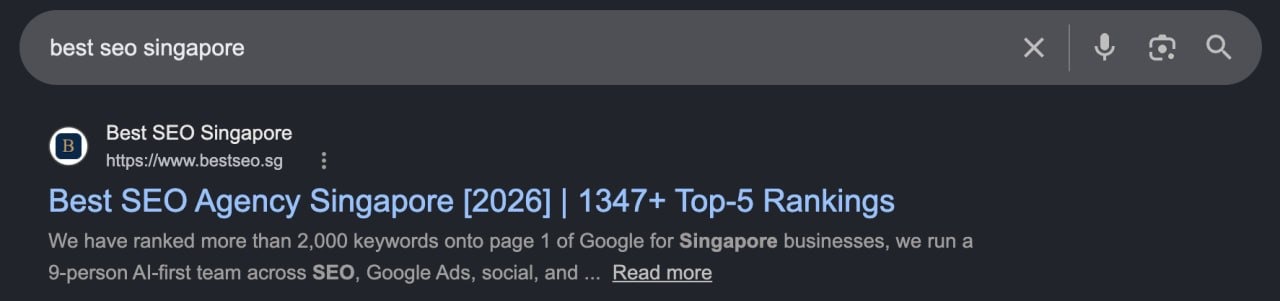
Best SEO. Another Singapore agency that clearly understood the assignment. They hold the number one spot for "best seo singapore", a phrase with around 220 searches a month. Their brand name and one of the most commercial searches in their market are, again, the same words.
In both cases the ranking still had to be earned the normal way, with content, links and years or months of graft. The name simply makes the effort pay double. Every mention, link and citation that builds the brand also reinforces the exact phrase customers type.
The Google Maps Exception
On Google Maps, the name that ranks you is your business name, not the domain.
Put a keyword in it and you get a real boost. "Tampines Aircon Servicing" turns up for "aircon servicing tampines". "Cool Breeze Pte Ltd" has to earn it.
It has to be your genuine business name, though. Stuff your Google listing with keywords you don't trade under and Google flags it as spam and takes it down.
Nail the name and you've still only done step one of ranking on Google Maps.
Insisting on a Keyword Domain? Check the Numbers First
Here is the catch that makes or breaks the whole idea: it only works if people actually search the words in your name. "SEO expert Singapore" pulls nearly three times the volume of "SEO expert" on its own. You would never guess that from the armchair. Name yourself after a phrase nobody types and the compounding effect earns you precisely nothing. Which is why, if you are set on a keyword name, you do ten minutes of homework first.
Say you are opening a matcha cafe and you want the keyword baked into the domain. Do not pick the words by feel. Check what people actually type.
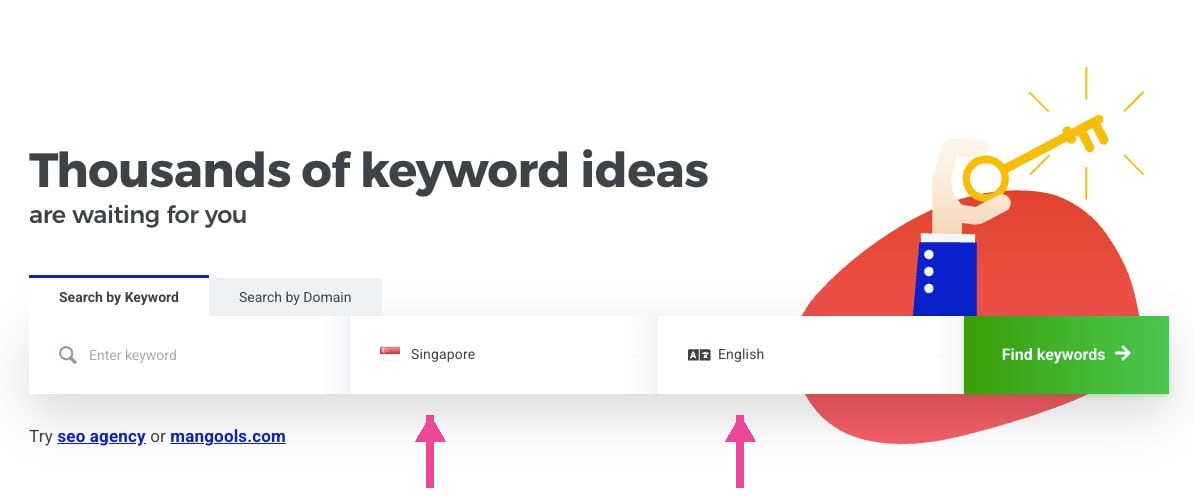
We use KWFinder, the keyword tool inside Mangools. Before you type anything, two settings matter: set the location to Singapore and the language to English. Skip this and you are reading global numbers that have nothing to do with your shop.
Now test your candidate words. "best matcha" pulls about 200 searches a month in Singapore:
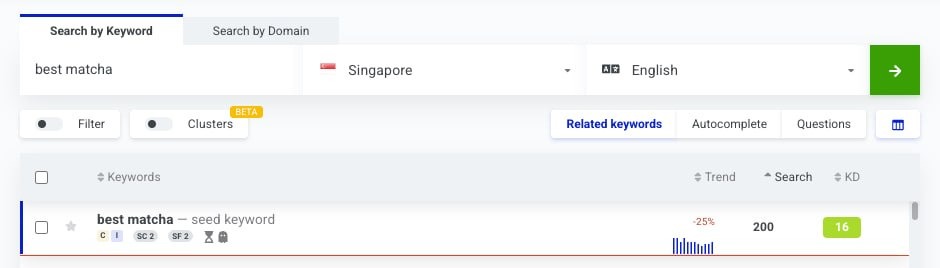
Suddenly bestmatcha.sg is not just a cute name, it is a phrase 200 people a month are already typing. Play around with variants, compare the volumes, and once a winner emerges, check whether the matching domain is still available before you fall in love.
KWFinder is paid. The free alternative is Google Keyword Planner, which needs a Google Ads account but shows exact averages too:
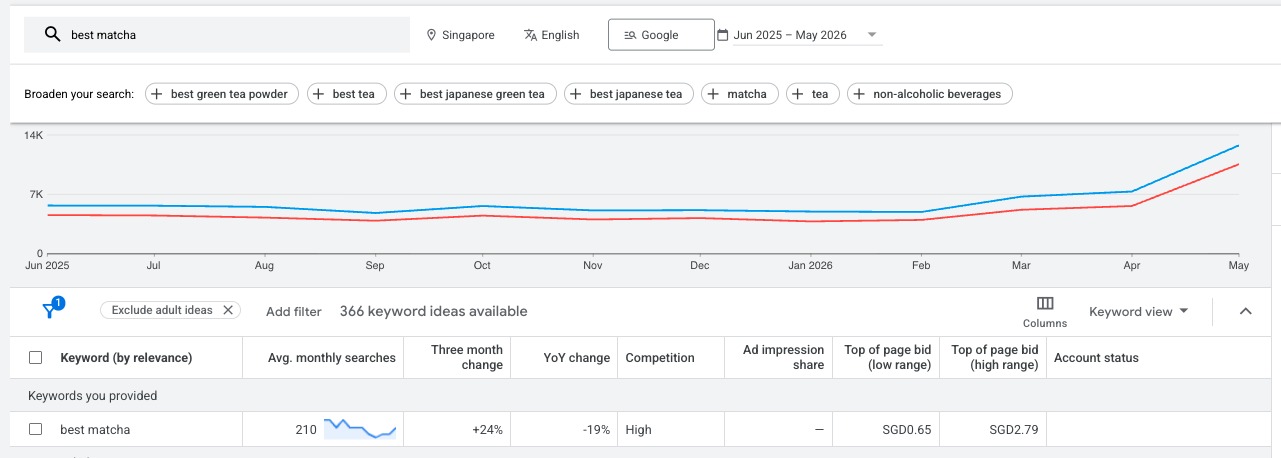
Same keyword, 210 a month on Google versus 200 on Mangools. That mismatch is normal. Search volume is an estimate in every tool, never 100% accurate, so treat it as a gauge rather than gospel. We still reach for Mangools first because of what comes bundled with the number: keyword difficulty, competitor keyword breakdowns, and the actual questions people ask around a topic. And if this little exercise felt useful, congratulations, you just did your first bit of keyword research. Our guide to what SEO keywords are takes it from here.
The Singapore Test
And if that homework sounds like more effort than a name deserves, here is the freeing part: you do not need a keyword in your name at all. Run this test on the local brands you already use:
- Grab contains no trace of "taxi", "ride" or "food delivery".
- Carousell never mentions "second hand" or "marketplace".
- Lazada means nothing in any language, and sells everything.
- Mothership runs one of Singapore's most read news sites with a name that sounds like a sci-fi film.
None of them needed a keyword. They built brands people search for by name, and Google learnt to trust them for their whole category.
And yes, some keyword-stuffed domains do rank. Look closely at any of them and you will find years of content and thousands of links doing the heavy lifting. The name rides on the work. It never replaces it.
So Should You Pick a Keyword Domain or Not?
Our honest advice, the same thing we tell paying clients:
If a keyword fits naturally, take it. We did. A name that says what you do saves you a marketing sentence and earns those small human advantages from earlier.
Do not overpay for one. A four-figure "premium" keyword domain buys you zero rankings. Take the same money and spend it on content and links instead. Those actually move rankings. The name never will.
Do not stuff it. Something like best-cheap-aircon-servicing-singapore dot com reads as spam to users, and since 2012, to Google too.
Brand beats keyword if you plan to grow. The keyword name turns awkward the moment you expand. Ask any "aircon" company that now also does plumbing.
If you are picking a domain because you are about to launch, our guide on SEO when building a website covers the decisions that carry far more weight: site structure, speed and content. And if any term in this article made your eyes glaze over, the plain English definitions live in our SEO glossary.
The Name Is the Easy Part
A good domain name is worth choosing carefully, the way a good shopfront sign is worth painting properly. Just stay clear on which part brings the customers. Nobody queues at a stall because the signboard says "Best Chicken Rice". They queue because the chicken rice is good and word got around.
Word getting around is the part we do professionally. Our SEO services cover the content, links and technical work that took this site from invisible to number one, and as a GEO agency in Singapore we make sure customers find you when they ask ChatGPT instead of Google.
Got a domain you are wondering about? Ask us. You will get the same straight answer we gave you here. Rather not test domain theories yourself? A best SEO specialist can tell you in one audit.