

Generative Engine Optimisation (GEO) is the practice of structuring and writing your content so AI-powered search tools, such as Google AI Overviews, ChatGPT, Perplexity, and Gemini, cite your website in their answers. Unlike traditional SEO, GEO targets AI-generated responses rather than ranked blue links.
Key Takeaways
- GEO stands for Generative Engine Optimisation. It means getting cited in AI-generated answers, not just ranking in Google's blue links.
- AI Overviews now appear in roughly 47% of Google searches (as of early 2026), making GEO a mainstream marketing priority.
- Princeton University research (KDD 2024) found that adding citations boosted AI visibility by 40%, statistics by 37%, and direct quotations by 30%.
- GEO does not replace SEO. They work together. Strong traditional SEO is the foundation that makes GEO possible.
- Singapore businesses have a specific opportunity: English-language, locally-contextualised content is underserved in AI training data for Southeast Asia.
Last updated: March 2026
What Exactly is Generative Engine Optimisation?
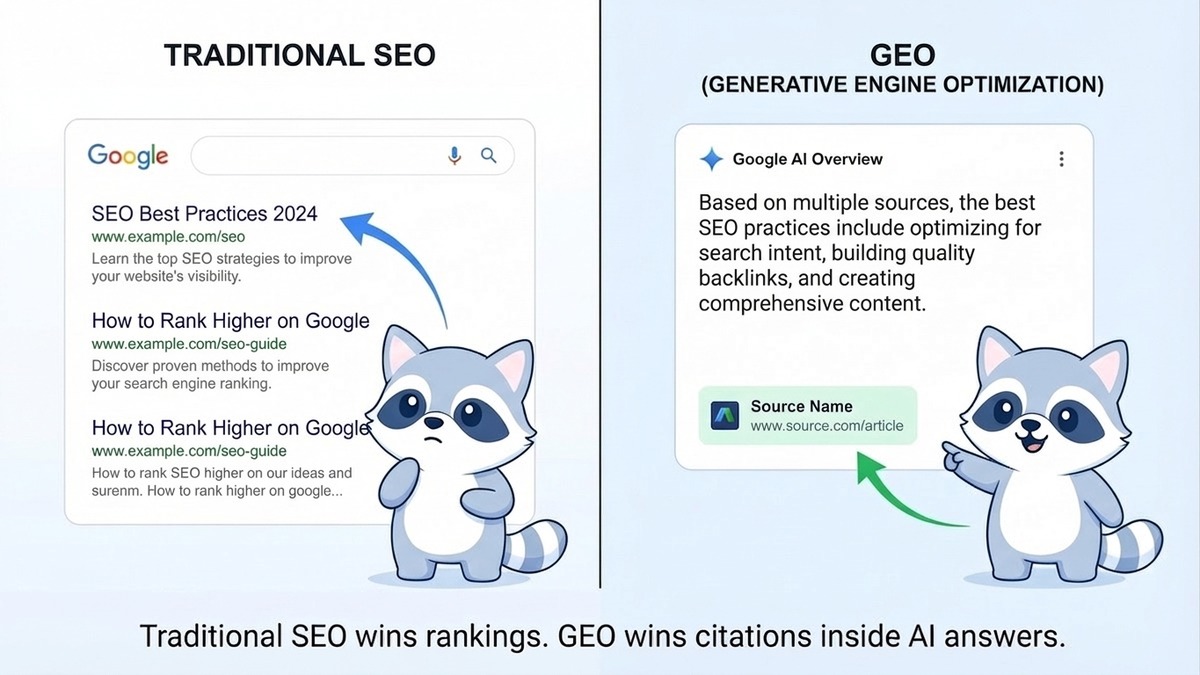
GEO is the discipline of optimising web content so that large language models (LLMs) and AI search engines select it as a cited source in their generated answers. The goal is not a higher ranking position but a mention, a quote, or a factual attribution inside the AI's response.
The term was formally introduced in a 2024 paper published at KDD (Knowledge Discovery and Data Mining), one of the top academic conferences in data science. Researchers from Princeton University, Georgia Tech, The Allen Institute for AI, and IIT Delhi tested nine content optimisation strategies across 10,000 prompts to measure which techniques most improved a website's chance of being cited in an AI-generated answer.
That research gave the field a scientific foundation. GEO is no longer just a marketing buzzword. It has measurable, reproducible tactics behind it.
How GEO Differs from Traditional SEO
GEO and SEO are related but target different outputs. Understanding the difference helps you allocate effort correctly.
| Factor | Traditional SEO | GEO |
|---|---|---|
| Target output | A ranked position (page 1, position 1) | A citation inside an AI-generated answer |
| Who evaluates content | Google's ranking algorithm | An LLM generating a response in real time |
| Success metric | Click-through rate, organic traffic | AI citation frequency, brand mentions in AI answers |
| Key signals | Backlinks, page speed, keywords, E-E-A-T | Factual density, authoritative sources, clear structure, direct answers |
| Timeline | Months | Weeks to months |
| Link required? | Yes, ranking drives clicks | Not always. AI may cite without a user clicking. |
The most important nuance: AI search engines still rely on crawlable, indexable web content. If your SEO fundamentals are weak, no amount of GEO optimisation will get you cited. GEO layers on top of SEO. It does not replace it.
If you are new to how search engines work in general, the SEO Explained and How SEO Works guides are good starting points.
Why GEO Matters in 2026
AI-generated answers now intercept a large and growing share of search traffic before users ever reach a ranked result.
By early 2026, Google AI Overviews appear in approximately 47% of all Google searches (source: BrightEdge AI Search Research, January 2026). That means nearly half of Google queries now display an AI-generated summary above the organic results. For informational queries, the rate is even higher.
Outside Google, the picture is equally stark:
- ChatGPT passed 300 million weekly active users in early 2025 (OpenAI, February 2025) and integrated search via Bing, making it a de facto search engine for hundreds of millions of people.
- Perplexity is growing at roughly 10 million monthly active users as of late 2025, with a search-first product design that almost always cites sources.
- Google Gemini, Microsoft Copilot, and Claude (Anthropic) all offer web-connected search with citation features.
For businesses in Singapore, this shift is compounded by mobile-first behaviour. Younger Singaporean users increasingly ask questions directly in AI chat interfaces rather than typing keywords into Google. If your business is not cited in those answers, you are invisible to a fast-growing segment of your audience.
The brands that act on GEO now will build citation authority before the market gets crowded. The brands that wait will face the same uphill battle that late SEO adopters faced in the 2010s.
How the Major AI Platforms Select Sources
Each AI platform has its own approach to deciding which content to cite. Knowing this helps you prioritise.
Google AI Overviews draws primarily from Google's existing index. Websites that already rank on page one for a query have the highest chance of being cited in an AI Overview for that same query. E-E-A-T signals (Experience, Expertise, Authoritativeness, Trustworthiness) carry significant weight.
ChatGPT (with search) uses Bing's index as its primary web source when search mode is active. Strong Bing presence, which often mirrors Google SEO best practices, matters here. ChatGPT also heavily favours structured, direct answers that can be cleanly extracted.
Perplexity is arguably the most citation-transparent platform. It shows users exactly which sources it used and ranks them. Perplexity favours content that is current (recently updated), factually dense, and matches the query intent closely. Being indexed by Bing and having a clear publication date are both important.
Google Gemini follows similar signals to Google AI Overviews. Content that performs well in standard Google Search tends to also surface in Gemini responses.
Microsoft Copilot is Bing-powered. If your site ranks in Bing and your content is structured clearly, Copilot is likely to pick it up.
Claude (Anthropic) currently does not offer live web search in all contexts, but Anthropic has partnerships and integrations that include web retrieval. Claude strongly favours authoritative, well-structured prose with explicit source attribution.
The common thread across all platforms: clear structure, factual accuracy, external source citations, and content freshness. These are your primary levers.
What the Princeton Research Actually Found
The landmark GEO paper, "GEO: Generative Engine Optimisation" (Aggarwal et al., KDD 2024), is the most rigorous study of AI citation optimisation to date. Here is what the researchers found when they systematically tested nine content strategies across 10,000 prompts:
| Optimisation Strategy | Average Improvement in AI Citation Rate |
|---|---|
| Adding authoritative citations to external sources | +40% |
| Incorporating specific statistics and data | +37% |
| Including direct quotations from experts | +30% |
| Using a more authoritative, confident tone | +25% |
| Adding fluency improvements (clearer writing) | +17% |
| Keyword stuffing | Negative or minimal effect |
The data contains a critical takeaway that surprises most marketers: keyword stuffing is ineffective and can harm AI citation rates. AI models evaluate content semantically, not by counting keyword occurrences. The strategies that work are the same ones that make content genuinely more useful to human readers.
This aligns with the broader shift in search quality: AI models are harder to game than keyword-matching algorithms. They reward substance.
For a deeper look at how these findings connect to traditional search, see ChatGPT for SEO.
How to Implement GEO: A Practical Checklist
Implementing GEO does not require a complete content overhaul. These steps can be applied to existing content incrementally.
1. Structure Every Section for Direct Extraction
Open each section with a 40-60 word paragraph that directly answers the question implied by the heading. This is the paragraph that AI tools are most likely to quote verbatim. Think of it as writing the answer first, then providing context second.
2. Add Specific Statistics With Dates and Sources
Vague claims ("many businesses are using AI") do not get cited. Specific, sourced data ("47% of Google searches triggered an AI Overview in January 2026, per BrightEdge") does. Every statistic should have a source name and a date inline, even if you also add a nofollow link.
3. Cite Authoritative External Sources
Link out to primary sources: academic research, government data, industry reports, established publications. Nofollow these links per SEO best practice, but include them. The Princeton study showed that this single change drives the biggest lift in citation rates (+40%).
4. Use Question-Based H2 and H3 Headings
AI tools scan headings to understand what a page covers. Headings that mirror how people phrase questions ("How does X work?", "What is the difference between X and Y?") align with how LLMs parse content for relevance.
5. Implement Schema Markup
Structured data (Article, FAQ, HowTo, Organisation schemas) helps AI crawlers understand your content type and authority. This is also one of the topics covered in Schema Markup for SEO in this cluster.
6. Build Third-Party Presence and Brand Mentions
AI models are trained on the broader web, not just your site. Being mentioned on reputable third-party sites, directories, review platforms, and publications reinforces your authority signal across the web. For Singapore businesses, being listed and reviewed on Google Business Profile, industry portals, and local publications is especially important.
7. Refresh Content Regularly
All major AI platforms, especially Perplexity, heavily favour recently updated content. Add a "Last updated" date to your articles and update key statistics and facts at least quarterly. This is also a signal for SEO copywriting workflows: evergreen content needs a refresh cadence.
8. Earn Genuine Quotes and Expert Attribution
If your content includes direct quotes from named experts, those quotes become extractable by AI. This works especially well for thought leadership content where you interview industry voices.
GEO for Singapore Businesses
Singapore sits in an interesting position for GEO: there is high English-language search volume, a tech-savvy population, and growing AI search adoption, but the local content ecosystem is much thinner than markets like the US or UK.
This creates a specific opportunity. When an AI tool is asked about topics like "best digital marketing agency Singapore," "GST changes for SMEs," or "HDB renovation requirements," it struggles to find authoritative local sources. Businesses that produce well-structured, locally-contextualised content will face less competition for AI citations than they would in English-language markets with more established content ecosystems.
Practical implications for Singapore businesses:
- Use Singapore-specific data. Cite MAS reports, MTI statistics, SkillsFuture figures, and local industry publications. This data is underutilised and highly specific.
- Name local regulations and programmes accurately. AI tools fact-check against authoritative data. Correct references to CPF, GST, MOM regulations, and government schemes increase your credibility signal.
- Build presence on local third-party platforms. Google Business Profile, Clutch (for agencies), industry associations like the Singapore Business Federation, and local media coverage all contribute to your GEO authority footprint.
- Target bilingual queries thoughtfully. Some Singapore users ask AI tools questions in a mix of English and Mandarin. If your audience uses bilingual searches, consider whether some content should address this directly.
If you are working with a digital marketing agency in Singapore to implement GEO, make sure they understand the distinction between global AI citation strategies and locally-relevant signals. The tactics are the same, but the source selection needs local context.
Common GEO Mistakes
Treating GEO as a Replacement for SEO
GEO depends on SEO. If your pages are not indexed, not authoritative, and not ranking, they will not be cited by AI tools either. Fix the foundation first.
Stuffing Content With Keywords
The Princeton research confirmed what good writers already knew: LLMs evaluate meaning, not keyword density. Over-optimised, repetitive content reads poorly to AI models and gets ignored.
Publishing Without Dates or Author Attribution
AI tools use content freshness and authorship as trust signals. Undated, anonymous content is at a structural disadvantage. Always include a visible publication date, a "last updated" date, and an author name with credentials.
Ignoring Third-Party Mentions
GEO is not just about your own website. Your footprint across the web matters. Businesses that focus exclusively on on-site optimisation and neglect link building, PR, and directory listings will have a weaker GEO signal than competitors with broad third-party presence.
Skipping Schema Markup
Many Singapore business websites still have no structured data. Schema markup is a low-effort, high-impact GEO lever. If you have not implemented it, the Schema Markup for SEO guide in this cluster walks through the process step by step.
Optimising for Only One AI Platform
Different AI tools use different data sources. A Bing-indexed site gets into ChatGPT and Copilot. A Google-indexed site gets into AI Overviews and Gemini. Both matter. Optimise for broad crawlability, not a single platform.
Frequently Asked Questions
Is GEO the same as AEO (Answer Engine Optimisation)? The terms overlap significantly. AEO is the older label, associated with optimising for featured snippets and voice search. GEO is the newer, more specific term for optimising for generative AI tools. If you see the terms used interchangeably, that is increasingly common. The core tactics are the same.
How long does GEO take to show results? Citation rates can improve within weeks of updating content, especially for Perplexity (which recrawls frequently). Google AI Overviews typically reflect changes in weeks to a few months, tied to Google's regular crawl cycle.
Do I need a separate GEO strategy or can I integrate it with existing SEO? Integration is the right approach. GEO optimisation applied during regular content updates and SEO audits is more sustainable than treating it as a separate workstream.
Start Getting Cited by AI, Not Just Ranked
GEO is not a future trend to watch. It is a present-tense competitive reality for any Singapore business that relies on search traffic. With AI Overviews appearing in nearly half of Google searches, and ChatGPT and Perplexity handling millions of queries daily, the question is no longer whether AI search matters. It is whether your content shows up in those answers.
The businesses acting now are building citation authority that will compound over time, the same way backlink authority did in the SEO era.
If you want help implementing GEO for your business, our team offers GEO services in Singapore and local SEO services designed for the Singapore market. Get in touch to find out what it would take to get your content cited in AI answers.