

Editor's Note: Updated 18 August 2026. Now includes coverage of Search Console's Generative AI performance report and Google's AI Optimization Guide.
Google AI Overviews are now one of the most visible features on the search results page, and they are reshaping how people interact with information online. If you have searched anything on Google recently, chances are you have already seen one: a block of AI-generated text that answers your query before you even click a result. Understanding what these are, how they select sources, and what you can do to appear in them is no longer optional for businesses that rely on search traffic.
Key Takeaways
- Google AI Overviews appear in approximately 47% of all Google searches as of early 2026.
- Studies show AI Overviews can reduce organic click-through rates by up to 58% for affected queries.
- Sources cited in AI Overviews strongly correlate with traditional top-10 rankings, but ranking alone is not enough.
- Informational, how-to, comparison, and "what is" queries are most likely to trigger AI Overviews.
- Optimising for AI Overviews requires clear content structure, authoritative signals, and direct answers at the start of each section.
- Singapore businesses face a particularly urgent window to adapt before AI Overviews fully roll out across Singapore Google Search.
What Are Google AI Overviews (and What Happened to SGE)?
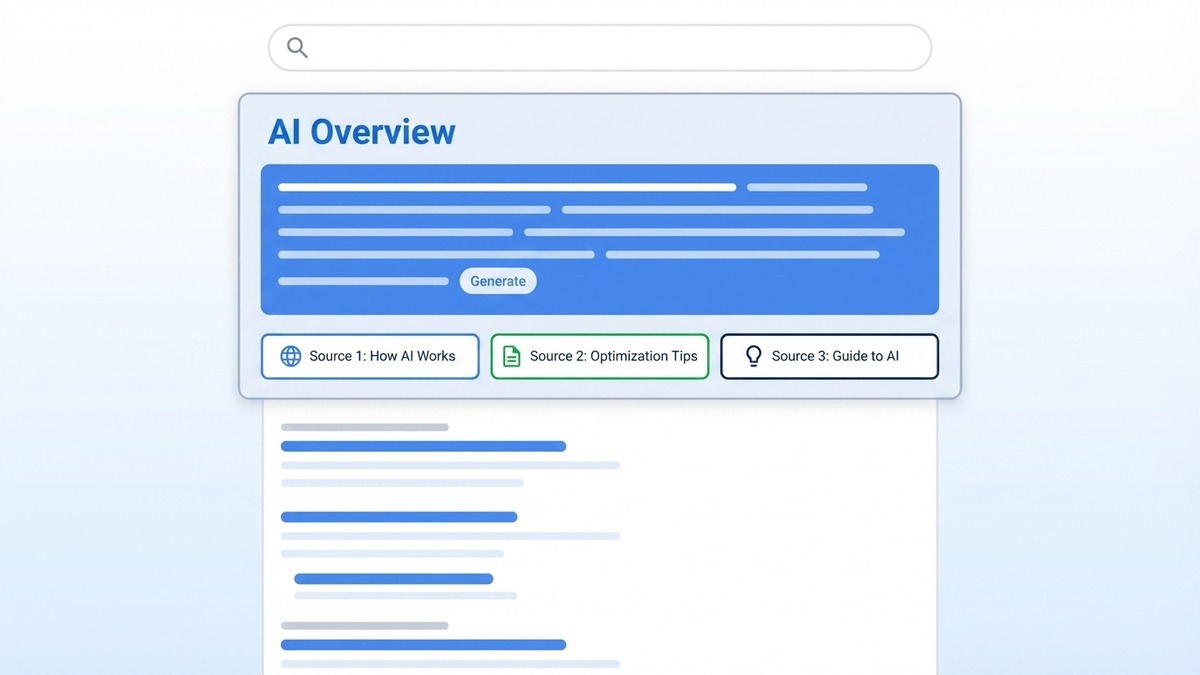
Google AI Overviews are AI-generated answer summaries that appear at the top of Google search results for qualifying queries. They pull information from multiple web sources, synthesise a direct answer, and display that answer before any traditional organic results.
AI Overviews are the successor to Google's Search Generative Experience (SGE), which was an experimental feature tested in Google Search Labs from mid-2023. SGE required users to opt in. AI Overviews are different: they are on by default and visible to all users. Google began rolling out AI Overviews broadly in the United States in May 2024, and expanded to additional markets, including Singapore, through 2025.
The naming change from SGE to AI Overviews was not merely cosmetic. It reflected Google's shift from treating the feature as an experiment to treating it as a core part of the search experience. If you were optimising for SGE, the good news is that the principles carry over directly. If you are starting fresh, this article covers everything you need.
How Common Are AI Overviews? The Numbers That Matter
Google AI Overviews appear in roughly 47% of all Google searches, according to tracking data compiled by BrightEdge and Semrush as of Q1 2026. That means nearly one in every two searches now shows an AI-generated answer above organic results.
The click impact is significant. Research published by Search Engine Land and SE Ranking in late 2024 found that pages ranking in positions 1-3 experienced click-through rate declines of up to 58% when an AI Overview was present for their target query. Other studies show more moderate declines of 20-35%, varying by query type and how well the AI Overview answers the question.
A few key data points worth knowing:
- AI Overviews are most common for informational queries (appearing in over 70% of "what is" and "how to" searches in some category tracking).
- Transactional queries (buy, price, book) trigger AI Overviews far less frequently.
- Queries with local intent (near me, in Singapore) sometimes trigger AI Overviews but typically show traditional local pack results instead.
- The feature is mobile-first: AI Overviews appear more consistently and more prominently on mobile search results.
For businesses in Singapore tracking search performance, an unexplained traffic dip since late 2024 or early 2025 may partly be explained by AI Overviews absorbing clicks that previously landed on your site.
How Does Google Select Sources for AI Overviews?
Google selects sources for AI Overviews based on a combination of traditional ranking signals and content structure factors. A page that ranks well in organic search has a significantly higher probability of appearing as a cited source. However, ranking in the top 10 is necessary but not sufficient on its own.
Based on analysis from Authoritas, BrightEdge, and SE Ranking (2024-2025), the key selection factors are:
Traditional ranking signals carry the most weight. Pages cited in AI Overviews tend to come from domains with strong authority and pages that already rank in the top 10 for the query. Google is not building a separate index for AI Overviews. It is using its existing index, weighted by its existing quality signals.
Content structure matters significantly. Pages with clear H2/H3 headings, direct answer paragraphs at the start of sections, and logical information hierarchy are cited more frequently. Google's language models need to extract clean, structured answers. Content that is buried in long paragraphs, uses convoluted sentence structures, or buries the answer after excessive preamble is harder to cite.
E-E-A-T signals influence source selection. Experience, Expertise, Authoritativeness, and Trustworthiness signals help Google determine whether a source is reliable enough to surface in an AI-generated response. Author bylines, about pages, original research, first-person experience, and cited statistics all contribute to E-E-A-T.
Schema markup improves parsability. Pages with FAQ schema, HowTo schema, and Article schema give Google's systems clearer signals about what kind of content they contain and how it is structured.
Freshness is a factor. AI Overviews tend to prefer recently updated content, especially for topics that change over time. A page last updated in 2021 is at a disadvantage compared to an equivalent page updated in 2025 or 2026.
What Google Officially Says About AI Overview Optimisation
In May 2026, Google published its AI Optimization Guide, the first piece of official documentation about how to appear in AI Overviews and AI Mode. The headline message: there is no separate playbook for AI search. Google states plainly that "the best practices for SEO continue to be relevant because our generative AI features on Google Search are rooted in our core Search ranking and quality systems."
For anyone optimising for AI Overviews, two specific mechanics from the guide are worth understanding because they change how you should think about content scope and freshness.
Retrieval-Augmented Generation (RAG)
Google's AI Overviews use a technique called retrieval-augmented generation, also known as grounding. Instead of relying solely on what the language model already knows, the system queries Google's regular Search index in real time to pull up the most relevant, up-to-date pages for the query. Those pages are then used to ground the AI-generated answer, and they appear as the clickable citations beneath the Overview.
The practical implication: your traditional SEO performance directly determines whether you become a candidate for AI Overview citation. If your page does not surface in Google's index for the target query, the RAG system cannot retrieve it, and the AI cannot cite you. Strong organic rankings are the entry ticket. The structural optimisations covered earlier in this article (direct answers, clean headings, schema, E-E-A-T) determine whether you get selected from the retrieved pool.
Query Fan-Out
Google's AI features also use query fan-out: when a user asks one question, the system generates a set of related, concurrent queries to gather a broader pool of relevant content. Google's own example: a user query of "how to fix a lawn that's full of weeds" can fan out into "best herbicides for lawns", "remove weeds without chemicals", and "how to prevent weeds in lawn".
This is why topical depth matters more than ever. If your site only ranks for the literal head query but has no supporting content on the obvious sub-queries, you may be left out of the synthesised answer even when you are technically the best match for the main query. Building topical clusters of related pages, rather than isolated standalone posts, increases your odds of being retrieved across the full fan-out.
What Google Says You Can Safely Ignore
The guide also pushes back on several practices being promoted in the wider AI-SEO conversation. Google states that LLMs.txt files, "chunking" content into tiny pieces specifically for AI parsing, and rewriting content in an AI-specific style are not requirements for AI Overview visibility. Their position is that Google's systems can already understand multi-topic pages and natural language, so the energy is better spent on the fundamentals.
Important caveat: this is Google's stance for AI Overviews and AI Mode specifically. ChatGPT, Claude, Perplexity, and other AI systems may weight things differently, and structure-for-AI tactics can still help in those surfaces. For Google AI Overview optimisation, though, the official guidance is unambiguous: ranking, structure, E-E-A-T, freshness, and helpful content win. The hacks do not.
Which Query Types Trigger Google AI Overviews?
Not every search triggers an AI Overview. Understanding which query types are most likely to produce them helps you prioritise your optimisation efforts.
Informational queries are the most common trigger. Searches like "what is domain authority," "how does Google indexing work," or "what is GEO in marketing" almost always trigger an AI Overview. These are queries where someone wants an explanation, not a product or a local business.
How-to queries are triggered very consistently. "How to set up Google Search Console," "how to improve website speed," and similar procedural questions reliably produce AI Overviews with step-by-step answers extracted from web content.
Comparison queries frequently trigger AI Overviews. "SEO vs GEO," "WordPress vs Webflow," "shared hosting vs VPS" and similar head-to-head questions often produce AI Overviews that synthesise comparisons from multiple sources. (We covered the difference between SEO, AEO, and GEO in detail in our previous article on AEO vs SEO vs GEO.)
"What is" queries are nearly guaranteed to trigger an AI Overview. If someone is asking for a definition or an explanation of a concept, Google almost always generates an AI Overview.
Queries that do NOT reliably trigger AI Overviews:
- Brand name searches ("Nike shoes")
- Navigational queries ("Facebook login")
- Purely transactional queries ("buy iPhone 16 Pro Singapore")
- Local queries with strong map intent ("coffee shop near me")
- Breaking news or real-time queries
- Queries where Google lacks sufficient reliable sources
Step-by-Step: How to Optimise for Google AI Overviews
Optimising for AI Overviews is an extension of good SEO practice. Here is a structured approach you can apply to existing and new content.
Step 1: Audit Which of Your Target Queries Trigger AI Overviews
Before optimising, know where the opportunity lies. For each of your target queries, do a manual Google search and note whether an AI Overview appears. Tools like Semrush and SE Ranking also have AI Overview tracking features that can monitor this at scale.
Prioritise queries that:
- Already trigger an AI Overview
- Your site currently ranks for in positions 1-20
- Are informational or how-to in nature
Step 2: Lead Every Section with a Direct Answer
For each major section of your content, write a short, self-contained answer paragraph immediately after the H2 heading. This paragraph should:
- Be 40-80 words long
- Directly answer the implied question of the heading
- Be understandable without reading the rest of the section
- Contain the key fact or recommendation, not just promise it
This is the single highest-impact structural change you can make. AI systems extract answers from the first few sentences of a section because that is where good writers put their conclusion.
Step 3: Use Descriptive, Question-Style Headings
Your H2 and H3 headings should match the way people phrase queries. Instead of "Overview" or "Introduction," use headings like "What Are Google AI Overviews?" or "How Does Google Select Sources for AI Overviews?" These heading formats tell Google's systems exactly what question each section answers.
Step 4: Implement Relevant Schema Markup
Schema markup does not guarantee AI Overview inclusion, but it improves your content's parsability. For most articles targeting AI Overviews:
- Article schema establishes content type, author, and date
- FAQ schema works well for sections that address common questions
- HowTo schema is appropriate for step-by-step instructional content
- BreadcrumbList schema helps with context and site structure
Step 5: Strengthen E-E-A-T Signals
For AI Overviews, Google wants sources that demonstrate real expertise and trustworthiness. Actions that improve E-E-A-T for AI Overview purposes:
- Add an author bio with credentials and real experience to every article
- Include original data, case studies, or first-person insights (not just summaries of other sources)
- Cite specific statistics with sources and dates
- Keep content updated (add a "Last updated" date and review annually at minimum)
- Build topical authority by covering a subject comprehensively across multiple interlinked articles
Step 6: Add Comparison Tables for Multi-Option Queries
When your content compares options (tools, approaches, services, platforms), a well-formatted comparison table gives Google's systems a clean, structured format to extract from. Include headers and clear categories. Tables outperform prose for comparison queries in AI Overview selection.
Step 7: Earn Quality Backlinks to the Specific Page
Domain authority matters for AI Overview selection, but page-level authority matters too. A page with strong backlinks from relevant, trusted sources is more likely to be cited. This is standard SEO services practice, but it applies directly to AI Overview eligibility.
What Do Google AI Overviews Mean for Singapore Businesses?
For Singapore businesses, AI Overviews represent an urgency that many have not yet recognised. Here is why this matters locally.
The rollout timeline is compressing. AI Overviews launched in the US in May 2024 and expanded rapidly. Singapore users are now regularly seeing AI Overviews in Google search results. The window to build AI Overview-optimised content before your competitors do is narrowing.
English-language search is the primary battleground. Singapore's primary business search language is English, which means AI Overviews are already active and competitive here. Markets that primarily use other languages have more time. Singapore businesses targeting English queries do not.
SME competitors are not yet optimising. Most small and medium Singapore businesses have not updated their content strategy to account for AI Overviews. If your competitors have outdated page structures, generic content without direct answers, and weak E-E-A-T signals, this is a window to gain ground.
Service and professional categories are at higher risk. If you provide legal, financial, medical, accounting, or similar professional services, AI Overviews will frequently answer the informational queries that previously drove top-of-funnel traffic to your site. You need to be the source Google cites, or you lose that traffic entirely.
Local queries have some protection, for now. Queries with strong local intent still tend to produce map packs and local organic results rather than AI Overviews. But this is evolving. Optimising for both traditional local SEO and AI Overviews is the prudent approach. Our local SEO services cover both dimensions.
The Relationship Between Traditional Ranking and AI Overview Selection
This is the question we get asked most often: "If I rank number one, will I automatically appear in AI Overviews?"
The honest answer is: ranking highly makes AI Overview inclusion more likely, but it does not guarantee it.
Research consistently shows that approximately 80% of sources cited in AI Overviews come from pages that rank in the top 10 for that query. So strong traditional rankings are the foundation. But Google does not simply pull from the number one result. It synthesises from multiple sources and selects pages that provide the clearest, most structured, most trustworthy answers.
Think of it this way. Traditional ranking gets you into contention. Content structure and E-E-A-T signals determine whether you get cited. A page ranking at position 6 with excellent structure and clear direct answers may be cited in an AI Overview ahead of a page ranking at position 2 with disorganised content.
This also means the investment you make in AI Overview optimisation is not separate from your traditional SEO investment. Better content structure, stronger E-E-A-T, and more authoritative linking all improve both. They are the same effort pointing in the same direction.
For a broader look at how GEO services in Singapore approach this dual-track optimisation, or to understand how AI search sits within the wider SEO picture, our article on what is SEO and GEO covers the strategic framework in more depth.
How to Check If Your Site Appears in Google AI Overviews
Search Console now has a native report for this. Its Generative AI report counts how often your pages appear in AI Overviews and AI Mode, but it gives you impressions and nothing else: no clicks, no queries, no average position. It confirms that you surfaced without telling you what it earned. Monitoring beyond Google still requires a combination of manual checks and external tools.
Manual checking: Search your target queries in Google while logged out (or in an incognito window) and note whether an AI Overview appears and whether your site is cited. This is time-consuming at scale but provides ground truth.
Semrush: Semrush's organic research and position tracking tools now flag whether a target keyword triggers an AI Overview and, in some reports, which domains are cited.
SE Ranking: SE Ranking similarly tracks AI Overview presence for monitored keywords. Their AI Overview tracker is one of the more comprehensive options available.
BrightEdge: For enterprise users, BrightEdge provides detailed AI Overview tracking including citation monitoring.
Google Search (manual sampling): For a quick audit, take your top 20 target queries, search each one, and record: (1) does an AI Overview appear, (2) is your site cited, (3) who is cited if not you. This gives you a prioritised target list for optimisation.
You can track how your overall search visibility evolves using the SEO metrics to track framework we recommend for ongoing monitoring.
Putting It All Together
Google AI Overviews are not a temporary feature or an experiment. They are now a permanent fixture of how Google presents search results, and they are expanding in scope and geographic reach. For Singapore businesses, the practical implication is clear: content that is not structured for AI citation will lose visibility over time to content that is.
The good news is that AI Overview optimisation does not require a completely separate strategy from traditional SEO. Google's own AI Optimization Guide confirms exactly this: the same core ranking systems power AI Overviews, so investments in real SEO compound across both surfaces. It requires making your existing content more direct, more structured, more credible, and more useful. The businesses that do this systematically, starting now, will hold a meaningful advantage as AI Overviews continue to expand.
If you are unsure where to start, our SEO copywriting services cover AI-optimised content restructuring for existing pages and new content creation built for AI citation from the ground up.
Ready to appear in Google AI Overviews?
We help Singapore businesses optimise for AI citation, traditional search, and the full spectrum of GEO signals. If you want a content audit or a full strategy built around AI Overview visibility, get in touch with our team.