

You have done the hard work. You have optimised your page, built your internal links, and earned a spot on the first page of Google. Then someone searches your keyword, sees your result, skips right past it, and clicks your competitor instead.
Your ranking did not fail you. Your meta description did.
The meta description is the short paragraph of text that appears under your page title in Google search results. It does not directly influence your ranking position, but it has an enormous influence on whether anyone actually clicks through to your site. And in SEO, a ranking that nobody clicks is a ranking that eventually disappears.
Key Takeaways
- Meta descriptions do not directly boost rankings, but low click-through rates send a negative signal to Google
- You have roughly 155-160 characters to make someone choose you over everyone else on the page
- A strong meta description acts like ad copy: it sells the click, not just describes the page
- Google rewrites meta descriptions roughly 70% of the time, but that is not an excuse to skip writing them
- Including your target keyword naturally helps your description stand out in search results
Why Click-Through Rate Matters More Than Most People Realise
Think of search results like a shop window on Orchard Road. Your ranking is your position in the window. But your meta description is the display, the thing that makes someone stop and walk in.
Google watches what users do after they see a search result. If a particular result consistently gets skipped in favour of others, that is a signal that the page may not be the most relevant or compelling result for that query. Over time, low click-through rates can contribute to rankings slipping.
Conversely, if your page sits at position four but gets clicks at a position-two rate, Google notices that too. Strong click-through rates can support rankings and, in some cases, help you move up.
This is why crafting your meta descriptions carefully is so important. Every search impression is an opportunity. Wasting it costs you traffic you technically earned.
Before we get into the how, if you need a refresher on the full landscape of on-page elements, our on-page SEO guide and our deep dive into SEO tags cover how meta descriptions sit alongside title tags, H1s, and other key signals.
The Anatomy of a High-Performing Meta Description
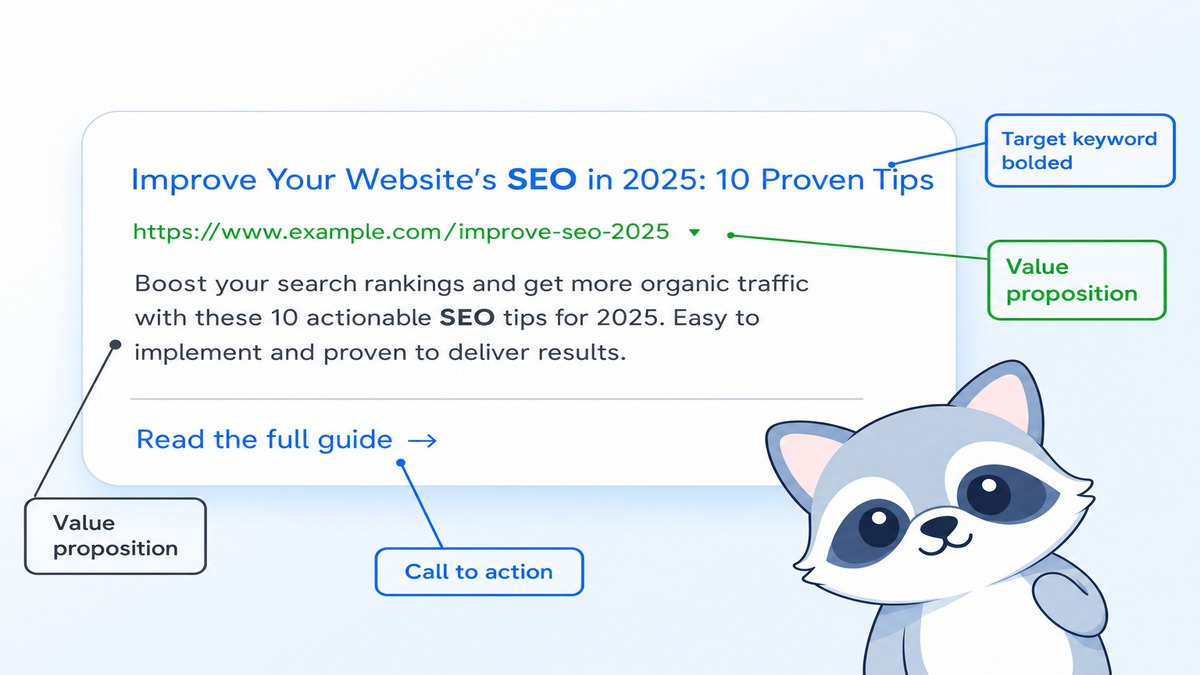
Length: 155-160 characters Google truncates anything longer, so you get cut off mid-sentence at the worst moment. Aim to stay within the limit while still being compelling. You can check how your title and description will look in SERPs using our free SERP simulator.
The keyword (naturally placed) When your meta description includes the user's search query, Google bolds those words in the result. Bold text draws the eye. This is a visual advantage that costs you nothing except including your keyword naturally in the copy.
A clear value proposition Why should someone click your page over the nine others on the page? Answer that in your description. Be specific. "Learn how to fix 404 errors" is weaker than "Fix 404 errors in under 10 minutes with this step-by-step walkthrough."
A call to action (subtle, not pushy) Phrases like "Find out how", "See the full guide", "Discover exactly how to", and "Get the answer here" encourage action. Not every meta description needs a CTA, but adding one often lifts clicks.
Relevance to the page Your description must match what is on the page. If someone clicks through expecting one thing and finds another, they bounce immediately. Bounce rate is another signal Google watches.
What a Good Meta Description Looks Like
Here is the difference between a lazy meta description and one that earns clicks.
Weak: "This page is about SEO services. We offer SEO for businesses in Singapore."
Strong: "Struggling to rank on Google? Our Singapore SEO team has helped 100+ businesses get to page one. See how we do it."
The second version does three things: it speaks to a pain point, it provides social proof, and it invites action. It also fits within 160 characters.
Here is another example, for a blog post about meta descriptions:
Weak: "Read our article about writing meta descriptions for SEO."
Strong: "Your meta description is free Google ad space, most businesses waste it. Learn how to write one that gets clicks, with examples."
Specific, benefit-led, and it makes the reader feel like they are missing something important if they do not click.
Google Rewrites Your Meta Descriptions: Should You Still Bother?
Yes. Absolutely yes.
Research from Ahrefs and others has found that Google rewrites meta descriptions the majority of the time. It pulls text from your page that it believes better matches the user's specific query.
But here is what that means in practice: Google rewrites descriptions when it thinks yours does not match the query well enough. If you write a meta description that genuinely addresses what searchers want, Google is less likely to override it. You are giving it less reason to rewrite.
And when Google does rewrite your description, the worst that happens is Google used its own version. If you wrote nothing, Google scrapes whatever text it finds on the page, which could be navigation text, a cookie notice, or some fragment of a sentence that makes no sense out of context.
Write the description. Control the narrative where you can.
Common Meta Description Mistakes
Writing the same description for multiple pages Google may penalise duplicate meta descriptions as a low-quality signal. Every page should have a unique description.
Making it too long Anything over 160 characters gets truncated, often at a crucial point. Keep it tight.
Making it too short A 30-character description wastes the opportunity. Use the space you have.
Being vague "We provide quality services to our clients" says nothing. Tell the reader exactly what they get and why it matters to them.
Treating it like a tag line A meta description is not a brand slogan. It is functional copy that answers the question: "What will I get if I click this?"
Meta Descriptions for Different Page Types
Blog posts: Lead with the insight or the problem you solve. Make the reader feel like the answer is one click away.
Service pages: Focus on benefits and a clear differentiator. Why you over a competitor? Say it in 160 characters.
Product pages (e-commerce): Price, availability, and a key feature if space allows. Specificity drives clicks.
Location pages: Include the location in the description naturally. "SEO services for Singapore businesses" beats "We offer SEO services."
For e-commerce sites in particular, writing meta descriptions at scale is a real challenge. Our e-commerce SEO service includes on-page optimisation across product and category pages, including meta descriptions that are built to convert impressions into clicks.
Integrating Meta Descriptions Into Your Broader On-Page Process
Meta descriptions do not exist in isolation. They work alongside your title tags, your H1, your URL structure, and your body content to create a coherent, relevant page signal for both Google and users.
If you have been building out your internal linking (as covered in our piece on internal link strategy), the next step in strengthening your on-page SEO is making sure every page has a compelling, unique meta description.
Run a quick audit: check how many pages on your site have missing, duplicate, or auto-generated meta descriptions. Most sites find a surprising number. Fixing these is a fast, high-value task with direct impact on click-through rates.
Our SEO copywriting services cover exactly this, writing copy that ranks and earns the click, from meta descriptions all the way through to full page copy.
The Click Is the First Conversion
Before a user can become a customer, they have to visit your site. Before they visit, they have to click. The meta description is the moment where that decision happens.
If you want help auditing your existing meta descriptions and rewriting them for maximum click-through, the Singapore SEO expert team is ready to help. Get in touch with us and let our AI SEO agency turn your search impressions into actual visits.