

SEO keywords are the words and phrases people type into Google when looking for information, products, or services. They are the foundation of any search optimisation strategy because search engines match content to search queries using these terms. Choosing the right keywords, understanding their intent, and using them correctly in your content determines whether your Singapore business website gets found or stays invisible.
Key Takeaways
- SEO keywords are the exact search terms your target customers type into Google
- There are five main keyword types: short-tail, long-tail, local, semantic (LSI), and question-based
- Long-tail keywords (3+ words) are less competitive and closer to buying intent. They're where most Singapore SMEs should start
- Keyword research doesn't require paid tools. Google autocomplete, Google Keyword Planner, and Google Search Console are free and highly effective
- "Are SEO keywords case sensitive?" No. Google treats "seo keywords singapore" and "SEO Keywords Singapore" as the same query
- Keywords only work when placed correctly in your content. Stuffing them everywhere makes things worse, not better
What Makes a Keyword an "SEO Keyword"
A keyword doesn't need to be a single word. Most SEO keywords are phrases. When someone types "best hawker centre near me" or "accounting firm Singapore Toa Payoh" into Google, those entire phrases are keywords.
What makes a keyword relevant for SEO is the intent behind it. Google has become very good at categorising queries into four types of intent:
Informational intent: The person wants to learn something. Example: "how does SEO work" or "what are meta descriptions." These queries are best served by educational content: guides, articles, and explainers.
Navigational intent: The person is looking for a specific website or brand. Example: "SEOExpert Singapore contact" or "Grab Singapore app." These queries are won by owning your brand name and making your site easy to find.
Commercial intent: The person is researching before buying. Example: "best SEO agency Singapore" or "compare WordPress SEO plugins." These queries are served by comparison articles, reviews, and case studies.
Transactional intent: The person is ready to buy or enquire. Example: "hire SEO agency Singapore" or "book renovation contractor HDB." These are the highest-value queries and the ones that drive leads and sales most directly.
Understanding intent is more important than keyword volume. A keyword with 50 monthly searches and high buying intent will often deliver more value than a keyword with 5,000 monthly searches from people who will never spend a cent.
The 5 Types of SEO Keywords
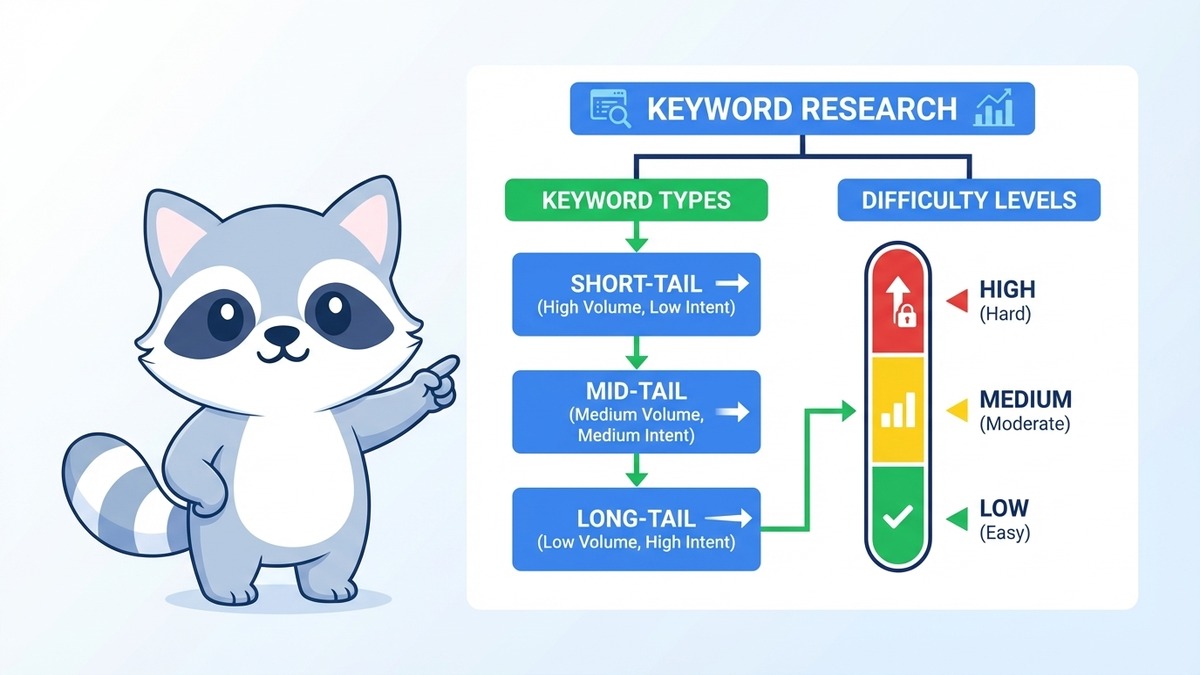
1. Short-Tail Keywords
Short-tail keywords are broad, high-volume terms. Usually 1 to 2 words. Examples: "SEO," "renovation contractor," "accounting software."
The appeal is the volume. The problem is the competition. Ranking for "SEO" on Google means competing with Wikipedia, Moz, HubSpot, and every major SEO publication on the internet. For a Singapore SME, this is not a realistic near-term goal.
Short-tail keywords also have ambiguous intent. Someone searching "renovation contractor" might be a homeowner wanting a quote, a journalist writing an article, a student doing research, or a competitor checking your pricing. The conversion rate from broad terms is lower because the intent is so mixed.
2. Long-Tail Keywords
Long-tail keywords are more specific phrases, usually 3 or more words. Examples: "affordable renovation contractor for HDB 3-room Singapore" or "best accounting software for small business Singapore free trial."
These are where most Singapore SMEs should focus first. Here's why:
- They're significantly less competitive. You can rank on page 1 for a long-tail term in months rather than years
- They carry clearer intent. Someone searching "affordable HDB renovation contractor Tampines" is much closer to calling you than someone searching "renovation contractor"
- There are often dozens or hundreds of long-tail variants for every competitive short-tail keyword, meaning many ranking opportunities
- Collectively, long-tail keywords drive the majority of all search traffic
As your site builds authority over time, the on-page optimisation and content you've built around long-tail terms also helps you climb for shorter, more competitive phrases.
3. Local Keywords
Local keywords include a geographic modifier. For Singapore businesses, this means terms like "SEO agency Singapore," "best sushi restaurant Orchard," or "plumber near me Bishan."
Google shows different results depending on the searcher's location and whether the query has local intent. If someone searches "renovation contractor" from a Singapore IP address, Google assumes they want Singapore-based results. But explicitly adding "Singapore," a district name, or "near me" to your content reinforces that local relevance.
For businesses with physical locations or service areas, local keywords are critical. They're also typically less competitive than purely national or global terms. Optimising for local SEO means appearing in both the organic results and the Google Maps "local pack" that appears above regular search results for many queries.
4. Semantic and LSI Keywords
LSI stands for Latent Semantic Indexing. In plain language, these are related terms, synonyms, and conceptually connected phrases that signal to Google that your content thoroughly covers a topic.
If your page is about "on-page SEO," semantic keywords might include: meta tags, title tag, heading structure, keyword density, internal links, and alt text. These aren't keywords you explicitly stuff into your content; they're the natural vocabulary of the topic.
Using semantic keywords matters because Google has moved beyond simple keyword matching. It understands context and topic coverage. A page that uses only its exact target keyword repeatedly, without the related concepts a comprehensive treatment would naturally include, looks thin to modern ranking algorithms.
5. Question-Based Keywords
These are keywords phrased as questions: "what are SEO keywords," "how do I improve my Google ranking," "why isn't my website showing up on Google." They map directly to voice search, AI chatbot queries, and the PAA (People Also Ask) boxes Google shows in search results.
Answering question-based keywords directly and clearly in your content increases the chance of appearing in featured snippets, People Also Ask boxes, and AI Overviews. If you're trying to understand how SEO works at a technical level, these are the queries Google AI tools pull from most often.
How to Find Keywords for Free
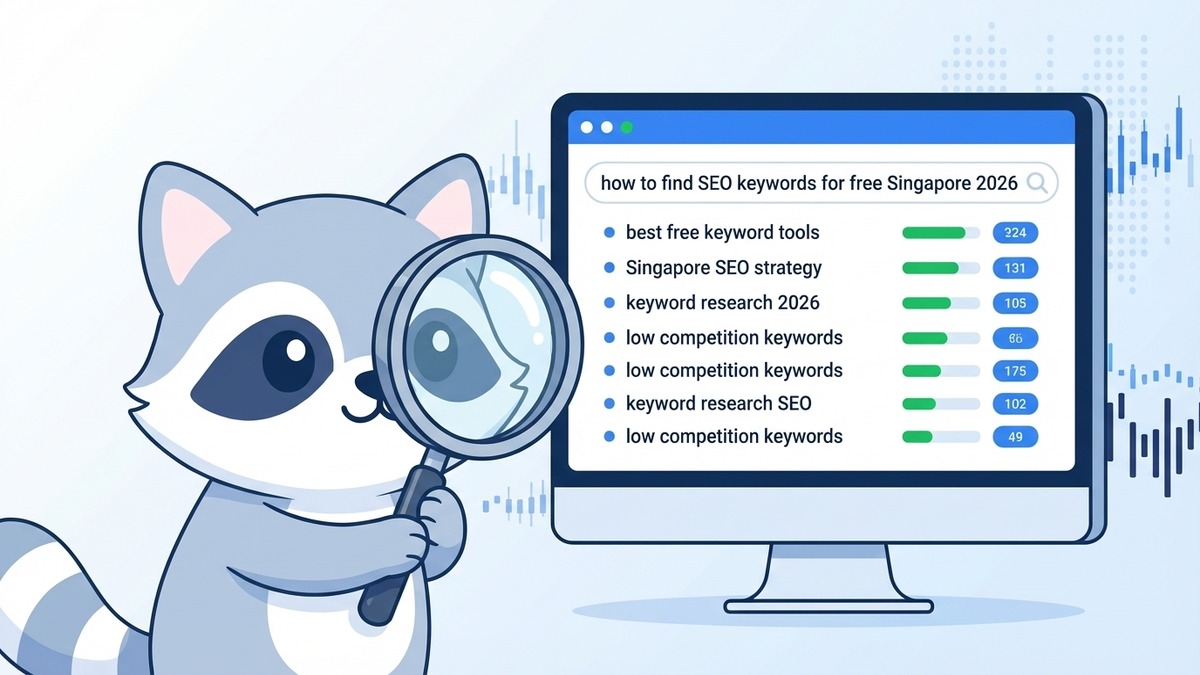
You don't need a paid tool to start finding keywords. Here are four free methods that work.
Google Autocomplete
Start typing any search term into Google and look at the dropdown suggestions. These are real queries people search for, ranked by frequency. They're also keyword goldmines for content ideas. Try "renovation contractor Singapore" and watch the suggestions: "renovation contractor Singapore price," "renovation contractor Singapore HDB," "renovation contractor Singapore license check."
Each suggestion is a potential content opportunity or a keyword to include on a service page.
Google Keyword Planner
Google's own keyword research tool is free with a Google Ads account (you don't need to run ads). Enter a seed keyword and it shows you related terms with approximate monthly search volume and competition levels. For Singapore-specific research, set the location to Singapore to see locally relevant volume data.
The volume data is shown in ranges rather than exact numbers unless you run ads, but ranges are enough for prioritisation decisions.
Google Search Console
If your site is connected to Search Console (it should be), the Performance report shows you every query that's already triggering your pages to appear in Google results. This reveals keywords you're ranking for, even if you didn't explicitly target them.
Look for queries where your average position is between 5 and 20. These are terms where you're visible but not prominent. With some focused content improvement and on-page optimisation, many of these can move onto page 1. This is often the quickest SEO win available.
AnswerThePublic and AlsoAsked
These tools visualise the questions people ask around any topic. Type in "SEO Singapore" and you'll see hundreds of question variants that reveal what your target audience is actually trying to understand. Both tools have free tiers with limited searches.
How to Prioritise Keywords
Once you have a list, not all keywords deserve equal attention. Prioritise using three factors:
Relevance. Is this something your target customer would actually search for? Does ranking for this term bring in the right people?
Search volume. A keyword no one searches for is not worth the content investment. But low volume doesn't mean worthless. 50 highly qualified monthly searchers can be more valuable than 5,000 browsing ones.
Competition (keyword difficulty). How hard will it be to rank? If the top results are dominated by major international brands with thousands of backlinks, your new site won't displace them quickly. Look for terms where the top results are from businesses of similar size and authority to yours.
A practical framework: build your keyword list in four buckets:
- "Win now": low difficulty, relevant, decent volume. Target these immediately.
- "Build to": medium difficulty, highly relevant, good volume. Create content for these as your site gains authority.
- "Long game": high difficulty, high value. Plan for these in year 2 or 3.
- "Not worth it": either irrelevant, no volume, or impossible to compete on.
How Singaporeans Search: Local Differences to Know
Keyword research for Singapore has a few nuances worth knowing.
Google.com.sg is the default for Singapore users, but searches also run through google.com. Volume data from tools may pool these. When doing geo-targeted research, always set your location to Singapore.
Singapore searches tend to include highly specific geographic modifiers. "Near me," district names (Ang Mo Kio, Tampines, Toa Payoh, Jurong East), and estate types (HDB, condo, landed) appear frequently in local searches. These modifiers reflect how Singaporeans think about proximity and neighbourhood identity.
Bilingual search patterns also matter. Some Singapore users search in English; others use simplified Chinese. If your business serves both communities, bilingual keyword research is worth doing. Your competition for Mandarin-language queries may be significantly lower than for English equivalents.
Where to Use Keywords in Your Content
Finding the right keywords is half the work. Using them correctly is the other half. Our article on on-page SEO essentials covers this in detail, but here are the key placements:
Title tag: Your primary keyword should appear in the title tag, ideally near the front. This is the single strongest on-page signal for what your page is about.
URL slug: Keep it short, descriptive, and include your main keyword. /blog/what-are-seo-keywords is better than /blog/?p=1042.
First paragraph: Google and AI tools read the first 100 words carefully. If your keyword and topic aren't clear immediately, the page is less likely to be surfaced as a relevant result.
Headings (H2, H3): Use your primary keyword in at least one H2. Use related terms and semantic keywords in others. This creates a clear content structure Google can parse.
Body copy: Use your keyword naturally throughout. There's no magic density number. Write for readers first. If your content genuinely covers the topic, the right keyword frequency happens naturally.
Image alt text: Describe what's in each image using relevant keywords where it's natural. Alt text helps both accessibility and image search.
Meta description: Your meta description doesn't directly affect rankings, but it affects click-through rate. Include your keyword and a clear reason to click.
Common Keyword Mistakes to Avoid
Targeting only high-volume, high-competition terms. Start where you can realistically win, then build toward competitive terms as your domain authority grows.
Ignoring search intent. Ranking for a keyword that doesn't match your content's purpose creates high bounce rates, which signals to Google that your page isn't a good result for that query.
Keyword stuffing. Repeating your keyword unnaturally many times used to work in 2008. Today it's a negative signal. Write naturally.
Neglecting existing rankings. Your site is already appearing for queries you didn't necessarily plan for. Mining Search Console for these near-first-page terms is often the fastest path to more organic traffic.
Ignoring the SEO glossary. If terms like search volume, keyword difficulty, or domain authority are unfamiliar, getting fluent in them will make your keyword strategy sharper.
Start Finding Keywords That Actually Bring in Business
Keywords are the starting point of everything in SEO. Getting them right means your content investment goes toward terms that bring in the customers you want. Getting them wrong means months of work for traffic that doesn't convert.
If you want help finding the right keywords for your Singapore business and building a content strategy around them, get in touch with our team. We work with businesses across industries to identify the keyword opportunities that match their revenue goals, not just their search volumes.
If you're weighing whether to manage keyword research and SEO in-house or bring in professional support, our breakdown of whether SEO services are worth the cost gives you a clear framework for the decision. As a digital marketing agency focused on Singapore's search landscape, we know which terms drive real enquiries in your category and how to build your site's authority to rank for them.