
SEO (Search Engine Optimisation) gets you ranked on Google. AEO (Answer Engine Optimisation) gets your content into featured snippets and voice search answers. GEO (Generative Engine Optimisation) gets you cited by AI tools like ChatGPT and Perplexity. All three exist on the same spectrum of search visibility, but each targets a different type of search behaviour. In 2026, Singapore businesses that want to stay visible need to understand what separates them, and how they reinforce each other.
Key Takeaways
- SEO, AEO, and GEO are not competing strategies. They build on each other in a logical sequence
- SEO is foundational: without it, AEO and GEO are much harder to achieve
- AEO emerged around 2015 with Google's featured snippets. GEO emerged in 2023 with mainstream AI search
- The content qualities that win in SEO (authoritative, structured, accurate) are amplified in AEO and GEO
- Singapore businesses are early in AI search adoption, which means the first movers have a real advantage
- A combined strategy doesn't require three separate content plans. One well-structured piece can serve all three simultaneously
What Are SEO, AEO, and GEO? (The Short Definitions)
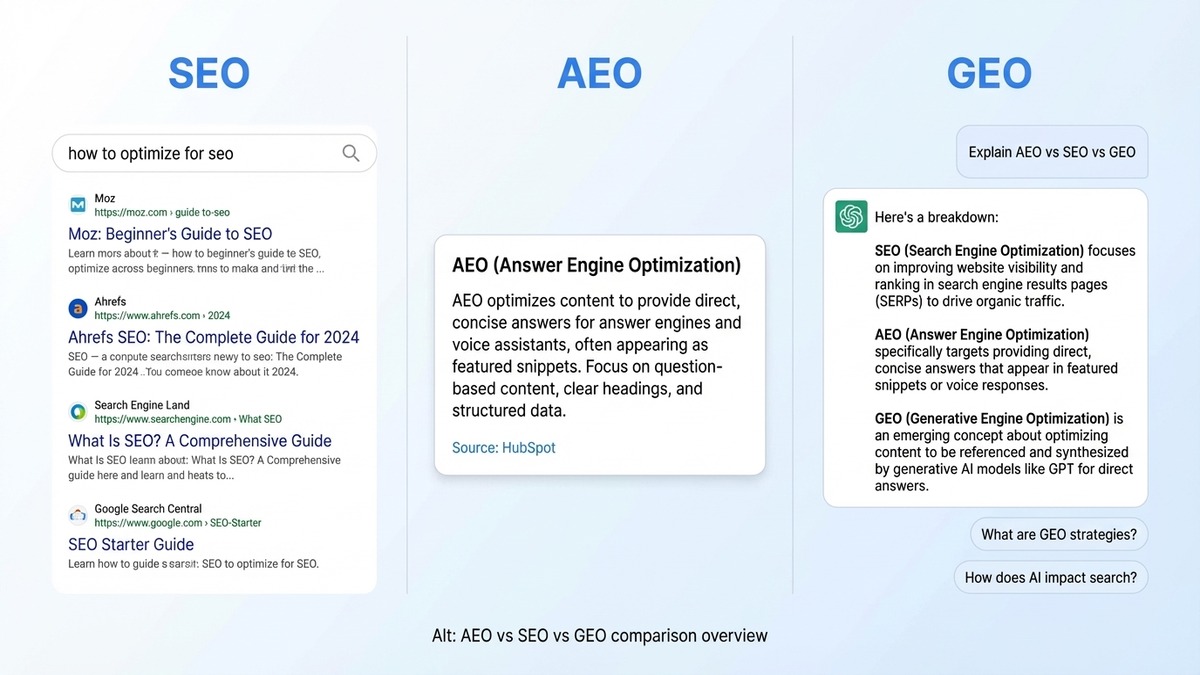
Before getting into the differences, here are the cleanest definitions of each:
SEO (Search Engine Optimisation): The practice of optimising websites and content to rank higher in traditional search engine results pages (SERPs) on Google, Bing, and similar platforms. You're competing for the 10 blue links.
AEO (Answer Engine Optimisation): A subset of SEO focused on getting your content selected as the direct answer to a query. This includes Google's featured snippets (the highlighted box at the top of results), People Also Ask answers, voice search responses, and structured knowledge panel entries.
GEO (Generative Engine Optimisation): The practice of structuring content so that AI-powered answer engines, specifically tools like ChatGPT, Perplexity, Google AI Overviews, and Microsoft Copilot, cite or reference your content when generating their responses.
Think of it as a progression: SEO is the broad foundation, AEO is the middle layer, and GEO is the newest frontier. Each one builds on the last.
The Full Comparison: SEO vs AEO vs GEO
Here's the detailed breakdown across the dimensions that matter most:
| Factor | SEO | AEO | GEO |
|---|---|---|---|
| Full name | Search Engine Optimisation | Answer Engine Optimisation | Generative Engine Optimisation |
| Primary goal | Rank in the top 10 organic results | Win featured snippets and direct answers | Get cited in AI-generated responses |
| Target platforms | Google, Bing, Yahoo | Google Featured Snippets, Voice Search, PAA | ChatGPT, Perplexity, Google AI Overviews, Copilot |
| Key tactics | Backlinks, technical health, keyword targeting | Structured data, Q&A formatting, concise answers | Authoritative facts, citable statistics, source credibility |
| Content style | Comprehensive and keyword-rich | Direct, question-and-answer format | Factual, well-attributed, self-contained sections |
| Primary metric | Keyword rankings and organic traffic | Featured snippet ownership and voice search appearances | AI citations and brand mentions in AI answers |
| Traffic model | Click-through to your website | Often zero-click (answer shown directly) | Often zero-click, but high-intent brand awareness |
| Schema markup needed? | Recommended | Essential (FAQ, HowTo, Article schema) | Helpful but not the core driver |
| Timeframe to results | 3-12 months | 4-8 weeks once content is indexed | Varies, often faster for AI Overviews |
| Maturity level | 25+ years, well-established | About 10 years, mature | 2-3 years, still evolving rapidly |
| Singapore adoption | Widespread and competitive | Moderate, most businesses have some structured data | Low, early-mover advantage available |
The key insight from this table: the goal shifts across the three disciplines, but the underlying content requirements don't change dramatically. Accurate, well-structured, authoritative content wins across all three. What changes is how you format and present that content.
How We Got Here: The Evolution of Search Optimisation
Understanding where each discipline came from explains why they exist and why they're all still relevant.
SEO: The 1990s to Now
SEO began in earnest in the mid-1990s, when the first search engines (AltaVista, Yahoo, early Google) started indexing the web. Webmasters quickly realised that how they structured their pages affected where they appeared in results. By the early 2000s, Google had established itself as the dominant search engine, and SEO became a formal discipline.
For nearly two decades, SEO meant: research the keywords people are searching, create content that matches that intent, earn backlinks from authoritative sites, and fix the technical issues that prevent Google from crawling and indexing your pages. That playbook is still valid in 2026. It has not been replaced. It has been extended.
AEO: The 2015 Shift Toward Direct Answers
Google launched featured snippets in 2014-2015. For the first time, rather than simply listing 10 links, Google started pulling a single answer directly to the top of the search results page, displaying a paragraph, list, or table from a third-party website. This was a significant shift. Suddenly, the goal wasn't just to rank, it was to be selected as the answer.
Voice search accelerated this. When someone asks Google Assistant a question, it reads out a single answer. That answer comes from a featured snippet. Optimising specifically for that position became its own discipline, which practitioners started calling AEO.
Key AEO tactics that emerged from this period:
- Structuring content with explicit Q&A formatting
- Using schema markup to tell Google what type of content a page contains
- Writing concise, self-contained answer paragraphs (40-60 words works well)
- Targeting "question" queries: "what is", "how to", "why does"
GEO: The 2023 Inflection Point
The launch of ChatGPT in late 2022 and Google's AI Overviews in 2023-2024 created a new search behaviour. Instead of typing keywords and browsing links, a growing segment of users now types full questions into AI tools and receives synthesised, cited answers.
The academic paper that coined "Generative Engine Optimisation" was published by researchers at Princeton, Georgia Tech, and others in 2024, and it demonstrated that specific content qualities (statistics, citations, quotations, authoritative tone, structured formatting) measurably increased the likelihood of content being cited by AI models.
GEO is the newest layer, but it is the fastest-growing one. Platforms like Perplexity are growing at pace. Google's AI Overviews now appear on a significant share of searches. For B2B services in Singapore, where buyers increasingly research vendors through AI tools, GEO visibility is becoming a commercial necessity.
When Do You Need Each One?
This decision framework helps you prioritise based on your situation:
You Need SEO When...
- You don't currently appear in Google results for your core service terms
- Your website has significant technical issues (slow speed, mobile problems, crawl errors)
- You have no backlink profile or domain authority
- You're starting a new website or have recently rebranded
- Your competitors consistently outrank you for commercial keywords
SEO is the foundation. Everything else is harder to achieve without it. If your pages don't rank at all, they won't be selected for featured snippets (AEO) and they're less likely to be cited by AI tools (GEO). Start here.
You Need AEO When...
- You already rank on page 1 for key queries but want the featured snippet position
- You have a product or service that involves common how-to or what-is questions
- Your target audience uses voice search (mobile-first, local searches, quick queries)
- You want to own the "People Also Ask" boxes that appear in search results
- You're in a content-heavy industry where structured answers provide real value (finance, legal, health, education)
AEO builds on existing rankings. You're not going to win a featured snippet for a query where you rank on page 3. Invest in AEO once your SEO foundation is solid.
You Need GEO When...
- Your audience researches purchases or vendors using AI tools (especially B2B)
- You want to appear when someone asks ChatGPT or Perplexity to recommend services like yours
- You're in a knowledge-intensive or advisory field where AI tools summarise and cite experts
- You're seeing referral traffic from Perplexity or AI Overviews in your analytics and want more of it
- You want to protect your brand's narrative in AI-generated answers (GEO isn't just about citations, it's about how you're described)
GEO has the lowest current competition in Singapore. Most local businesses haven't started optimising for it. That's the window.
Quick Decision Matrix
| Your Situation | Start With |
|---|---|
| New website, minimal rankings | SEO first |
| Ranking on page 1, not in snippets | AEO next |
| Good rankings, targeting AI visibility | GEO layer |
| B2B service, buyer research via AI | GEO urgently |
| Local business, voice search queries | AEO priority |
| All of the above | Integrated strategy (see below) |
Why SEO, AEO, and GEO Are Not Competing Strategies
The framing of "AEO vs SEO vs GEO" implies a choice. It is not a choice. These three disciplines work as a stack, and the effort required to add each layer is smaller than building it from scratch.
Here's the logic:
SEO builds the foundation. A technically sound website with strong content and backlinks is the prerequisite for everything else. Without it, neither AEO nor GEO is achievable at scale.
AEO sharpens the content. The structural changes that help content win featured snippets (clear headings, concise answers, proper schema) also make content more readable for AI models. When you optimise for AEO, you're doing 60-70% of the GEO work at the same time.
GEO extends the reach. Adding AI-citation-specific elements (attributed statistics, expert quotes, citable summary paragraphs) takes a well-structured AEO page and makes it visible in AI-generated answers. You're not rebuilding the page. You're adding a layer.
The same piece of content, written well, can rank on Google (SEO), win the featured snippet (AEO), and get cited by Perplexity (GEO). These are not separate content strategies. They are different things a single good piece of content can accomplish.
For a deeper look at how GEO works specifically, read our guide on how to get cited by AI. And if you want to understand how GEO fits into the broader picture of modern search, our SEO and GEO overview covers the relationship in detail.
What a Combined SEO + AEO + GEO Strategy Looks Like in Practice
Here's how a Singapore B2B service business (say, an accounting firm targeting SMEs) might execute all three simultaneously:
Step 1: SEO Foundation
- Conduct keyword research targeting commercial intent queries: "accounting services Singapore", "SME tax services", "corporate secretary Singapore"
- Create or improve service pages with proper on-page SEO (title tags, meta descriptions, internal linking, structured headings)
- Fix technical issues: site speed, mobile responsiveness, crawl errors
- Build backlinks through local business directories, industry publications, and digital PR
- This maps to SEO services in Singapore
Step 2: AEO Layer
- Identify the "what is / how does / why do" questions your clients ask
- Write dedicated FAQ-style sections that answer each question in 40-60 word paragraphs
- Add FAQ schema markup to key pages
- Target PAA (People Also Ask) boxes with structured Q&A content
- Optimise for local voice search: "best accounting firm near me"
- This maps to optimising content structure with SEO copywriting services
Step 3: GEO Layer
- Add specific, cited statistics to your content ("According to IRAS 2024 data...")
- Include expert attribution: quotes from your own team, or references to industry authorities
- Write citable summary paragraphs at the start of each major section (what we call the "direct answer" format)
- Build a presence in third-party sources that AI tools regularly cite: industry reports, business directories, news publications
- Monitor AI tool appearances using search mention tools and branded queries in ChatGPT/Perplexity
- This maps to GEO services in Singapore
The Content Template That Does All Three
A single blog post or service page can target all three simultaneously if it follows this structure:
- Opening paragraph: Direct answer to the core query (60 words, self-contained)
- Key Takeaways: Bullet points summarising the article (good for AI summarisation)
- H2 headings: Phrased as questions people actually ask
- Section lead paragraphs: 40-60 word direct answers before the expanded explanation
- Comparison tables: The most citable content format in AI responses
- Statistics with attribution: Specific numbers, sources, and dates
- Schema markup: FAQ, Article, or HowTo depending on content type
- Internal links: Connecting related content for authority and crawlability
Singapore Market Context
Singapore's search landscape is competitive but structured. A few things that make the SEO/AEO/GEO stack particularly relevant here:
English-first with bilingual nuances. Singapore searches are predominantly in English, but Singaporean English has specific colloquialisms and phrasing patterns. Both traditional SEO and AEO benefit from understanding the local vocabulary.
B2B decision-making is research-heavy. Singapore SMEs and enterprise buyers conduct substantial research before choosing service providers. AI tools are increasingly part of that research workflow, especially for technology, professional services, and marketing. GEO is not optional for B2B service providers here.
High mobile and voice search usage. Singapore has very high smartphone penetration, and voice search usage is significant. AEO's role in winning voice search results is commercially meaningful for local businesses.
Low GEO competition right now. Unlike SEO, where Singapore's major keywords are already fiercely contested, the GEO landscape is largely unclaimed. Most local businesses have not started optimising for AI citation. The businesses that start in 2026 will establish a presence that is genuinely difficult for later entrants to displace.
Putting It Together
SEO, AEO, and GEO are not three separate investments. They are three outcomes that a single well-built content strategy can achieve.
Start with SEO if your technical foundation is weak. Add AEO once you're ranking on page 1 and want to capture the snippet position. Layer in GEO to extend that visibility into AI-generated answers.
The businesses in Singapore that treat this as a stack, rather than a choice, will be the ones that dominate search visibility across every format: the traditional SERP, the featured snippet, and the AI answer.
If you're not sure where your current strategy sits across these three disciplines, the most useful next step is an audit. Our team at SEO Expert reviews all three layers and identifies the fastest path to visibility for your specific business.
Get your free SEO audit from our digital marketing agency in Singapore.