

Images are supposed to help your content. They break up walls of text, illustrate concepts, and make your pages more engaging. But left unoptimised, every image on your site is quietly working against you, slowing down your load times, confusing search engines, and costing you rankings you should have earned.
The irony is that image SEO is one of the easiest areas to fix. Most sites get it completely wrong by default, which means the upside for anyone who gets it right is significant.
Key Takeaways
- Image file size is one of the most common causes of slow page speed, which directly affects rankings
- Alt text is how Google "reads" your images, skipping it means missing a significant relevance signal
- Descriptive file names tell search engines what an image is about before they even analyse it
- Images can rank in Google Image Search, driving a separate stream of organic traffic
- Modern image formats like WebP can cut file sizes by 30-50% without visible quality loss
Why Images Are an SEO Problem Most Sites Ignore
Open your site in Google PageSpeed Insights right now. There is a good chance that images are either the top issue or in the top three. Oversized images, wrong formats, images without dimensions, images without alt text, these are the most common page speed killers, and they directly affect your Core Web Vitals scores.
As covered in our guide on Core Web Vitals and site speed, Google uses page experience signals as a ranking factor. Slow pages rank lower. A site full of unoptimised images is a slow site.
But image SEO goes beyond speed. It is also about relevance. Google cannot see an image the way a human can. It relies on text signals, file names, alt text, surrounding content, to understand what an image depicts. Get those signals right, and your images reinforce the relevance of your page. Get them wrong (or skip them entirely), and Google is flying blind.
And then there is Google Image Search. Millions of searches happen there every day. An optimised image can appear in those results and drive traffic back to your page, a traffic stream most sites never think to pursue.
Alt Text: The Most Important Image SEO Element
Alt text (alternative text) serves two purposes. First, it is read aloud by screen readers for visually impaired users, making it a basic accessibility requirement. Second, it is how Google understands what your image depicts.
Writing good alt text is straightforward:
- Describe what is actually in the image, concisely and accurately
- Include your target keyword naturally where it fits the description
- Do not stuff keywords, Google can spot alt text that reads like a keyword list
- Do not start with "Image of" or "Picture of", Google already knows it is an image
Bad alt text: alt="seo"
Also bad: alt="SEO Singapore SEO services best SEO company"
Good alt text: alt="SEO audit checklist on a laptop screen, reviewed by a digital marketing consultant in Singapore"
Every image on your site without alt text is a missed opportunity. For a site with hundreds of images, fixing alt text across the board can deliver a noticeable relevance boost.
File Names: The First Signal Google Sees
Before Google reads your alt text, it reads your file name. Most images come off cameras and phones with names like IMG_4892.jpg or DSC_0012.png. These tell Google absolutely nothing.
Rename your images before you upload them. Use lowercase letters, separate words with hyphens (not underscores), and include a relevant keyword where natural.
Instead of: IMG_4892.jpg
Use: on-page-seo-checklist-singapore.jpg
This is a small step that costs almost no time. Over hundreds of images, the cumulative effect on relevance signals is meaningful.
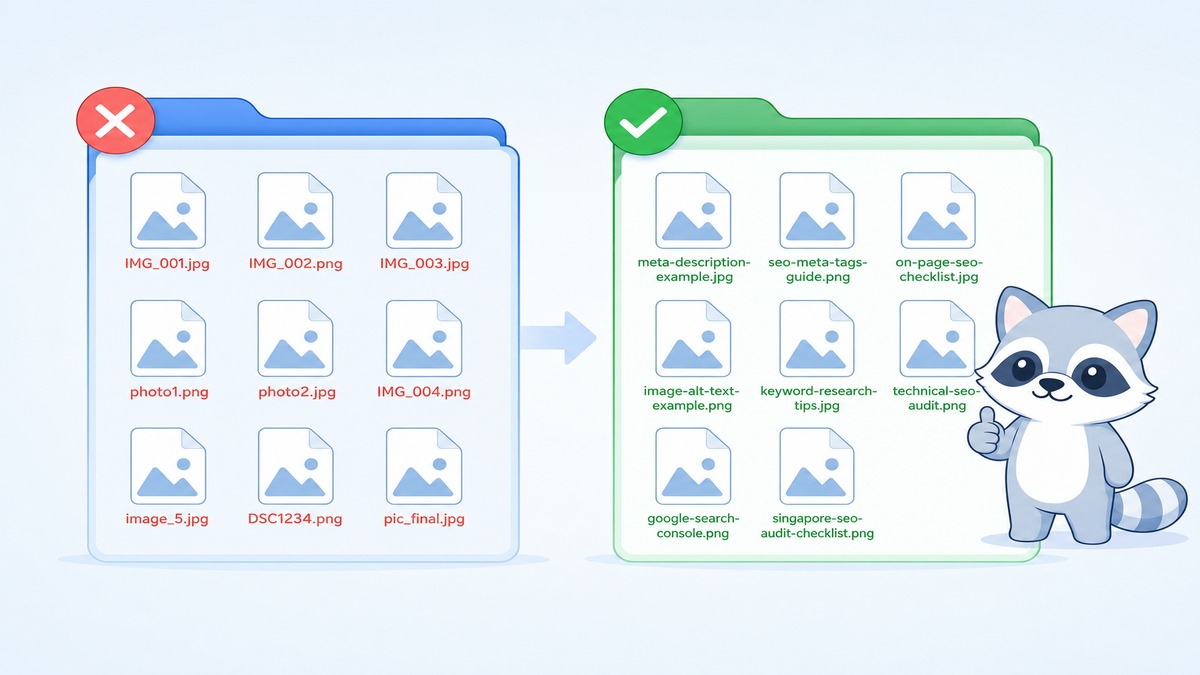
Image Compression and Format: The Speed Fix
File size is the biggest image-related drag on page speed. A high-resolution photo straight from a camera can be 5-10MB. The same image, properly compressed and resized for web use, can be under 200KB with no visible quality difference.
The key practices:
Resize to display dimensions. If an image will be displayed at 800px wide, there is no point uploading it at 3000px wide. Resize before uploading.
Compress aggressively. Tools like TinyPNG and Squoosh compress images without visible quality loss. Most images can be compressed 60-80%.
Use modern formats. WebP is supported by all modern browsers and delivers 25-50% smaller file sizes than JPEG or PNG at comparable quality. Convert your images to WebP. For animated images, consider AVIF or WebP instead of GIF.
Enable lazy loading. Images below the fold do not need to load when the page first opens. The loading="lazy" attribute tells browsers to load these images only as users scroll down. This dramatically improves initial page load time.
Set width and height attributes. Specifying image dimensions in HTML prevents layout shift, a Core Web Vitals metric that affects your ranking. This one line of code prevents the page from "jumping" as images load.
Structured Data and Image Sitemaps
If images are a significant part of your content, there are two additional steps worth taking.
Image sitemaps tell Google about images on your site that it might otherwise miss, particularly images loaded via JavaScript. You can include image information in your existing XML sitemap or create a dedicated image sitemap. Google has clear documentation on how to do this.
Structured data can be applied to specific image types. Recipe images, product images, and article images all benefit from appropriate schema markup. Properly marked-up images are eligible for rich results, which take up more visual space in Google Search and tend to attract more clicks.
Our article on SEO tags and technical on-page elements covers structured data in more depth if you want to go further.
Image SEO for E-Commerce: A Bigger Opportunity
For e-commerce sites, images are not just decorative, they are often the primary way users evaluate a product before buying. This means image SEO has a direct impact on both rankings and conversions.
Each product image should have:
- A descriptive file name (e.g.,
blue-running-shoes-nike-singapore.jpg) - Unique alt text for each image (not the same alt text repeated across 20 product images)
- Compression to ensure fast loading
- Multiple images per product where possible, as this improves user engagement time on page
Our e-commerce SEO service covers image optimisation as part of a full product page SEO strategy. If you are running an online store in Singapore and your product pages are slow or thin on image signals, there is likely significant untapped ranking potential.
Auditing Your Images: Where to Start
If you have an existing site with hundreds of images, a full manual audit is not realistic. Use tools to do the heavy lifting:
- Screaming Frog crawls your site and flags images with missing alt text, oversized files, and broken image links
- Google Search Console shows Core Web Vitals issues, some of which trace back to images
- Google PageSpeed Insights identifies image-specific speed issues with specific recommendations
Prioritise in this order: fix missing alt text first (it is the easiest and most impactful), then address file size and format issues, then tackle file naming for new uploads going forward.
This fits well into the broader context of on-page SEO work. Our piece on writing meta descriptions that get clicks is another quick win in the same category: small changes to how you present content that have an outsized impact on rankings and traffic.
The Hidden Traffic Stream You Are Missing
Google Image Search is not a niche channel. For certain industries and topics, image results drive significant traffic. Recipes, design inspiration, product research, how-to guides, these are all areas where image search is heavily used.
When your images are properly optimised, they can appear in these results. The image links back to your page. You get the traffic. And that traffic is often highly targeted, because the searcher was specifically looking for something visual that your image provided.
Most sites in Singapore are completely ignoring this channel. The businesses that take image SEO seriously are quietly picking up traffic their competitors do not even know is available.
If you want help auditing and optimising your images as part of a full SEO service, it pays to work with a Singapore SEO expert who treats these details as standard rather than an afterthought. To explore what better on-page SEO could do for your business, reach out to the SEOExpert team. Our Singapore GEO agency will take a look at where your site stands and what the biggest opportunities are.