
SEO stands for Search Engine Optimisation. It is the process of improving your website so it ranks higher on search engines like Google, bringing in more organic (unpaid) traffic to your business.
That's the short answer. But if you want to understand what SEO actually does, how it works in digital marketing, and whether your business needs it, keep reading. This will take less than 5 minutes.
Key Takeaways
- SEO stands for Search Engine Optimisation. It is how you get your website to rank higher on Google without paying for ads.
- There are 3 pillars: Technical SEO (site foundation), On-Page SEO (content and keywords), and Off-Page SEO (backlinks and authority).
- SEO is a long game. Expect 3 to 6 months for meaningful results, but the compounding returns make it one of the most cost-effective marketing channels.
- In Singapore, Google owns 96%+ of search. If you are not doing SEO, you are invisible to most of your potential customers.
- SEO works alongside other channels like PPC, social media, and the emerging field of GEO (Generative Engine Optimisation).
- Every business needs a different SEO approach. Local businesses, e-commerce stores, and enterprises each require tailored strategies.
What Does SEO Stand For?
SEO stands for Search Engine Optimisation (also spelled "optimization" in American English). The term covers a set of techniques used to make websites more visible in search engine results pages, commonly called SERPs.
When someone types a query into Google, the search engine scans billions of web pages and returns the most relevant, trustworthy results. SEO is the work you do behind the scenes to make sure your website earns one of those spots.
If you want to get familiar with the full vocabulary, the SEO glossary covers every major term you will encounter on this journey.
What SEO Means in Marketing
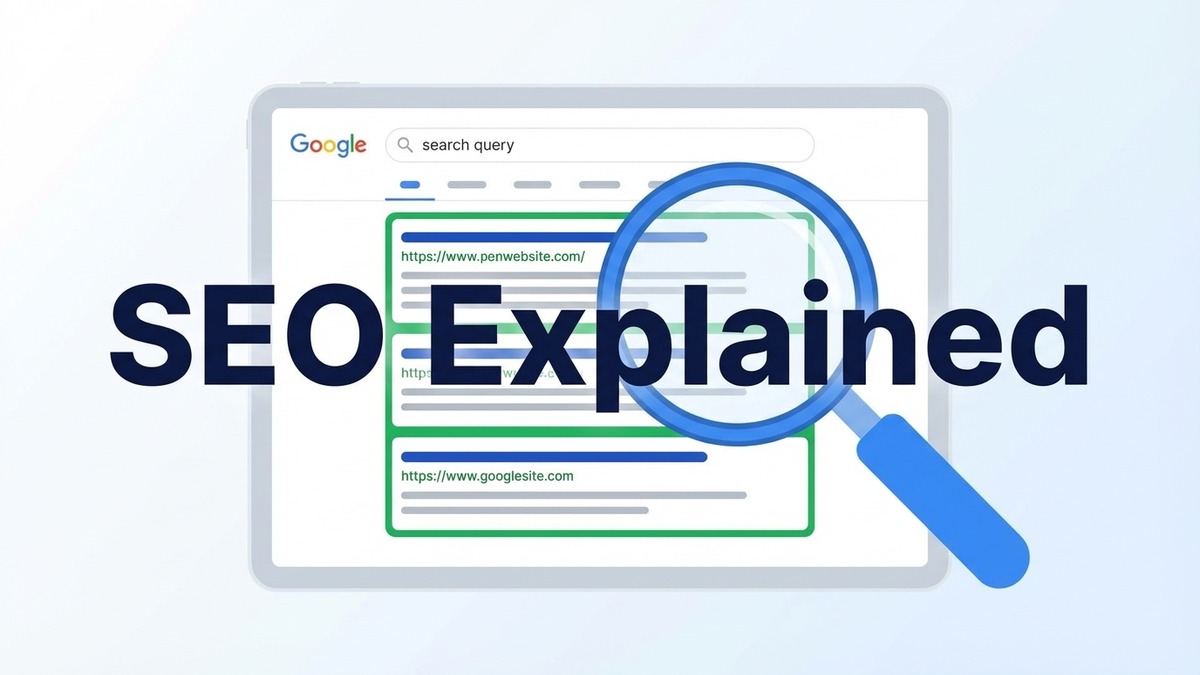
In marketing, SEO means building a sustainable, long-term channel for acquiring customers without paying for every click.
Compare that to PPC (pay-per-click advertising): with paid ads, you pay each time someone clicks. The moment you stop paying, the traffic stops. SEO works differently. A well-optimised page can generate traffic for months or years after you publish it.
That compounding effect is why SEO sits at the core of most digital marketing strategies. Done right, it turns your website into an asset that works for you around the clock, rather than just a digital brochure collecting dust.
What SEO Does for Your Business
SEO does three concrete things:
- Increases visibility. Your website appears when people search for what you offer.
- Drives qualified traffic. People who find you via search are already looking for your solution. They are not being interrupted by an ad.
- Builds authority. Ranking well on Google signals credibility, which reinforces trust before a prospect even clicks through.
In Singapore, Google holds over 96% of the search engine market share. That means if your website is not showing up on Google, you are invisible to the overwhelming majority of online searchers in this market. That is not a minor issue. It is the whole ballgame.
According to Google Search Central, organic search drives more website traffic than any other single channel for most websites. For Singaporean businesses, getting this right is not optional.
The 3 Pillars of SEO
SEO optimisation breaks down into three core areas. All three matter. Neglecting any one of them limits your results. 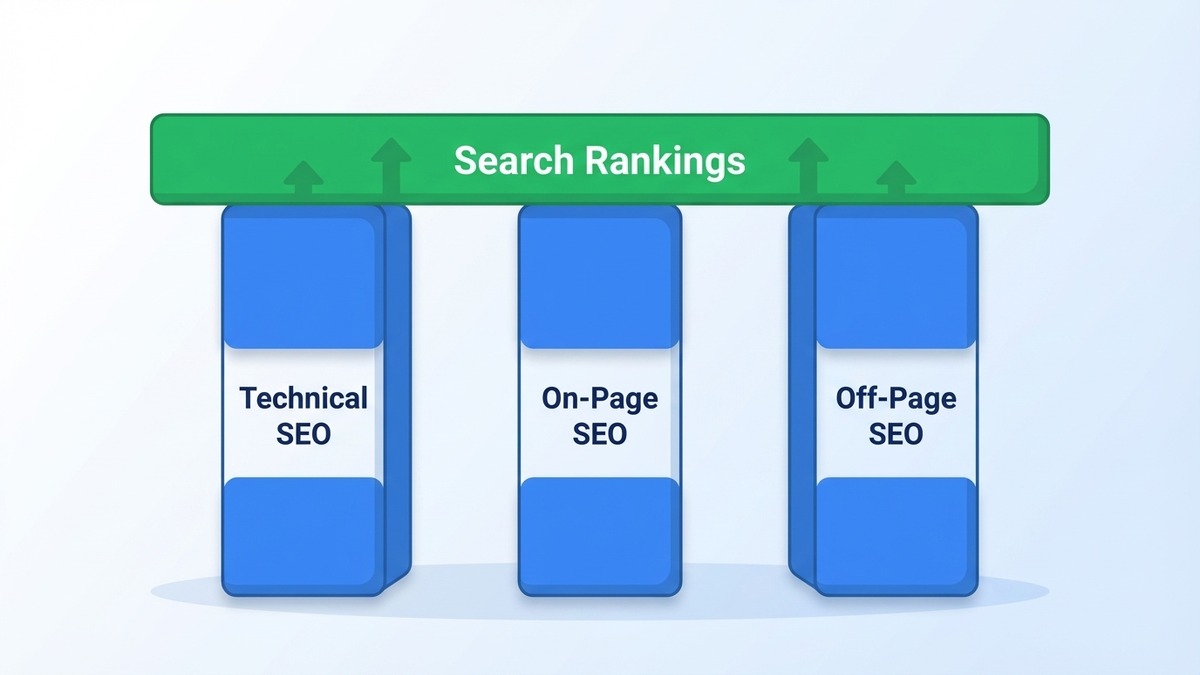
1. Technical SEO
This is the foundation. Technical SEO ensures your website can be found, crawled, and indexed by search engines in the first place. Key elements include:
- Site speed (Google uses page experience as a ranking signal)
- Mobile-friendliness (over 70% of Singaporean internet users browse on mobile)
- Clean URL structures
- Proper sitemaps and robots.txt configuration
- Fixing crawl errors and broken links
If your technical foundation is broken, nothing else you do will fully work. You are building on sand.
2. On-Page SEO
On-page SEO is what most people picture when they hear the term. It covers:
- Keyword research: Finding the exact words and phrases your target customers type into Google
- Content: Writing helpful, accurate information that fully addresses what the searcher needs
- Title tags and meta descriptions: The text that appears in search results, which affects both rankings and click-through rates. You can preview how yours will look using our SERP simulator
- Internal linking: Connecting related pages on your site to help both users and search engines navigate
- SEO copywriting: Writing that satisfies readers and algorithms at the same time, without sacrificing one for the other
Good on-page SEO starts with understanding your audience deeply, then creating content that genuinely serves them.
3. Off-Page SEO
Off-page SEO is about building your site's authority and reputation outside your own website. The main lever is backlinks: links from other websites pointing to yours.
Think of a backlink as a vote of confidence. When a reputable, relevant site links to your content, Google reads it as a signal that your page is worth trusting. Quality and relevance matter far more than raw quantity here.
Off-page SEO also includes brand mentions, review signals, and the overall perception of your domain's authority across the web.
SEO in Digital Marketing: Where It Fits
SEO does not exist in isolation. It works alongside every other digital marketing channel.
- Paid ads: SEO and PPC often target the same keywords. Running both gives you more real estate on the results page and data on what converts.
- Social media marketing: Social content builds awareness and can drive links back to your site over time.
- GEO (Generative Engine Optimisation): As AI-powered tools like Google AI Overviews and ChatGPT gain traction in 2026, GEO is emerging as a complement to traditional SEO. It focuses specifically on getting your content cited by AI systems, a channel that did not exist three years ago.
- Content marketing: The fuel that powers SEO. Without content, there is nothing to rank.
A good digital marketing agency integrates these channels so they reinforce each other, rather than treating them as separate disconnected activities.
Types of SEO You Should Know About
SEO is not one-size-fits-all. Different businesses need different approaches.
- Local SEO: For businesses serving a specific geographic area. Critical for F&B, clinics, legal firms, and service businesses in Singapore. It optimises your Google Business Profile, local citations, and location-specific pages so you appear in "near me" searches.
- E-commerce SEO: For online stores. Focuses on product pages, category pages, and managing large volumes of content without cannibalising your own rankings.
- Enterprise SEO: For large websites with thousands of pages. Requires systematic, technical approaches and clear governance at scale.
The type of SEO you need depends on your business model, your competitors, and your goals.
How Long Does SEO Take?
This is the most common question. The honest answer: most websites see meaningful traction within 3 to 6 months of consistent work. Competitive industries can take 12 months or more.
SEO is not a quick fix. It is a long-term investment with long-term returns. The payoff is that once you rank well, you are not paying per click. A page sitting at position one on Google can drive thousands of monthly visitors for free, month after month.
For a Singapore-based business investing in SEO services in Singapore consistently over 12 months, the typical outcome is significantly lower customer acquisition costs compared to running paid ads alone over the same period.
SEO vs. Doing Nothing
Let's be direct. If you have a website and you are not doing SEO, you are effectively invisible to search engines.
Singapore has one of the highest internet penetration rates in Southeast Asia, exceeding 92% in 2026. Singaporeans search online before buying products, booking services, choosing clinics, and hiring lawyers. If your competitors are ranking and you are not, they are getting your customers by default.
That is what SEO does. It closes that gap.
Ready to Start?
SEO has moving parts. But the fundamentals are stable: build a technically sound site, create content people actually want, and earn the trust of other sites linking to you.
If you want help making that happen for your business, get in touch here and let's talk through what it would take.