

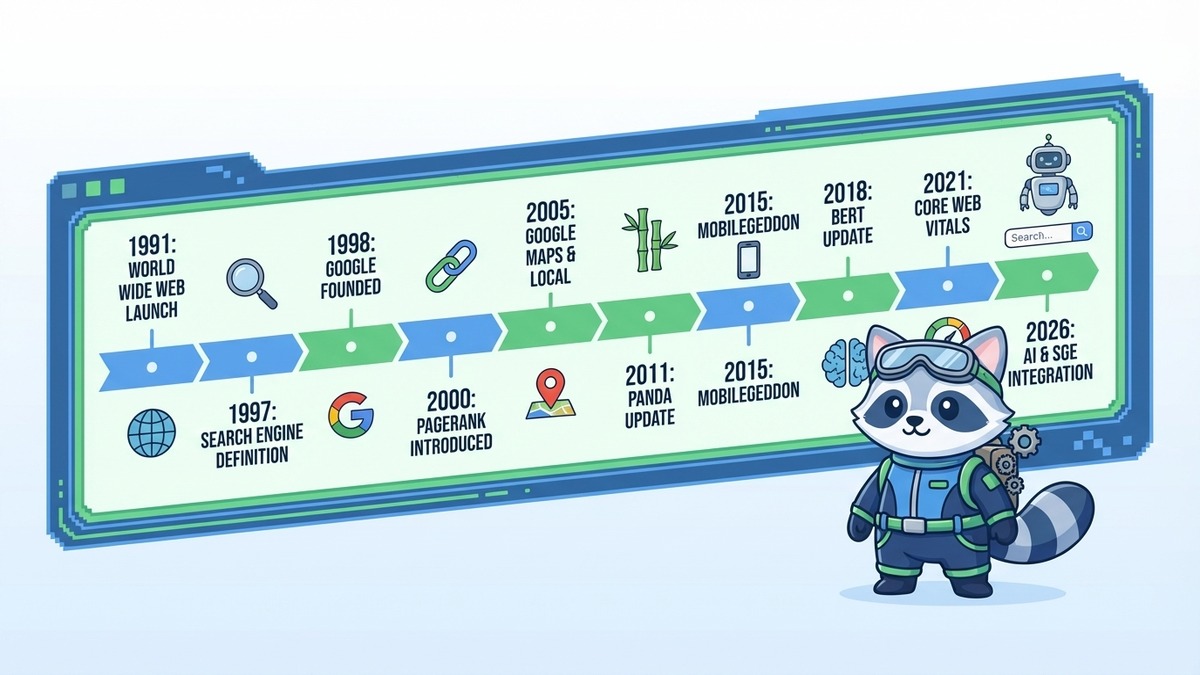
SEO (Search Engine Optimisation) became a recognised practice around 1997, when website owners first started deliberately manipulating search engine rankings. The term "SEO" is widely attributed to Bob Heyman and Leland Hee, who reportedly coined it in 1997. But the full story of how search optimisation evolved, from the first website in 1991 to today's AI-powered search, spans three decades of cat-and-mouse games between webmasters trying to rank and search engines trying to deliver accurate results.
Understanding this history isn't just trivia. It explains why modern SEO works the way it does, and why shortcuts that used to work now get you penalised.
Key Takeaways
- SEO as a term and practice emerged around 1997, just as the commercial web was taking off
- Early SEO relied heavily on tactics that Google would later penalise: keyword stuffing, link farms, hidden text
- Google launched in 1998 and fundamentally changed the rules by prioritising links as a quality signal
- Major algorithm updates (Panda, Penguin, Hummingbird, BERT, Helpful Content) progressively eliminated manipulative tactics
- Singapore businesses began adopting SEO in earnest around 2008 to 2012, as broadband penetration and e-commerce grew
- AI is now reshaping search again, with Google's AI Overviews and tools like ChatGPT changing how people find information
1991 to 1996: Before SEO Existed
The first website went live on 6 August 1991, created by Tim Berners-Lee at CERN. By 1993, the first web crawlers appeared: tools that automatically traversed links and indexed pages. Early search engines like Archie, Gopher, and later Excite, Lycos, and AltaVista tried to make sense of the rapidly growing web.
Ranking in these early search engines was almost entirely based on keyword matching: how many times a word appeared on a page. There was no "SEO" industry yet, but some webmasters noticed that pages with more keyword repetitions ranked higher. The seeds of optimisation (and manipulation) were planted.
By 1996, the web had grown to approximately 100,000 websites. Yahoo had launched its directory (human-edited, not algorithmic). The race for visibility was beginning.
1997 to 1999: The Birth of SEO
By 1997, the commercial web was in full expansion. Businesses were realising that ranking at the top of search results meant customers. The term "Search Engine Optimisation" entered common use, and the first SEO practitioners began offering their services.
Early SEO techniques were crude but effective on the engines of the time:
- Keyword stuffing: Repeating target keywords dozens or hundreds of times on a page, often in white text on a white background (invisible to users, readable by crawlers)
- Meta keyword tags: Early search engines ranked pages partly on the basis of meta keywords, so stuffing hundreds of keywords here was common
- Hidden text: Keywords hidden via tiny fonts or matching background colours
- Doorway pages: Thin pages created purely to rank for specific searches, then redirecting visitors elsewhere
In 1998, two Stanford PhD students launched a search engine that would change everything: Google. Larry Page and Sergey Brin's breakthrough was PageRank: an algorithm that measured a page's authority based on how many other pages linked to it, and the authority of those linking pages.
This was a significant shift. For the first time, off-page signals (links from other sites) mattered as much as on-page content. The link economy was born.
2000 to 2004: The Wild West of Links
With Google's rise to dominance in the early 2000s, the SEO industry exploded. Link building became the central activity, but in ways that bear little resemblance to legitimate link building today.
Link farms: Networks of websites created purely to link to each other and to paid clients. A site could buy thousands of links overnight.
Article spinning: Low-quality articles with keywords stuffed throughout, submitted to hundreds of article directories to generate links.
Forum spam: Automated bots posting links in forum threads and comment sections across thousands of websites.
Reciprocal link exchanges: "Link to me and I'll link to you" schemes that had nothing to do with editorial relevance.
These tactics worked for a while because Google's algorithm, still relatively young, struggled to distinguish genuine editorial links from manufactured ones.
In 2003, Google rolled out the "Florida Update," a major algorithm change that targeted obvious keyword stuffing and many first-generation spam techniques. For many marketers relying on these shortcuts, it was the first wake-up call. Rankings evaporated overnight.
2005 to 2010: Google Takes More Control
This period saw Google progressively tightening its algorithm and introducing tools that gave it more visibility into SEO practices.
Google Analytics launched in 2005, giving website owners (and Google) unprecedented insight into how users behaved on sites.
Google Webmaster Tools (now Google Search Console) launched in 2006, creating a direct communication channel between Google and site owners.
The Nofollow attribute was introduced to combat comment spam: links tagged as nofollow would not pass PageRank. This reduced the incentive for comment spam overnight.
Universal Search in 2007 integrated images, videos, news, and local results into standard search results, beginning the diversification of what "ranking" could mean.
For Singapore, this period marked the beginning of digital marketing professionalisation. As broadband internet reached most Singaporean homes and businesses (broadband penetration exceeded 60% by 2008), Singapore companies began investing more seriously in their online presence. The first dedicated SEO agencies appeared in Singapore around 2008 to 2010, primarily serving e-commerce retailers and property developers.
2011: Panda Arrives and Content Changes Forever
In February 2011, Google launched the Panda algorithm update. Its target: low-quality, thin, and duplicate content.
Entire content farm businesses, sites generating thousands of shallow articles purely to capture search traffic, were decimated overnight. Sites with high ad-to-content ratios, scraped content, and thin pages that added no genuine value lost rankings en masse.
Panda introduced the concept of site-wide quality signals: if a significant portion of your site had low-quality content, it could suppress the entire domain's rankings, not just individual pages.
The message from Google was clear: content quality was now a real ranking factor, not just keyword presence.
For Singapore businesses, Panda reinforced the emerging understanding that SEO required genuine investment in content, not just technical tricks.
2012: Penguin Kills Link Manipulation
In April 2012, Google launched Penguin, targeting manipulative link building practices directly.
Sites with unnatural link profiles (high volumes of low-quality links from irrelevant sites, keyword-stuffed anchor text patterns, paid links) faced significant ranking drops. In many cases, penalties were severe enough to effectively remove sites from Google's results entirely.
The link economy changed permanently. Instead of building as many links as possible, the new strategy required building fewer, higher-quality, genuinely relevant links from authoritative sources.
Penguin's influence explains why legitimate backlink building today focuses on digital PR, genuine partnerships, guest content on relevant publications, and earning links through content worth referencing. It also accelerated the divergence between organic SEO and paid search (SEM), as businesses that lost rankings overnight looked to Google Ads to maintain visibility. Our SEO vs SEM comparison covers how the two channels differ and how Singapore businesses use them together today.
2013 to 2015: Hummingbird, Mobilegeddon, and the Rise of Intent
Hummingbird (2013) was Google's most significant algorithm architecture change since the early days. Rather than matching keywords mechanically, Hummingbird introduced semantic search: understanding the intent and context behind a query, not just its keywords.
"Best accountant near me for my small business Singapore" could now be understood as a local, commercial, professional services query, even though the phrase wasn't matched word-for-word to any page.
Mobilegeddon (April 2015) introduced mobile-friendliness as a direct ranking factor. Sites that weren't optimised for mobile devices saw ranking drops in mobile search results. Given that over 80% of searches in Singapore were already happening on mobile devices by 2015, this update had immediate real-world impact on Singapore businesses.
2015 to 2019: Quality Signals Deepen
Google continued its evolution toward rewarding genuine quality and relevance:
RankBrain (2015): Google's first machine learning ranking component, helping to interpret unfamiliar or ambiguous search queries by learning from patterns.
Featured Snippets became more prominent, pulling direct answers from pages into "Position Zero" above traditional results. Structured content (with clear answers to specific questions) gained a new advantage.
E-A-T (Expertise, Authoritativeness, Trustworthiness) appeared in Google's Quality Rater Guidelines in 2015, signalling that Google was increasingly evaluating content sources, not just content.
BERT (2019): A natural language processing model that significantly improved Google's ability to understand conversational queries, especially ones with nuanced context like "can you get medicine for someone at the pharmacy in Singapore without a prescription." BERT focused on understanding the relationship between words in a query, not just individual keywords.
Singapore's digital marketing industry matured significantly during this period. By 2018, virtually every established Singapore brand had an SEO strategy, and the discipline had become a standard component of marketing budgets rather than an experimental channel.
2020 to 2022: Core Web Vitals and Page Experience
Google formalised page experience as a ranking factor with Core Web Vitals: measurable metrics around loading speed (Largest Contentful Paint), interactivity (First Input Delay), and visual stability (Cumulative Layout Shift).
Sites that loaded slowly, had intrusive pop-ups, or shifted layout as content loaded were officially at a ranking disadvantage.
For Singapore businesses, this update reinforced the connection between technical SEO and user experience. An SEO agency that only managed content and links without addressing site performance was leaving ranking potential on the table.
2023 to Present: The AI Era
In March 2023, Google began rolling out its Search Generative Experience (SGE), later renamed AI Overviews. For the first time, Google's search results page included AI-generated answer summaries above traditional organic results.
This introduced a new consideration: GEO (Generative Engine Optimisation), the practice of optimising content to be cited and referenced by AI-generated answers. This is covered in detail through our GEO services.
Meanwhile, ChatGPT's explosive growth from late 2022 onward changed how many people search for information. Instead of querying Google for research questions, more users began asking AI tools directly.
This has raised the same question that every major change in search history has raised: is SEO dead? As with every previous disruption (social media, mobile, voice search), the answer is no. SEO evolves. The businesses that understand the history understand why.
What History Tells Us About SEO Today
Three decades of SEO history reveal a consistent pattern: Google consistently moves toward rewarding genuine quality, expertise, and relevance, while penalising manipulation and shortcuts.
Every major algorithm update has had the same underlying direction:
- Panda: reward quality content
- Penguin: reward genuine links
- Hummingbird and BERT: reward relevance and intent
- Core Web Vitals: reward good user experience
- AI Overviews: reward content that genuinely answers questions with authority
The SEO strategies that have survived every update share the same characteristics: they're built on creating genuinely useful content, earning authoritative links, and delivering a good experience to users.
For Singapore businesses building long-term online presence, this is reassuring. The approach that works today is not a short-term trick waiting to be penalised. It's the same approach that has been rewarded for 20 years.
If you're thinking about how SEO fits into your overall digital marketing approach, our article on SEO in digital marketing gives the full picture.
Ready to build an SEO strategy designed for the long term? Get in touch with the SEOExpert team. We've helped Singapore businesses grow their organic presence through every algorithm change, and we're built for whatever comes next.