
SEO in digital marketing is the practice of increasing a website's visibility in organic search results as part of a broader online marketing strategy that typically also includes paid advertising, content marketing, social media, and email. SEO is not a standalone channel: it's the foundation that amplifies the effectiveness of every other digital marketing activity. When SEO is working, it brings qualified traffic to all your other marketing assets. When it's absent, those assets are harder to find.
Many Singapore businesses treat SEO as a separate line item in their marketing budget, disconnected from their ads, social, and email efforts. This is exactly the mistake that leaves significant growth on the table.
Key Takeaways
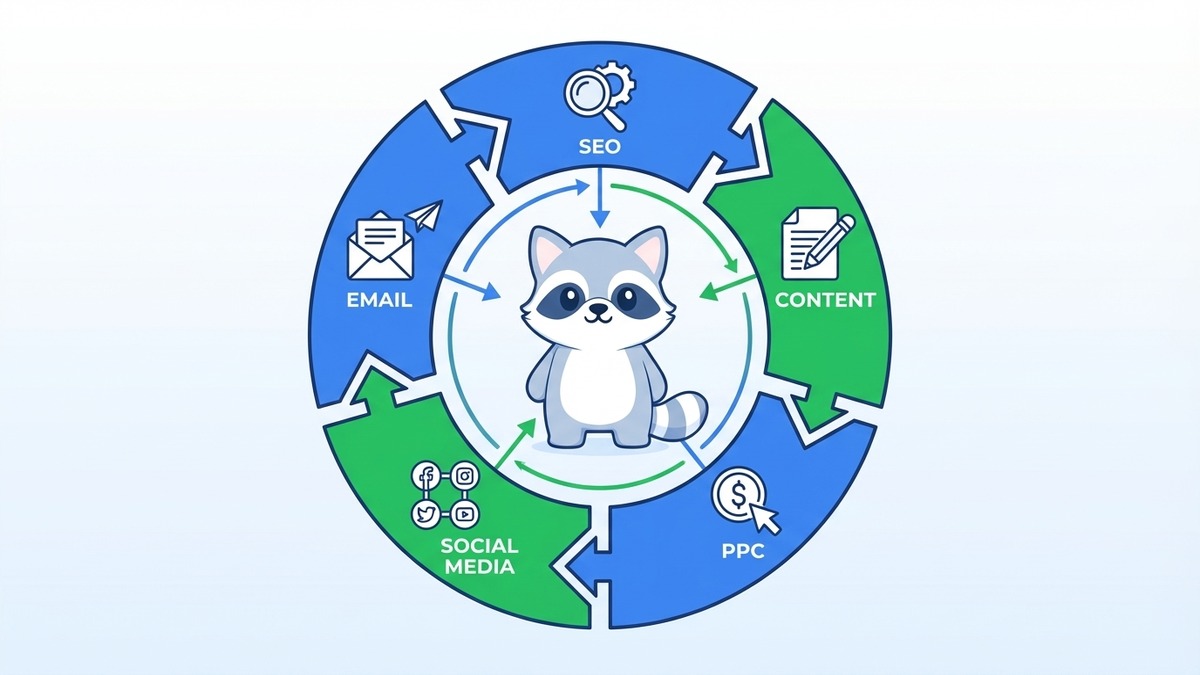
- SEO is one component of digital marketing, not all of it: effective strategy integrates SEO with content, paid ads, social, and email
- SEO provides the foundation: it brings organic traffic that the rest of your marketing can then convert, nurture, and retain
- Content marketing and SEO are deeply intertwined: most SEO gains come through content that earns rankings and links
- Paid search (SEM/PPC) and SEO target the same audience through different mechanisms and work best when coordinated
- Social media does not directly improve SEO rankings, but drives traffic and amplifies content that earns links
- Singapore's digital marketing landscape is Google-heavy for search and Facebook/Instagram-heavy for social, which shapes how SEO integrates here
- A digital marketing agency that only handles one channel is leaving strategic gaps
The Digital Marketing Ecosystem
Before understanding where SEO fits, it helps to map out the full digital marketing ecosystem. For most Singapore businesses, this includes:
Organic Search (SEO): Unpaid traffic from Google and other search engines. Earned through content quality, technical health, and backlink authority.
Paid Search (SEM/PPC): Paid traffic from Google Ads, showing up in the "Sponsored" slots at the top and bottom of search results. Immediate but costs money per click.
Content Marketing: The creation and distribution of useful content (articles, guides, videos, infographics) that attracts and engages a defined audience.
Social Media Marketing: Building brand presence and driving traffic through platforms like Instagram, Facebook, TikTok, and LinkedIn.
Email Marketing: Direct communication with subscribers through campaigns, newsletters, and automated sequences.
Paid Social: Advertising on social media platforms (Meta Ads, LinkedIn Ads, TikTok Ads) to reach specific audience segments.
Each of these channels has its own strengths, costs, and appropriate use cases. SEO sits at the intersection of several of them. Understanding how SEO evolved alongside these other channels is useful context; the history of SEO from 1991 to today shows how the discipline matured from a technical loophole into a core marketing function.
How SEO Connects to Each Channel
SEO and Content Marketing: Nearly Inseparable
Content marketing and SEO are so closely intertwined that many practitioners treat them as a single discipline. The connection is direct: creating content that targets what people are searching for is the most sustainable way to build organic search rankings.
A well-executed content strategy produces blog articles, guides, and resource pages that:
- Rank organically for target keywords
- Answer questions your audience is actively asking
- Earn backlinks from other sites (a core SEO signal)
- Provide material to share across social channels
- Give email subscribers reasons to visit your site
This is why the SEOExpert content approach is research-first: identify what Singapore audiences are searching for, then create content that genuinely answers those searches better than anything currently ranking.
Content that earns rankings keeps generating traffic for months and years. Content that doesn't target search queries depends entirely on paid distribution or social sharing to get seen.
SEO and PPC: Same Audience, Different Roads
SEO (organic) and PPC (paid search) target the same searchers on the same platforms. Understanding how they complement each other, rather than treating them as either/or choices, is central to effective search marketing.
Several key interactions between SEO and PPC:
Data sharing: PPC campaigns tell you which keywords convert visitors into leads or customers. That conversion data is gold for SEO content strategy: target the keywords that actually convert, not just the ones with high search volume.
Gap coverage: New websites or new service pages won't rank organically for competitive keywords immediately. PPC covers the gap while SEO builds.
SERP domination: Appearing in both the paid ad position AND the organic results for a query increases overall brand visibility and click-through rates. Some studies show combined presence increases click-through significantly above either channel alone.
Remarketing: PPC campaigns can retarget visitors who found your site through organic search but didn't convert. SEO brings them in; paid ads bring them back.
Our PPC services work in coordination with SEO strategy for exactly this reason. Separating the two creates blind spots.
For a deeper comparison of how the two channels differ in cost, timeline, and ROI, our article on SEO vs SEM covers the full breakdown.
SEO and Social Media: Indirect but Real
A common question from Singapore marketing managers: does social media help SEO?
The direct answer: social media shares and likes are not a ranking factor in Google's algorithm. A viral Instagram post doesn't directly improve your Google rankings.
The indirect answer: social media matters for SEO in real but less obvious ways.
Amplification: Social media puts your content in front of more people. More people seeing your content means more chances that bloggers, journalists, and other site owners discover and link to it. Those links DO improve SEO.
Traffic signals: Social traffic to your site can, over time, contribute to user behaviour signals that Google observes.
Brand search volume: Strong social presence increases branded search queries. People who see your brand on Instagram may later search for you directly on Google. Higher brand search volume sends positive authority signals.
Content discovery: Journalists and bloggers who find your content on social may reference or link to it in their articles. Social is often the discovery mechanism that leads to editorial links.
For Singapore businesses, social media marketing and SEO should share a content calendar. The same piece of content can serve organic search rankings AND social media engagement if planned properly.
SEO and Email Marketing: Converting the Traffic SEO Builds
Email marketing and SEO operate at different stages of the customer journey, but they're deeply complementary.
SEO brings strangers to your website. Email marketing converts those strangers into subscribers, nurtures them into leads, and keeps customers engaged over time.
The connection:
- SEO-driven blog content can include email signup prompts, converting organic visitors into subscribers
- An email list gives you a direct audience for new content, which can earn early traffic and engagement signals that help new pages rank faster
- Email campaigns that promote content on your site increase page engagement metrics
- Re-engaging past email subscribers who haven't visited recently can spike traffic to pages that need a ranking boost
For Singapore B2B companies in particular, the SEO-to-email funnel is powerful: organic traffic from informational searches builds a subscriber list, which then converts through drip email sequences into qualified sales enquiries.
The Singapore Digital Marketing Landscape
Understanding where SEO fits in Singapore's specific digital landscape matters.
Google dominance in search: Google holds over 95% of search engine market share in Singapore. This makes Google-focused SEO the clear priority for local businesses. Bing, Yahoo, and other engines are minimal factors.
Facebook and Instagram for social: Singapore's social media landscape is dominated by Facebook and Instagram for most consumer categories, with TikTok growing rapidly among younger demographics and LinkedIn important for B2B. Understanding this shapes how SEO-driven content gets amplified.
High mobile usage: Over 85% of Singapore internet users access the web primarily via mobile. This makes mobile SEO not optional but mandatory. Page speed, mobile-responsive design, and Core Web Vitals are direct ranking factors that also affect the user experience across all your other marketing channels.
Competitive, high-CPC environment: As covered in our SEO vs SEM comparison, Singapore Google Ads CPCs are among the highest in Southeast Asia. This makes organic search a high-value channel: traffic earned through SEO has a high implied cost if you had to pay for it through PPC.
Multilingual opportunity: Singapore's English, Chinese, and Malay-speaking populations represent distinct audience segments. Businesses that invest in multilingual SEO can reach segments their English-only competitors miss entirely.
Why SEO Is the Foundation, Not Just a Channel
Here's the case for treating SEO as the foundation of your digital marketing:
Organic search is intent-based. Unlike social media (where you interrupt people mid-scroll) or display ads (where you reach people who haven't expressed interest), SEO reaches people at the exact moment they're searching for what you offer. That intent alignment is why SEO conversion rates typically outperform other channels.
SEO builds an asset, not just traffic. PPC traffic stops when your budget stops. Social reach depends on the algorithm's willingness to show your posts. Email depends on list health. Organic rankings, once built, continue generating traffic without ongoing per-click costs. They're a business asset in a way that paid channels aren't.
SEO amplifies everything else. A well-ranked website is a more credible brand in every other context. When your sales team references your website in proposals, when your social posts link back to your blog, when your email campaigns drive traffic to landing pages: the quality and authority of those destination pages affects outcomes.
SEO is where your competitors are investing. If you're curious about why Singapore businesses with healthy marketing budgets consistently prioritise SEO, our article on why your competitors are investing in SEO makes the case clearly.
How a Digital Marketing Agency Should Integrate SEO
A genuinely effective digital marketing agency doesn't treat SEO as a siloed service. It integrates keyword research into content planning, aligns PPC and organic keyword strategies, ensures social media amplification of SEO content, and uses email to capture and convert the traffic SEO generates.
This is exactly how SEOExpert operates. Rather than offering isolated SEO audits that sit in isolation from your broader marketing, our approach connects organic search strategy to every other channel.
If you're evaluating how SEO currently integrates (or doesn't) with your other marketing activities, reach out to us. We'll map out exactly where the gaps are and what a connected strategy looks like for your Singapore business.