
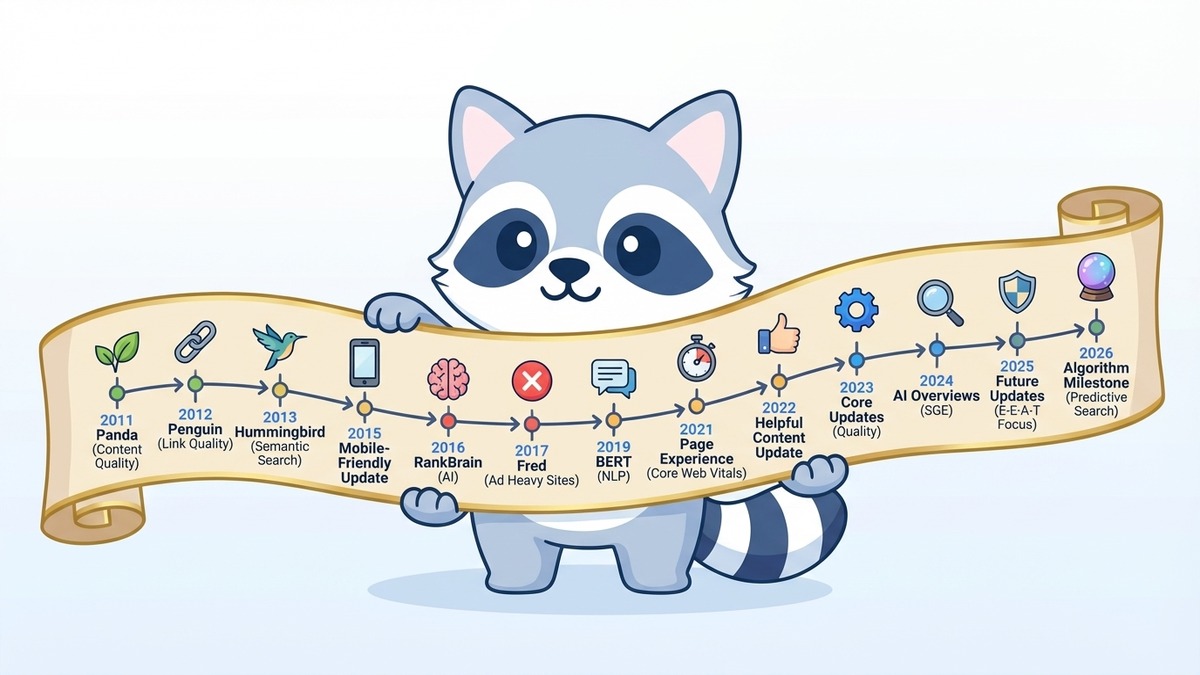
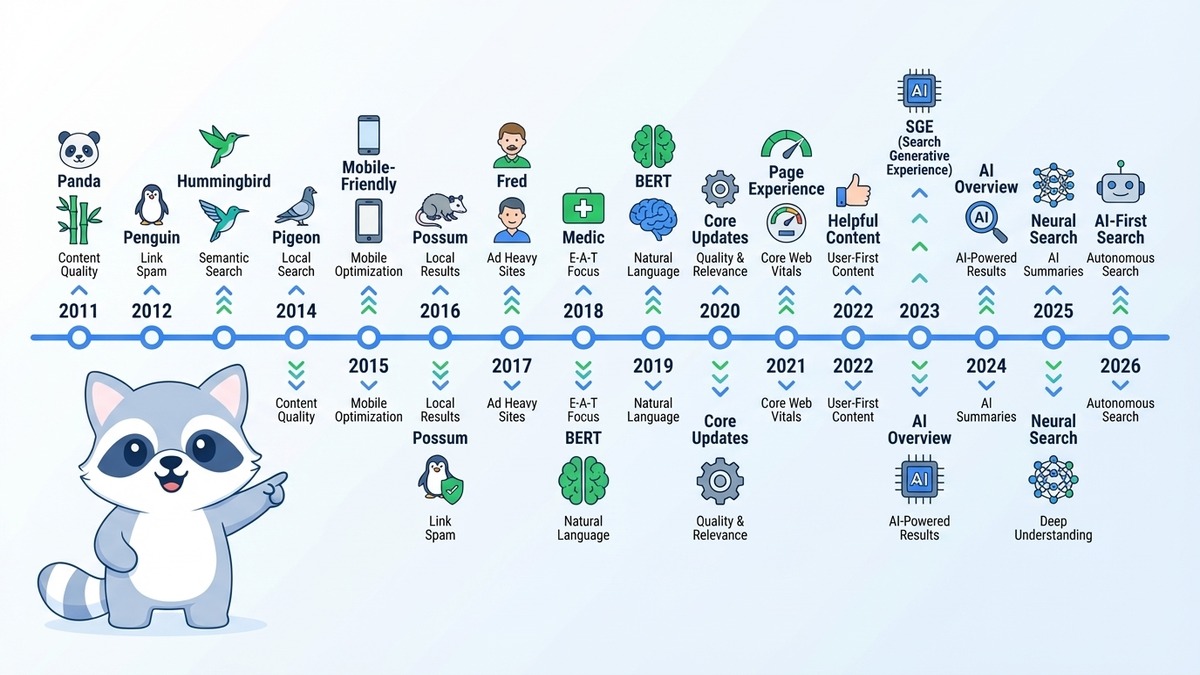
Google runs thousands of algorithm updates every year, but only a handful have fundamentally reshaped how websites rank. Since Google Panda launched in February 2011, each major update has pushed the same direction: reward genuinely useful, authoritative content from trustworthy sources, and penalise manipulation. Understanding these updates is not just history. It is the clearest possible guide to what Google will keep rewarding in the future.
This hub page covers every significant Google algorithm update from 2011 through 2026, what each one targeted, who got hit, and what recovery looked like. It is updated with new entries as confirmed updates roll out.
Key Takeaways
- Every major Google algorithm update has targeted the same underlying problem: websites trying to game the algorithm rather than genuinely serve searchers.
- Panda targeted low-quality content. Penguin targeted manipulative links. BERT and MUM improved language understanding. Helpful Content targeted AI-generated spam. The direction is consistent.
- Recovery from algorithm penalties typically requires fixing the underlying quality problem, not just technical fixes.
- Singapore websites are subject to the same global algorithm as all other Google markets. There are no Singapore-specific algorithm adjustments.
- The 2024-2026 period has been the most disruptive since Penguin, driven by AI-generated content spam and the integration of AI into search results themselves.
- Staying ahead of updates means building for long-term quality, not short-term manipulation.
How to Use This Page
Each update section below follows a consistent structure:
- What changed: What Google targeted or improved
- Who was affected: Sites that gained or lost
- Recovery: What to do if hit
- Singapore relevance: Local market context where applicable
Use Ctrl+F (or Command+F) to find a specific update by name or year. New updates are added to the "2024-2026" section as they are confirmed by Google.
2011-2012: The Quality Era Begins
Google Panda (February 2011)
What changed: Panda was Google's first major content quality update. It targeted sites with thin content, duplicate content, content farms, and sites that ranked primarily by gaming keyword signals rather than providing value. Panda assigned a quality score to entire websites, not just individual pages.
Who was affected:
- Gained: Sites with deep, original, high-quality content
- Lost: Content farms, article directories, sites with large amounts of thin or duplicate pages
Recovery: Removing or significantly improving low-quality pages. In many cases, consolidating many thin pages into fewer comprehensive ones. Adding "noindex" to low-value pages (e.g., tag archives, thin category pages) to lift the Panda score of the overall domain.
Singapore relevance: Singapore's early SEO market in 2011 relied heavily on keyword-stuffed pages and spun content. Sites that adapted early gained significant competitive advantages that some still hold today.
Google Penguin (April 2012)
What changed: Where Panda targeted content quality, Penguin targeted link manipulation. It penalised websites that had built their rankings on unnatural link profiles: paid links, link networks, keyword-anchor-text manipulation, and links from low-quality or irrelevant sites.
Who was affected:
- Gained: Sites with naturally diverse, editorially earned link profiles
- Lost: Sites that had purchased links, used private blog networks, or over-optimised anchor text (e.g., having 80% of backlinks with the exact same keyword anchor)
Recovery: Auditing the entire backlink profile, disavowing toxic links via Google Search Console, and building genuine editorial links over time. Many sites penalised by Penguin took 12-24 months to fully recover.
Singapore relevance: The Singapore SEO industry in 2012 was heavily dependent on link schemes. Penguin wiped out rankings for many local businesses and agencies overnight. The cleanup period lasted years for some.
2013-2015: Understanding Intent
Google Hummingbird (September 2013)
What changed: Hummingbird was a full algorithm rewrite (not a penalty update) that fundamentally improved Google's ability to understand the meaning of queries, not just the individual words. It enabled Google to answer conversational and natural language queries with much better accuracy.
Who was affected: Not a penalty. Sites with content that answered questions comprehensively (not just pages stuffed with exact-match keywords) gained. Exact-match keyword pages with no semantic depth lost visibility over time.
Recovery: N/A as a penalty. For sites that lost visibility: shift from exact-match keyword targeting to topic-based content that answers questions fully and naturally.
Google Pigeon (July 2014)
What changed: Pigeon significantly improved Google's local search algorithm, tying local results more closely to traditional web ranking signals (like Domain Authority and content quality) and improving distance and location ranking accuracy.
Who was affected:
- Gained: Legitimate local businesses with quality websites and strong local citations
- Lost: Local sites relying on poor-quality, keyword-stuffed content but geographic proximity alone
Recovery: Building genuine local citation profiles, optimising Google Business Profile (then Google My Business), and improving overall website quality.
Singapore relevance: For Singapore businesses competing in local search, Pigeon was a significant improvement in result accuracy. It rewarded businesses with complete, accurate GBP listings and consistent NAP citations. Our local SEO framework is built on the signals Pigeon established.
Mobilegeddon (April 2015)
What changed: Google announced in advance that mobile-friendliness would become a direct ranking signal on April 21, 2015. Sites not optimised for mobile devices would rank lower in mobile search results.
Who was affected:
- Gained: All mobile-friendly websites
- Lost: Sites with non-responsive designs, text too small to read on mobile, touch elements too close together
Recovery: Switch to a responsive design. Fix mobile usability issues reported in Google Search Console.
Singapore relevance: Singapore's high smartphone penetration rate (among the highest in Asia-Pacific by 2015) made Mobilegeddon particularly impactful locally. Sites that had not invested in mobile design lost significant traffic almost overnight.
RankBrain (October 2015)
What changed: Google introduced RankBrain, a machine learning component that helped Google process and rank results for queries it had never seen before (which accounted for a significant percentage of daily searches). RankBrain also began weighting user engagement signals (how users interacted with search results) as ranking factors.
Who was affected: Not a penalty update. Sites with genuinely useful, engaging content that kept users satisfied gained. Sites with poor content that users immediately bounced from lost.
Recovery: Improve content quality and user experience. Reduce bounce rates by ensuring content matches search intent. RankBrain is now deeply embedded in Google's core algorithm and not separable from overall SEO quality work.
2016-2019: Refinement and E-A-T
Possum (September 2016)
What changed: Possum adjusted local search results to filter out results that were similar to other already-showing results. It also made results more dependent on the physical location of the searcher.
Who was affected: Businesses with addresses just outside a target city or CBD area could now rank for city searches. But businesses sharing an address with competitors saw reduced visibility.
Singapore relevance: For Singapore businesses in shared office buildings or business parks, Possum sometimes caused unexpected visibility changes.
Google Medic Update (August 2018)
What changed: The Medic Update (informally named) was a broad core algorithm update that significantly impacted health, medical, legal, and financial sites. It strengthened Google's emphasis on E-A-T (Expertise, Authoritativeness, Trustworthiness) for "Your Money, Your Life" (YMYL) content.
Who was affected:
- Gained: Health and finance sites with credentialed authors, cited sources, and transparent ownership
- Lost: Thin medical and financial content sites without clear author credentials or transparency
Recovery: Adding author bios with verifiable credentials, citing reputable sources, improving site transparency (About page, contact information), and significantly improving content depth and accuracy.
Singapore relevance: Singapore's finance, medical, and legal industries were all affected. Clinics and financial advisory firms with thin online content saw drops. Those with credentialed, comprehensive content gained.
BERT (October 2019)
What changed: BERT (Bidirectional Encoder Representations from Transformers) was Google's most significant natural language processing improvement to date. It enabled Google to understand the context and nuance of words in relation to all the other words in a search query, not just left-to-right.
Who was affected: Not a penalty. Content that wrote naturally for humans, using complete sentences and contextual language, benefited. Content stuffed with keywords in unnatural patterns lost relevance.
Recovery: Write naturally. Stop forcing exact-match keywords into awkward sentences. Focus on answering questions completely rather than matching specific keyword strings.
2021-2023: Page Experience and Helpful Content
Page Experience Update / Core Web Vitals (May-August 2021)
What changed: Google officially made Core Web Vitals (LCP, FID/INP, CLS) ranking signals as part of a broader Page Experience Update. HTTPS, mobile-friendliness, and absence of intrusive interstitials were also formalised as ranking signals.
Who was affected:
- Gained: Fast, stable, mobile-friendly sites with no intrusive popups
- Lost: Slow sites, especially those failing CLS (layout shifts) or LCP (slow main content load)
Recovery: Improve Core Web Vitals scores as measured by Google Search Console and PageSpeed Insights. Compress images, improve server response times, eliminate layout shifts.
Singapore relevance: Singapore businesses on shared hosting with slow server response times saw compounded impacts. The update accelerated the shift to faster hosting and modern web frameworks among Singapore agencies.
Helpful Content Update (August 2022 - Multiple Rollouts)
What changed: The Helpful Content Update (HCU) introduced a site-wide classifier that assessed whether a website's content was created primarily for humans or primarily for search engines. Sites with large amounts of low-quality, search-engine-first content received a site-wide signal that suppressed all pages, even otherwise good ones.
HCU was expanded and refined multiple times through 2023 and 2024, eventually being folded into Google's core algorithm in March 2024.
Who was affected:
- Gained: Sites with expert-authored, experience-backed content clearly written for readers
- Lost: Sites with large amounts of AI-generated or shallow content produced purely to rank for keywords
Recovery: Removing or significantly improving low-quality pages. Demonstrating genuine expertise and first-hand experience. Understanding your audience's actual needs rather than just keyword intent.
Singapore relevance: Singapore digital marketing agencies that had built client sites on bulk AI-generated content saw dramatic traffic drops through 2023-2024.
March 2023 Core Update and Review Spam Updates
Google's March 2023 Core Update was one of the largest of that year. Alongside core quality signals, Google also continued its series of review spam updates targeting sites with fake, incentivised, or low-quality product and service reviews.
Recovery: Consistent investment in E-E-A-T signals. Removing fake review content. Genuine acquisition of customer reviews through legitimate means.
2024-2026: The AI Era
March 2024 Core Update (March-April 2024)
What changed: The March 2024 Core Update was specifically described by Google as targeting low-quality, unoriginal content at scale. It folded the Helpful Content classifier into the core algorithm and significantly expanded coverage of AI-generated spam. Google reported that the update, combined with spam policy changes, would reduce low-quality, unoriginal content in search results by approximately 40%.
Who was affected:
- Lost heavily: Sites that had built traffic primarily through AI-generated content with no original perspective, experience, or value added
- Gained: Sites with genuine expertise, original research, and experience-backed content
Recovery: This update had some of the most severe, lasting impacts seen since Penguin 2012. Many affected sites have not recovered even after producing quality content, suggesting a longer trust-rebuilding period.
Singapore relevance: Several Singapore affiliate and content sites that had adopted aggressive AI content strategies lost 60-90% of their traffic in this period.
Google AI Overviews Launch (May 2024)
What changed: Google launched AI Overviews (previously SGE/Search Generative Experience) at Google I/O 2024, rolling out to US searches initially and expanding globally through late 2024. AI Overviews generate synthesised answers to queries from multiple cited sources, appearing above organic results.
Impact on SEO: Sites cited in AI Overviews receive traffic and brand visibility. Sites not cited for their core keywords effectively lost a position in search results. The update accelerated the importance of GEO (Generative Engine Optimisation) alongside traditional SEO. For a full analysis of this shift, see our article on AI and SEO in 2026.
2025 Core and Spam Updates
Google released several significant core and spam updates through 2025 continuing the focus on:
- Reducing "parasite SEO" (low-quality content published on high-authority third-party sites)
- Penalising sites that expired domain abuse (purchasing expired domains with authority and using them for spam)
- Improving ranking of first-hand experience content
- Expanding AI Overview coverage to more query types
Recovery framework for any 2025 update: Run a full content audit. Identify and remove or improve thin pages. Ensure all remaining content demonstrates genuine expertise or first-hand experience. Build consistent E-E-A-T signals.
2026: The Current Landscape
As of 2026, Google's algorithm consistently rewards:
- Original, experience-backed content: Information that could not be generated by scraping existing web content
- Topical authority: Comprehensive coverage of a topic area from a credible domain
- Technical excellence: Fast, mobile-friendly, crawlable, well-structured websites
- Authoritative backlinks: Editorial links from genuinely credible, relevant sources
- Brand signals: Branded searches, entity mentions across the web, consistent NAP data
- User satisfaction signals: Content that genuinely answers queries and keeps users engaged
The SEO strategies that work in 2026 reflect all of these current algorithm priorities. And for Singapore businesses wondering where to start, our how to do SEO yourself guide translates these algorithm realities into a practical action plan.
Lessons From 15 Years of Algorithm Updates
Looking across every major update from 2011 through 2026, the pattern is clear:
Google's direction has never changed. Every update moves toward the same goal: surface the most genuinely useful result for every query, from the most trustworthy source. Manipulation tactics earn short-term gains followed by long-term losses.
Recovery is possible but slow. Sites hit by major algorithm penalties typically need 6-18 months of consistent quality improvements before rankings recover. Some sites with severe trust signals issues never fully recover.
The safest SEO strategy is also the most effective one. Build content that genuinely serves your audience. Earn backlinks through real credibility. Maintain a technically sound website. This approach does not just protect against algorithm penalties. It builds compounding value.
What worked in 2015 probably hurts you in 2026. Tactics that generated quick wins in earlier eras (exact-match keyword stuffing, thin content at scale, private blog networks) are now active liabilities. Sites still running those strategies are future casualties waiting to happen.
How to Stay Updated on Google Algorithm Changes
Knowing about an algorithm update quickly matters. A site that identifies a core update impact within days can begin recovery work immediately. A site that notices a drop three months later has lost significant traffic and ranking ground while waiting.
Reliable sources for algorithm update news:
Google Search Central Blog (developers.google.com/search): The official source. Google confirms core updates, spam updates, and significant algorithm changes here. Bookmark it and check after any unexplained traffic drop.
SearchLiaison on X (formerly Twitter): Google's Search Liaison posts real-time updates about algorithm rollouts, often providing context before the formal blog post appears.
Search Engine Land and Search Engine Journal: Both publish rapid coverage of algorithm updates with detailed analysis of who is affected and what Google has confirmed. Not official, but fast and generally accurate.
Google Search Console email alerts: Set up GSC to email you when significant issues are detected. Manual actions, indexing drops, and coverage errors can appear within days of an algorithm update affecting your site.
Rank tracking alerts: Configure your rank tracker (Ahrefs, SEMrush, SE Ranking) to alert you when keyword positions drop by more than 3-5 positions. This is often your earliest signal that something has changed before the drop shows up in traffic data.
The Algorithm Update Recovery Playbook
If your site has been affected by an algorithm update, here is a structured recovery process used by experienced SEO professionals.
Week 1: Assess and diagnose
Do not start making changes in week 1. Google updates take 1-2 weeks to fully roll out, and traffic fluctuates throughout. Making changes during an active rollout muddies your data.
Instead:
- Confirm the update timeline from official sources
- Export your ranking data for affected keywords before and after the update
- Identify which specific pages and keyword groups lost the most visibility
- Review your Google Search Console Coverage and Core Web Vitals reports for any new issues
Week 2-4: Root cause analysis
Compare your affected pages against the top-ranking pages for the same keywords. Ask honestly:
- Is the content thinner, less comprehensive, or less current than what is now ranking?
- Does the page lack first-hand experience, specific data, or expert perspective?
- Are there technical issues (slow loading, poor mobile experience, crawl errors)?
- Has the competitive landscape changed (a stronger competitor entered the space)?
- Were there changes to your site (redesign, URL restructure, plugin updates) that coincide with the drop?
For content-focused updates (Helpful Content, core updates): the issue is almost always content quality. For link-related updates: backlink profile manipulation. For technical drops: site changes that inadvertently affected crawlability.
Month 2-6: Sustained improvement
Recovery from major algorithm impacts requires sustained quality improvements, not a one-time fix. A helpful content site that rewrites five pages in February and then publishes nothing new will not see the same recovery as one that consistently publishes high-quality, experience-backed content through the year.
Document changes with dates. When Google runs the next core update, you want to be able to see whether sites that improved their quality during the intervening period recovered. This data helps you validate that your efforts are moving in the right direction.
Setting realistic recovery expectations:
- Technical fixes: visible impact in 4-8 weeks as Google recrawls and reindexes
- Content quality improvements: 3-6 months to see consistent ranking recovery
- Link penalty recovery (disavow + quality rebuild): 6-18 months
- Severe HCU penalty (large-scale AI content): 12-24 months in the most severe cases
Proofing Your Site Against Future Updates
The best algorithm update strategy is making your site already aligned with where Google is heading before the update arrives. Historically, every major Google algorithm update has rewarded sites already doing the fundamentals well.
Content proofing checklist:
- Every article is authored by a named person with verifiable expertise
- Articles include specific data points, first-hand examples, or original research
- Content is regularly refreshed with updated information
- No pages exist purely to target a keyword with no additional value offered
- Author pages link to credentials, social profiles, or portfolio
Technical proofing checklist:
- Core Web Vitals passing (green) in Google Search Console
- No crawl errors or indexing issues in GSC Coverage report
- Site is fully mobile-friendly
- HTTPS implemented correctly with no mixed content issues
- Sitemaps submitted and up to date
Link profile proofing checklist:
- Backlink profile is diverse (multiple domains, multiple anchor texts)
- No significant concentration of links from irrelevant or low-quality sources
- Anchor text distribution is natural (brand name, URL, and contextual anchors dominate; exact-match keyword anchors are a small minority)
Applying the 12 proven SEO strategies from our strategy guide consistently is the most effective algorithm proofing approach available. Businesses that implement these fundamentals rarely experience the severe ranking drops that affect sites built on shortcuts.
When New Updates Hit Your Site
If you notice a significant traffic drop that coincides with a Google update announcement, here is the framework:
- Confirm the cause. Check Google's official communication channels (Search Central Blog, SearchLiaison on X) to identify whether an update rolled out around the time of your traffic drop.
- Identify affected pages. Use Google Search Console to identify which pages and keywords lost visibility.
- Assess the content. Compare your affected pages against what is currently ranking. Where does your content fall short in terms of depth, expertise, or user experience?
- Do not panic-publish. Google's guidance is consistent: do not chase algorithm changes with reactive content. Focus on genuine, sustained quality improvements.
- Allow time. Core updates take 1-2 weeks to fully roll out. Traffic fluctuations during rollout are normal. Assess impact after the rollout stabilises.
For Singapore businesses dealing with an unexplained traffic drop, our SEO services team conducts algorithm impact assessments that identify the likely cause and provide a prioritised recovery roadmap.
Stay Ahead of the Next Update
The best way to protect your rankings from future algorithm updates is to ensure your site already meets the standards Google is moving toward. That means:
- Content with genuine expertise and first-hand experience
- Technical performance that delivers fast, stable, mobile-friendly pages
- An authoritative, natural backlink profile
- Brand signals that confirm you are a real, trusted entity in your industry
Algorithm updates do not randomly hurt good sites. They consistently hurt sites that were gaming the system. Build for quality, and updates become competitive advantages, not threats.
Want to know how your Singapore website stacks up against Google's current quality standards? Contact our team for a free SEO audit. We will show you exactly where your site stands and what to prioritise for sustainable rankings.