

If you have ever opened Google Analytics 4 and immediately wished you were back in Universal Analytics, you are not alone. GA4 is powerful but punishing.
The interface buries simple questions behind layers of configuration. Reports that took 30 seconds in UA now take much longer, or a custom exploration you have to build from scratch.
Privacy-first alternatives like Plausible and Fathom Analytics have stepped into that gap. Both are simpler, both respect user privacy by design, and both have grown serious user bases among teams tired of GA4 complexity.
The question for Singapore businesses: what's the right call?
Key Takeaways
- GA4 is free and powerful, but the learning curve is steep and the data models are confusing for casual users.
- Plausible is a privacy-first, open-source analytics tool. Simpler interface, no cookie banners needed, on affordable monthly plans.
- Fathom Analytics is similar in philosophy: simple, privacy-first, no cookies. Pricing is comparable to Plausible, billed by pageviews.
- For teams that need detailed funnel analysis, audience segmentation, custom events and Google Ads integration, GA4 still wins.
- For teams that just want to know how much traffic each page gets, Plausible or Fathom is faster, cleaner and PDPA-friendly without configuration.
- You can run GA4 alongside Plausible or Fathom without conflict.
What Each Tool Does
All three measure web traffic. Beyond that, the philosophies diverge.
Google Analytics 4 is the successor to Universal Analytics, which Google sunset in July 2023. GA4 is event-based (everything is an event) rather than session-based, which is a major change from how most marketers learned analytics.

Source: Google Analytics official product page, showing its analytics offering, captured in July 2026.
It is free, deeply integrated with Google Ads and Search Console, and supports advanced features like predictive audiences and custom funnels.
Plausible Analytics is open-source, hosted in the EU, and built specifically to be a lightweight privacy-respecting alternative to GA. The dashboard is one page.
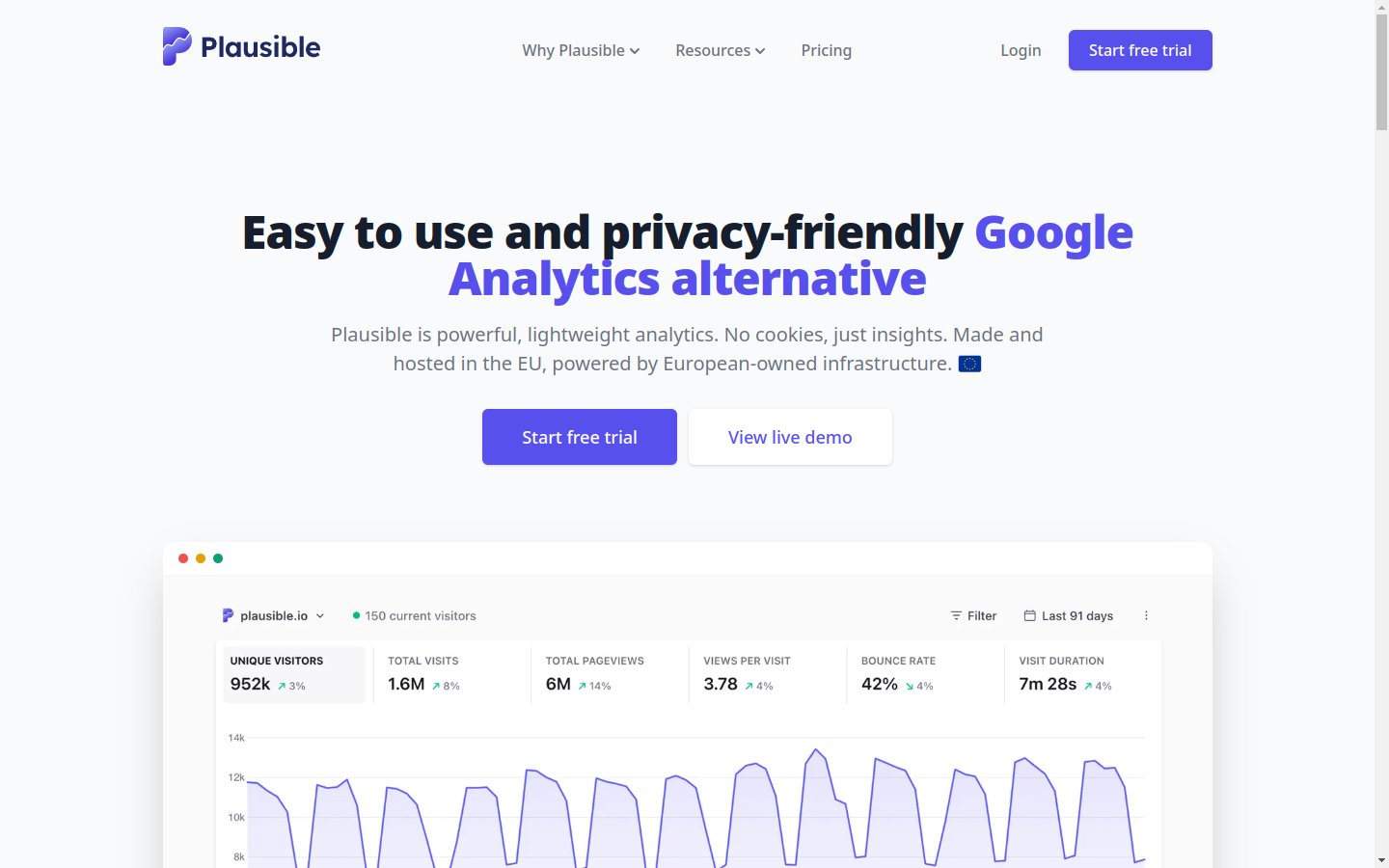
Source: Plausible official homepage, showing its privacy-friendly analytics positioning, captured in July 2026.
There are no cookies, and there is no PII collection. You install one script and you are done.
Fathom Analytics is conceptually identical to Plausible: simple, privacy-first, cookieless. It is closed-source and based in Canada with hosting options in the EU and US.
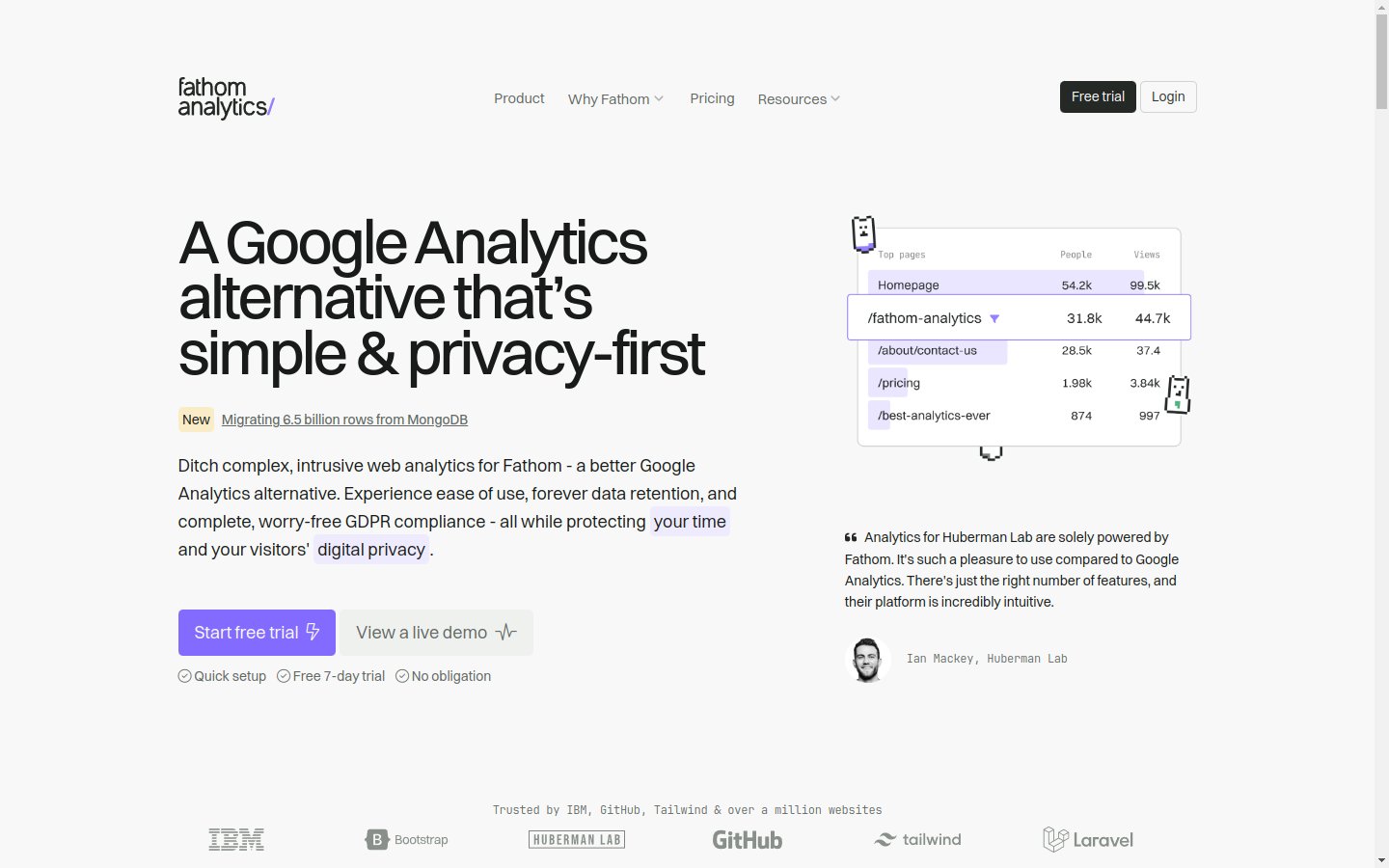
Source: Fathom Analytics official homepage, showing its simple, privacy-first analytics positioning, captured in July 2026.
The interface is minimalist and the pricing is by pageview rather than per-site.
The Privacy Angle
This is where the privacy-first tools differentiate sharply from GA4.
GA4 sets cookies by default to track unique users across sessions. In Singapore under the PDPA, you must inform users about this tracking and provide a meaningful way to opt out.
Most Singapore sites handle this through cookie consent banners. EU sites face stricter GDPR requirements that have made GA4 legally contentious, with regulators in Austria, France and Italy all ruling against it in various contexts.
Plausible and Fathom do not set cookies. They do not collect personally identifiable information.
They use anonymous aggregation to count visitors without tracking individuals across sessions. This means:
- No cookie banner required (in most jurisdictions)
- Cleaner site experience for users
- Compliance with GDPR, PDPA, CCPA out of the box
For Singapore businesses serving privacy-conscious audiences (B2B, healthcare, finance), the absence of cookies is a real advantage. For consumer e-commerce, the practical benefit is smaller.
Data Accuracy and Ad-Blockers
GA4 is heavily blocked. A meaningful share of global traffic runs an ad-blocker, and when one blocks GA4's tracking script, those visits don't get counted.
Plausible and Fathom are blocked too, but less commonly. Their lightweight scripts and ethical reputation mean fewer ad-blocker lists target them.
The result: the analytics often shows higher visitor counts than GA4, even though both tools are technically measuring the same traffic. This is one reason teams sometimes run both.
GA4 handles Google Ads attribution and Search Console integration. Plausible or Fathom give you cleaner top-line traffic numbers.
For a deeper dive on what to actually track, our guide on the SEO metrics that matter covers which signals are worth watching.
Interface and Learning Curve
This is the biggest practical difference for most users.
GA4 has a steep learning curve. The default reports are limited and the deep insights live in Explorations, which require building custom dashboards from scratch.
Even experienced UA users typically need several months to feel fluent in GA4.
Plausible has essentially no learning curve. The dashboard is one page.
You see top pages, top sources, top countries, and you can filter by date range. That is it.
Fathom is almost identical to Plausible in interface simplicity. A single dashboard with the most important metrics, filtering and date selection, and no Explorations to configure.
For Singapore SME owners who just want to know "how much traffic did my site get this month and where did it come from," Plausible and Fathom answer that in seconds. GA4 takes longer.
Features Where GA4 Still Wins
Privacy-first tools intentionally skip features. Some of those features matter for serious marketing work.
Google Ads integration: GA4 talks directly to Google Ads. Conversion tracking, audience sharing for remarketing, attribution modelling: all handled.
Plausible and Fathom integrate with Google Ads via tags but the data flow is far less rich. If you spend on Google Ads, GA4 is the better connector.
Search Console integration: GA4 imports Search Console data directly. You can see organic traffic, queries and landing pages alongside the rest of your analytics.
Plausible has a Search Console integration as of recent updates. Fathom does not, as of writing.
Custom funnel analysis: GA4's Explorations include funnel reports that show drop-off at each step of a conversion path. Plausible has basic goal tracking, Fathom has goal tracking, and neither replicates GA4's full funnel analysis.
Predictive audiences: GA4 uses machine learning to predict purchase or churn likelihood. Plausible and Fathom don't have anything equivalent.
Cohort analysis and lifetime value: GA4 supports both. The privacy-first tools do not, by design, since these features require tracking individual users across sessions.
For e-commerce SEO sites running large product catalogues with complex conversion paths, GA4's depth is genuinely useful. For service businesses that mostly need to know which content drives traffic and contact form fills, the privacy-first tools cover everything you need.
Pricing
GA4: Free for a very high monthly event allowance that covers almost every SME. The paid Google Analytics 360 runs into enterprise-level annual fees and is overkill for most Singapore businesses.
Plausible: Affordable monthly plans that scale by traffic. The self-hosted version is free if you host it yourself, since it is open-source.
Fathom: Comparable monthly pricing to Plausible, scaling by pageviews and number of sites.
For smaller sites, Plausible and Fathom sit close on price, and both are dramatically cheaper than GA 360. Compare the current pageview tiers on each tool's own pricing page before you commit.
What Singapore Businesses Actually Need
For most Singapore SME sites:
- Lower-traffic sites with a marketing-light setup: Plausible or Fathom alone. Skip the GA4 complexity entirely.
- Running Google Ads or paid acquisition: GA4 is the right primary tool. Add Plausible or Fathom on top for cleaner top-line numbers if you want.
- Enterprise-level marketing operation: GA4 plus a privacy-first tool plus a dedicated BI layer.
The teams we see struggle most are SMEs that installed GA4 because they thought they had to, then never used it because the interface scared them off. If that's you, switching to Plausible or Fathom often results in your team actually checking analytics for the first time.
One more distinction worth making: analytics tools tell you what is happening on your site, not why. Diagnosing the technical issues behind weak traffic (broken pages, crawl problems, indexability) is a job for a desktop crawler, and our Screaming Frog vs Sitebulb comparison breaks down the two options worth knowing.
Migration Notes
If you switch from GA4 to a privacy-first tool, you lose your historical UA/GA4 data inside the new tool, because it does not import. Export key reports from GA4 first if you want to preserve history.
You can also run both tools in parallel for a few months and compare. The numbers will not match exactly (different tracking philosophies), but trends should align.
Pick One. Actually Use It.

Analytics is only useful if you check it regularly. If GA4 is so confusing that you avoid it, you're getting zero value from it.
If Plausible's simplicity means you actually open the dashboard each week, you're getting more value despite fewer features.
Pick the tool that matches how you'll actually use it. Whichever you choose, the harder skill is reading the numbers correctly, which is where a Singapore SEO expert earns their keep: spotting which traffic actually converts and which is just noise.
Analytics is also shifting as search does. With more visitors arriving from AI answer engines that strip referrer data, attribution gets murkier, and knowing how to track and influence that traffic is exactly what a GEO agency in Singapore focuses on alongside traditional SEO.
If you'd like help interpreting your analytics data and turning it into actionable SEO services decisions, reach out to our team. A good SEO consultant reads whichever dashboard you picked and tells you which visits are worth chasing, so the trend lines finally lead somewhere.