
Most websites are written for humans to read top-to-bottom. AI systems do not read that way. They scan for extractable passages, pull the clearest answer to a query, and surface it without ever sending traffic to your page. If your content is not built to be extracted, it will not be cited, no matter how good it is.
The good news: this is a structural problem, and structural problems have structural solutions.
Key Takeaways
- AI extracts passages, not pages. Every section needs to function as a standalone answer.
- The ideal answer block is 40-60 words and makes sense without surrounding context.
- Heading structure matters: H2s and H3s should mirror the exact questions your audience searches.
- Princeton GEO research found that adding fluency improvements and statistics can boost AI citation visibility by up to 115% for lower-ranking pages.
- Comparison content earns the largest share of AI citations (~33%), followed by definitive guides (~15%) and original research (~12%).
- E-E-A-T signals, first-hand experience and expert attribution, directly influence whether AI trusts your content enough to cite it.
Why AI Extracts Passages, Not Pages
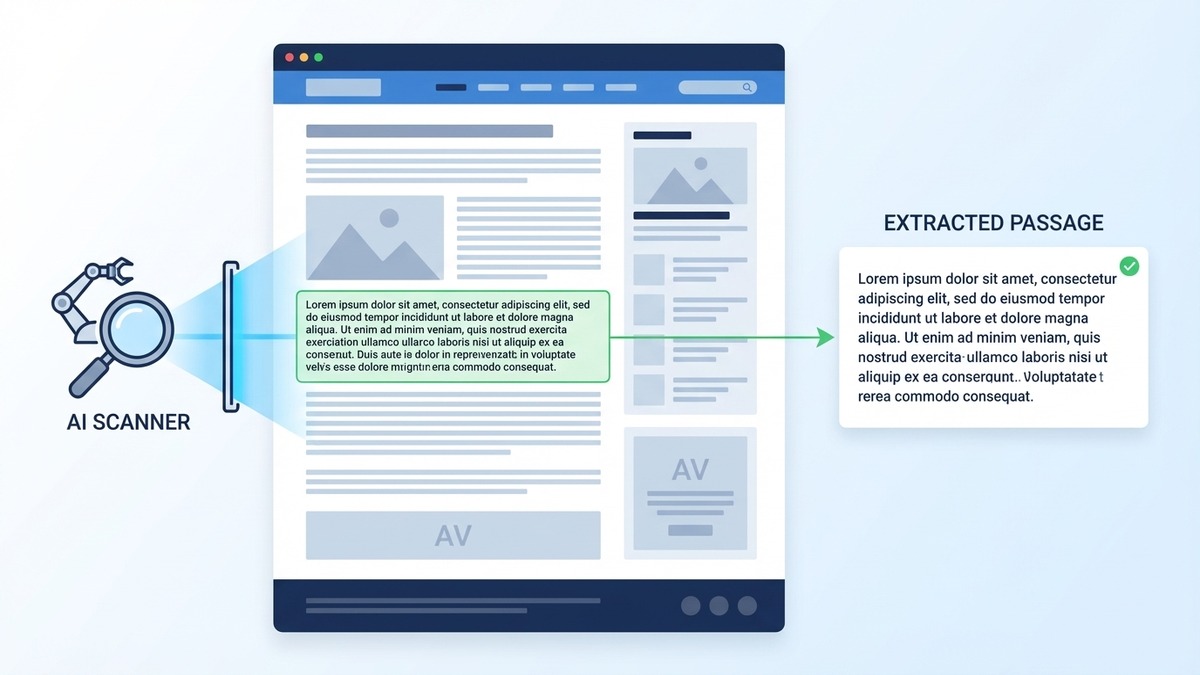
AI systems do not read your article from start to finish. They scan your content for the most direct, self-contained answer to the user's query, then lift that passage into their response. This means a 2,000-word article can fail to get cited if no single section answers a query cleanly on its own.
This is a fundamental shift from traditional SEO, where ranking the page was the goal. In GEO services, the goal is making individual passages extractable. A page that ranks on page two but has perfectly structured answer blocks can still get cited ahead of a page that ranks number one.
Think of it like a library. The AI is not checking out your book. It is photocopying the one paragraph that answers the question and putting the rest back on the shelf.
What Makes an Ideal Answer Block?
An ideal answer block is 40-60 words long, begins with a direct answer to an implied question, and makes complete sense without any surrounding text. It includes the topic, the key claim, and enough context to stand alone.
Here is what separates a citable answer block from a regular paragraph:
- Starts with the answer, not a wind-up ("There are many reasons why...")
- Names the topic explicitly so the passage works without a heading above it
- Stays between 40-60 words: long enough to be informative, short enough to be extractable
- Avoids pronouns that reference earlier context ("it", "this approach", "the above method")
- Contains at least one specific detail: a number, a named concept, or a clear qualifier
A paragraph that opens with "As we discussed earlier..." is invisible to AI systems. A paragraph that opens with "Canonical tags tell search engines which version of a duplicate page to index" is extractable in seconds.
Content Patterns That Get Cited Most
Certain content formats are structurally easier for AI to extract. These five patterns consistently outperform standard prose.
Definition Blocks
A definition block opens with "[Term] is [definition]" and adds one sentence of practical context. These are among the most-cited passages online because they answer definitional queries directly. Example: "Generative Engine Optimisation (GEO) is the practice of structuring content so AI systems cite it as a source in their generated responses, rather than just ranking it in traditional search results."
Step-by-Step Blocks
Numbered steps are high-value because they match "how to" queries. Each step should be a complete action sentence, not a label. Write "2. Add your target keyword to the first 100 words of your article body" rather than "2. Keyword placement." AI systems prefer steps with enough detail to be actionable.
Comparison Tables
Tables are powerful citation anchors. They condense high-information content into a scannable structure, and AI systems can extract both the table and its surrounding context. Any time you compare two tools, methods, or concepts, use a table. A simple two-column table comparing "Traditional SEO" vs "GEO" will outperform three paragraphs of prose covering the same ground.
Statistic Blocks
A sentence that contains a specific statistic with a named source and year is one of the easiest things for AI to cite. Format: "[Claim] ([Source], [Year])." Example: "Pages with fluency-optimised content and added statistics saw up to 115% improvement in AI citation visibility, according to Princeton University GEO research (2024)."
Pros/Cons Blocks
Short bulleted pros and cons lists answer comparison and evaluation queries cleanly. They work best when each point is a complete sentence, not a single word. "Pros: Faster to produce than long-form content" is extractable. "Pros: Fast" is not.
How to Structure Your Headings for AI Search
Your headings should be the questions your audience actually types. Most sites use headings as labels ("Introduction", "Our Approach", "Conclusion"). AI-optimised content uses headings as queries.
Instead of: ## Content Formatting Tips Write: ## How Should I Format Content for AI Search?
Instead of: ## Schema Markup Write: ## Does Schema Markup Help AI Citation?
The heading acts as the query. The opening paragraph directly below it acts as the answer. Together, they form a matched query-answer pair that AI systems can extract as a unit. For more on how schema markup complements this approach, see our previous article in this cluster.
H3s follow the same logic: frame them as sub-questions, and open each with a 1-2 sentence direct answer before going into detail.
What the Princeton GEO Research Actually Found
Princeton GEO research (Aggarwal et al., 2023) tested which content optimisation techniques improved AI citation rates. The findings were clear: fluency improvements combined with added statistics produced the largest citation gains. For lower-ranking websites, the visibility boost reached up to 115%.
This matters because it inverts the traditional SEO assumption that you need strong domain authority before results compound. With GEO, the structure of your content can compensate for low authority. A well-structured page on a newer domain can outperform an unstructured page on a high-authority domain when it comes to AI citation.
The research also found that keyword stuffing, a tactic still used in traditional SEO, had a neutral or negative effect on AI citations. AI systems evaluate passage quality, not keyword density.
The practical takeaway: polish your prose, add specific statistics with sources, and write for clarity. These are not stylistic preferences. They are citation signals.
Content Types Ranked by Citation Share
Not all content gets cited equally. Based on analysis of AI citation patterns across major AI platforms, here is how content types rank by citation share:
| Content Type | Estimated Citation Share |
|---|---|
| Comparison content | ~33% |
| Definitive guides | ~15% |
| Original research | ~12% |
| Listicles | ~10% |
| How-to guides | ~8% |
| Other formats | ~22% |
Comparison content dominates because AI systems answer a high volume of "X vs Y" and "best X for Y" queries. Definitive guides rank second because they cover a topic comprehensively enough that multiple sub-queries can be answered from the same source.
If you are building a content calendar with AI citation as a goal, prioritise comparison pages and comprehensive guides over standalone blog posts. A single "Best Project Management Tools for Small Teams in Singapore" comparison page will likely outperform five individual tool review posts in terms of AI citation frequency.
Before and After: Rewriting Content for AI Extractability
Here is a concrete example of the same information, before and after rewriting for AI citation.
Before (not extractable):
When it comes to improving your website's performance in search, there are quite a few things to consider. Many factors play a role, and it can be hard to know where to start. Some people focus on technical elements, while others prioritise content.
This passage contains no specific claim, no named concept, and no standalone value. AI will not cite it.
After (extractable):
Technical SEO covers site speed, crawlability, and structured data. Content SEO focuses on keyword relevance, answer quality, and topical authority. For most websites, technical issues should be resolved before content optimisation, because search engines need to crawl a page before they can evaluate its content.
This version: names two concepts, draws a comparison, includes a practical recommendation, and makes complete sense without context. AI can extract and use this passage directly.
Apply this test to every section you write: if you removed the heading and the sections around it, would this paragraph still answer a question clearly? If not, rewrite it until it does.
The E-E-A-T Connection: Why AI Needs to Trust Your Content
E-E-A-T (Experience, Expertise, Authoritativeness, Trustworthiness) is a framework Google uses to evaluate content quality. AI systems apply similar trust filters before citing a source.
Content that demonstrates first-hand experience gets cited more because it contains specific, verifiable detail that generic content lacks. "We tested 12 schema types across 40 client sites over 6 months" is more citable than "Many studies suggest schema markup helps."
Expert attribution works the same way. Attributing a claim to a named expert, organisation, or study increases extractability because AI systems can verify the source. Compare: "Link building is important" vs "According to Google's Search Quality Rater Guidelines (2024), page authority is a key trust signal."
Transparent sourcing, with named sources, dates, and methodology, signals to AI that your content is reliable enough to cite. This is why original research and detailed case studies consistently earn high citation shares, even when they come from smaller sites.
For practical guidance on building these signals into your site, our GEO services in Singapore cover the full technical and content side of AI visibility.
Putting It Together: A Checklist for Every Article
Before publishing any page you want AI to cite, run through this list:
- Does every H2 section open with a 40-60 word self-contained answer?
- Are your headings phrased as questions people actually search?
- Have you included at least one comparison table?
- Do you cite specific statistics with named sources and years?
- Does each passage make sense without surrounding context?
- Have you attributed key claims to named experts or research?
- Is there at least one step-by-step section for any procedural topic?
These are not optional polish items. They are the difference between content that gets cited and content that gets ignored.
If you are building out an AI-optimised content strategy and want a structured approach, SEO copywriting services that include GEO formatting can accelerate this significantly. It is also worth reading our guide on getting cited by AI and what GEO actually is for the broader strategic context.
Ready to Get Cited by AI?
Structuring content for AI citation is a skill, and most sites have not started yet. That means the sites that do build this into their content process now will compound their advantage over the next 12-24 months.
If you want help auditing your existing content for AI extractability, or building a GEO-ready content system from scratch, contact us and we can walk through what is possible for your site.
Our digital marketing agency in Singapore works with B2B and SaaS brands specifically on AI search visibility, and we can show you exactly which pages are closest to being cited with a few targeted changes.