
Editor's Note: Updated 28 May 2026. Now includes coverage of Google's AI Optimization Guide.
Europol predicted it. Nina Schick wrote a book about it. And now, in 2026, we are living in it.
The forecast that 90% of online content could be synthetically generated by 2026 is no longer a projection. It is the reality businesses are navigating every single day. AI-generated blog posts, product descriptions, social media captions, ad copy, landing pages, and even news articles now outnumber human-written content in many categories.
For businesses trying to get found online, this changes everything.
Key Takeaways
- The 90% AI content prediction from Europol and researchers like Nina Schick is playing out in real time
- Google's March 2026 core update specifically targeted mass-produced AI content, with affected sites losing up to 71% of traffic
- The flood of AI content makes original, experience-driven content more valuable, not less
- Businesses that rely on generic AI-generated content are now competing against millions of near-identical pages
- E-E-A-T signals (Experience, Expertise, Authoritativeness, Trustworthiness) are the clearest way to differentiate
- AI is a tool, not a strategy. The businesses winning in 2026 use AI for efficiency while keeping human expertise at the centre
The Content Flood Is Real
The numbers are staggering. Before ChatGPT launched in late 2022, nearly all indexed web content was human-created. Within 18 months, AI-generated content exploded across every corner of the internet.
By mid-2025, studies estimated that a significant portion of new web pages being published daily were partially or fully AI-generated. By early 2026, the scale has reached a point where Google has had to fundamentally rethink how it evaluates content quality.
This is not just blog posts. AI is generating product reviews, local business descriptions, how-to guides, FAQ pages, comparison articles, and even the kind of long-form content that used to require subject matter experts. The barrier to publishing content has dropped to near zero.
What Google Is Doing About It
Google's response has been aggressive. The March 2026 spam update specifically targeted scaled content abuse, which is Google's term for mass-producing low-quality content to manipulate search rankings, regardless of whether AI wrote it.
The March 2026 core update went further, recalibrating how Google evaluates content quality across the entire web. Sites relying on high-volume, low-depth AI content saw traffic drops of up to 71%.
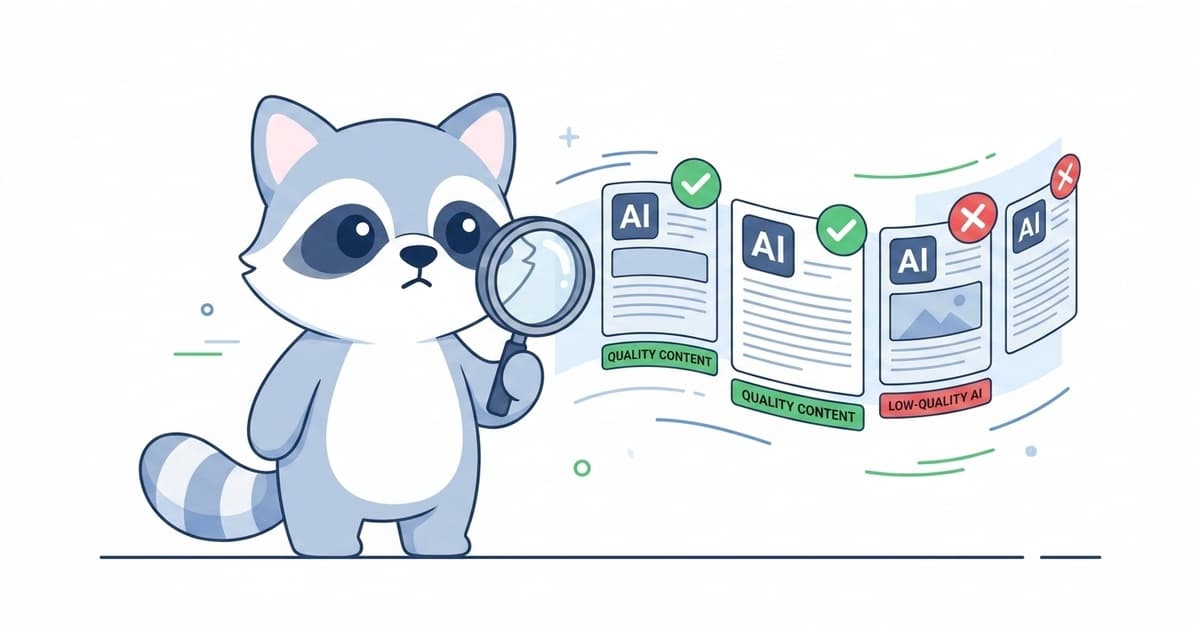
Google's position has been consistent: AI-generated content is not inherently bad. Using AI to mass-produce thin content purely for rankings is. The distinction matters.
"Using automation, including AI, to generate content with the primary purpose of manipulating ranking in search results is a violation of our spam policies," Google states in its documentation.
The key phrase is "primary purpose." If the purpose is to help users and the content demonstrates genuine expertise, Google does not care whether AI assisted in creating it. If the purpose is to flood search results with low-effort pages, the penalties are severe.
Google followed up the enforcement with positive guidance. In its AI Optimization Guide for generative AI features (AI Overviews and AI Mode), Google states that "the best practices for SEO continue to be relevant because our generative AI features on Google Search are rooted in our core Search ranking and quality systems." Translation: there is no separate AI SEO playbook. The same signals that win in regular search are what get your content surfaced in AI answers.
Why This Actually Helps Good Businesses
Here is the counterintuitive truth: the AI content flood is good news for businesses that invest in quality.
When every competitor can generate 100 blog posts overnight, the content itself stops being the differentiator. What differentiates is the quality, depth, and trustworthiness of that content.
Think of it like this. Before AI, a business that published 10 well-researched articles a month had a content advantage over a competitor publishing 2. Now, any business can publish 100 articles a month. The volume advantage is gone. What remains is the quality advantage.
Google's ranking systems are designed to surface the most helpful, reliable content. When the internet is flooded with AI-generated sameness, content that demonstrates real experience and expertise stands out more, not less.
What Google Actually Says to Do (and Not Do)
Beyond the enforcement updates, Google's AI Optimization Guide lays out what the team actually wants website owners to focus on, and what they can safely ignore.
What Google says to focus on
- Create non-commodity content that's helpful, reliable, and people-first. Google contrasts commodity content (think generic "7 Tips for First-Time Homebuyers" listicles) with non-commodity content (lived-experience pieces like "Why We Waived the Inspection and Saved Money: A Look Inside the Sewer Line"). The first is what AI floods the internet with. The second is what Google wants to surface in AI Overviews.
- Organise content in a way that helps your readers. Clear paragraphs, sections, and headings that humans can follow. Write for the person on the other side of the screen, not for a crawler.
Myths Google explicitly debunks
There is a small industry selling AI-specific "optimisation hacks" right now. Google's guide quietly dismantles two of the biggest:
- "Chunking" content for AI. Google: "There's no requirement to break your content into tiny pieces for AI to better understand it." Write naturally. The systems can handle multiple topics on a page.
- Rewriting content just for AI systems. Google: "You don't need to write in a specific way just for generative AI search." AI systems can understand synonyms and natural language. The AEO and GEO "hacks" being sold online are not what Google rewards.
One important caveat: this is Google's official stance for AI Overviews and AI Mode. ChatGPT, Claude, Perplexity, and other AI systems may weight things differently, and chunking or AI-friendly formatting can still help in those surfaces. For Google specifically, though, the official message is: focus on the fundamentals, ignore the hacks.
What Businesses Should Do in 2026
Invest in E-E-A-T, Not Volume
Google's E-E-A-T framework (Experience, Expertise, Authoritativeness, Trustworthiness) is the clearest signal of what matters now.
- Experience: Include firsthand perspectives. Case studies, client results, original data, and personal insights that no AI can fabricate
- Expertise: Demonstrate deep knowledge. Go beyond surface-level explanations that any AI could generate
- Authoritativeness: Build citations and backlinks from credible sources. Get referenced by industry publications
- Trustworthiness: Be transparent about who you are, what you do, and how you do it
If your content reads like something ChatGPT could produce in 30 seconds, it will not rank. If it reads like something only your team could produce, it will.
Use AI for Efficiency, Not Replacement
The businesses winning in 2026 are not avoiding AI. They are using it strategically.
A solid AI-assisted workflow looks like this: humans do the research and create the strategy. AI helps draft and speed up production. Humans add expertise, verify facts, and ensure the content reflects real experience. The final product combines AI efficiency with human depth.
This is the approach SEO professionals who understand the landscape are taking. AI handles the busywork. Humans handle the thinking.
At our agency, we have learned this firsthand. Every piece of AI-assisted content we produce starts with a detailed set of guidelines: brand voice rules, structural requirements, topics to avoid, and specific constraints the AI must follow. Without those guardrails, AI defaults to generic. With them, it becomes a genuine force multiplier.
For example, we maintain a living content guidelines document that governs everything from tone ("direct, not salesy") to structure ("key takeaways at the top, no fluff sections at the bottom"). The AI drafts within those boundaries. A human reviews every piece before it goes live. The result is content that is produced faster but does not read like it was.
Audit Your Existing Content
If your website has dozens of thin, generic pages that read like AI output, they are now a liability. Google's recent updates have made it clear that low-quality pages can drag down your entire site's rankings, not just the individual pages.
Run a content audit. Identify pages that add no unique value. Either improve them with original insights and real expertise, or remove them entirely. Sometimes, deleting pages improves rankings. A smaller site with consistently high-quality content outranks a large site padded with filler.
We practice this ourselves. When we spot content that reads too generically, we do not just tweak a few sentences. We go back to the brief: what unique perspective can we add? What data do we have that nobody else does? What has our team actually experienced that contradicts the conventional advice? If we cannot answer those questions, the content is not ready to publish.
Prepare for AI Search
The AI content flood is happening alongside another shift: AI-powered search itself. Google AI Overviews, ChatGPT, Perplexity, and other AI search tools are changing how users find information.
These AI systems are selective about what they cite. They prioritise content that demonstrates expertise, provides original data, and comes from authoritative sources. Generic AI-generated content is exactly what these systems are designed to filter out.
Businesses that optimise for GEO (Generative Engine Optimisation) alongside traditional SEO will have a significant advantage as AI search becomes the primary way people find businesses.
The Bottom Line
The 90% AI content prediction is not a future scenario. It is today's reality. But that reality is not a threat to businesses that do things properly. It is an opportunity.
When everyone has access to the same AI tools, the differentiator becomes what you bring that AI cannot: real experience, genuine expertise, original data, and authentic perspective.
The businesses that will thrive in this environment are the ones that use AI as a tool while keeping human thinking at the centre of their strategy.
Need Help Standing Out in the AI Content Flood?
If your content strategy needs to evolve for the new reality, we can help. Our team builds SEO and GEO strategies that prioritise the signals Google and AI search engines are actually looking for. Get in touch.