
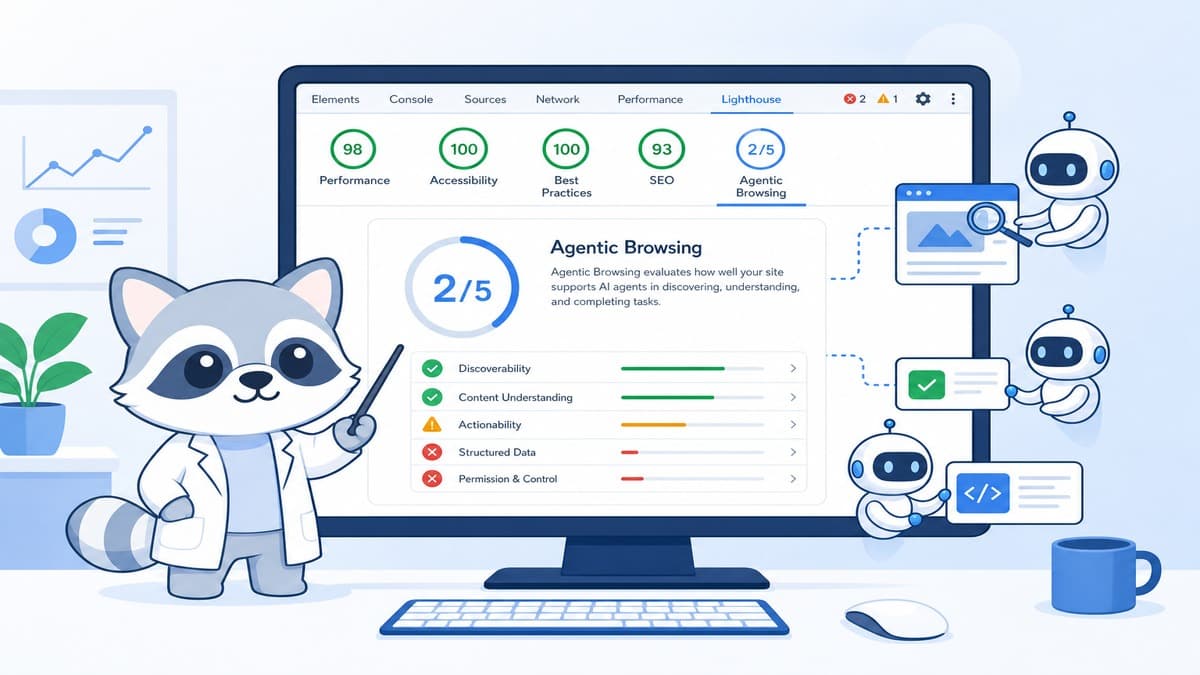
For twenty years, you built your website for two audiences: humans and search engine crawlers. There is now a third, and most Singapore businesses have no idea it exists. AI agents, the kind that browse, click, and complete tasks on a user's behalf, are starting to visit websites the way a person would. And Google just gave everyone a free tool to check whether your site is ready for them. It is a new Lighthouse report, it runs right inside Chrome, and the results are a preview of a ranking factor that does not fully exist yet but is coming fast.
Key Takeaways
- Google added an "Agentic Browsing" category to Lighthouse that scores how ready your website is for AI agents to use it.
- The report does not give a score out of 100. It shows a ratio of how many agent-readiness checks your site passes.
- It evaluates three things that matter for the agentic web: your accessibility tree, WebMCP integration, and your llms.txt file.
- The llms.txt check is the controversial one. Google's own AI guidance says you do not need the file for Search, while this report checks for it.
- Most Singapore sites do not need to act on every signal today, but the businesses that understand this shift early will have a head start when agent recommendations start influencing visibility.
A Third Kind of Visitor
Think about how a person uses your website. They look at the page, they read the labels, they find the button, they click it. An AI agent doing a task for someone, like booking an appointment or comparing services, has to do the same thing. But it does not have eyes in the human sense. It reads your page through code and structure.
If your site is messy under the hood, a human can still muddle through because they are smart and patient. An agent is neither. It will fail, give up, and move on to a competitor whose site it can actually understand. As AI assistants increasingly act on behalf of users, the sites that agents can navigate cleanly are the ones that will get the booking, the enquiry, or the sale. This is the same logic that drives GEO: being machine-readable is becoming as important as being human-readable.
The New Lighthouse Report, Explained
Lighthouse is a free auditing tool that has lived inside Chrome for years. Most people know it for the performance and SEO scores it spits out. Google has now added a new category called "Agentic Browsing."
Right now it is not in the standard version of Chrome. You need Chrome Canary, the early beta build. Once you have it, you right-click any page, choose Inspect, go to the Lighthouse tab, and you will see the new "Agentic Browsing" category alongside the familiar ones.
Here is the important part: unlike the usual Lighthouse scores, this report does not give you a number out of 100. According to Google's own documentation on agentic browsing scoring, the standards for the agentic web are still emerging, so instead of a weighted score it shows a fractional ratio, how many agent-readiness checks your site passes, plus pass or fail flags on specific audits. It is built to give you actionable signals, not a final grade.
The 3 Things It Checks
1. The Accessibility Tree
The accessibility tree was originally built for screen readers, so that blind and low-vision users could navigate the web. It turns out that the same structure is exactly what an AI agent needs. It tells the agent where the buttons are, what each element does, and how the page is organised.
If your accessibility tree is broken or incomplete, agents struggle to use your site, the same way a screen reader user would. Google's documentation says Lighthouse checks for things like every interactive element having a programmatic name, valid roles and parent-child relationships, and content not being hidden from the tree while still being clickable. The fix is good semantic HTML and proper labelling, which is the same hygiene that makes a site accessible to humans with disabilities. Building it well serves both audiences at once.
2. WebMCP
WebMCP is a proposed web standard for exposing your site's tools and functions to AI agents in a structured way. In plain terms, it is a method of teaching an agent how to actually use the features of your website, like a form, a booking flow, or a search box.
There are two flavours: declarative, which is simple code wrapped around something like a form, and imperative, which lets the agent interact back and forth with your site through JavaScript. Most small business websites do not need WebMCP today. But if your site has interactive tools that people will want their agents to operate, this is going to matter a lot sooner than you think.
3. The llms.txt File
This is the one that has SEOs talking, and for good reason. An llms.txt file is a proposed standard, similar to robots.txt, where you place a markdown summary at the root of your domain to help AI systems understand your site and what they are allowed to do.
Here is the confusion. Google recently published guidance on optimising for AI features in Search that effectively says you do not need an llms.txt file. Yet this new Lighthouse report checks for the presence of one. SEOs noticed the contradiction immediately, and it sparked a lively discussion on r/SEO about Google seemingly saying two different things.
The reconciliation is subtle but important. The Search guidance is about ranking in Google's AI-powered search results. The Lighthouse report is about agents using your website directly, which is a different job. llms.txt is not a Search ranking signal. It is a hint for agents operating on your site. So both statements can be true at the same time: you likely do not need llms.txt to rank in AI Search, and you might want it if agents are going to be using specific functions on your site. For the vast majority of Singapore businesses, this is a "be aware of it" item, not a "do it this week" item.
Why This Matters Before It Officially Matters
None of this is a confirmed ranking factor yet. Google has been clear that the agentic web is still emerging. So why pay attention now?
Because the direction of travel is obvious. The same pattern played out with mobile-friendliness, with page speed, and with Core Web Vitals. Each started as a "nice to have" that Google was clearly nudging toward, and each eventually became something that affected visibility. Agent-readiness has every sign of following the same path. When AI assistants start recommending businesses based partly on which sites they can actually use, the sites that prepared early will be the ones getting recommended.
There is also a happy overlap. Most of what makes a site agent-ready, clean semantic HTML, a sound accessibility tree, stable layouts with minimal shift, fast loading, also makes it better for humans and better for traditional SEO. As we covered in our guide on structuring content so AI cites you, machine-readability and human-readability are converging, not competing. Doing this work is rarely wasted.
What Singapore Businesses Should Actually Do
You do not need to panic-build an llms.txt file or rush into WebMCP. Here is a sensible order of priority.
- Run the report. Install Chrome Canary, open the Agentic Browsing audit on your homepage and a key service page, and see where you stand. It costs nothing and takes ten minutes.
- Fix your accessibility tree first. This is the highest-value, lowest-regret work. It helps agents, helps users with disabilities, and overlaps with good technical SEO. If you have unlabelled buttons or broken structure, that is the place to start. A proper technical audit, the kind covered in our piece on fixing the crawl errors that quietly kill rankings, will surface most of these issues.
- Watch WebMCP and llms.txt. Understand what they are. Implement them only when you have interactive tools that agents will genuinely use, or when the standards firm up.
- Keep building real authority. Agent-readiness is plumbing. It does not replace good content, genuine expertise, or the trust signals that make you worth recommending in the first place. That is what our work on being cited by AI tools is built around.
The Web Is Getting a New Set of Eyes
For two decades, SEO meant building for Google's crawler and the humans behind the search box. The agentic shift adds a third reader: the AI assistant acting on someone's behalf. Google handing out a free Lighthouse report to measure agent-readiness is a strong signal of where this is heading.
The smart move is not to chase every emerging standard the moment it appears. It is to understand the shift, fix the fundamentals that help all three audiences at once, and stay ahead of the curve. If you want help auditing your site for both traditional SEO and the agentic future, our experienced SEO experts can help. Our SEO services and our work as an AI SEO agency in Singapore are built for exactly this moment. Get in touch and we will tell you where your site stands.