
You can absolutely learn SEO on your own. The fundamentals of SEO, which include keyword research, on-page optimisation, link building, and technical auditing, are documented thoroughly in free resources published by Google, Moz, Ahrefs, and Search Engine Journal. The bigger challenge is not finding resources. It is knowing which resources to trust, which order to study in, and how to apply what you learn to an actual website. This guide gives you that structure: a self-study roadmap from complete beginner to confident SEO practitioner, with honest guidance on when DIY makes sense and when hiring an expert is the smarter call.
For Singapore business owners, marketers, and career changers, this guide includes local context on where to learn SEO affordably and how the Singapore job market values SEO skills.
Key Takeaways
- SEO is learnable on your own. You do not need a degree or an expensive course to get started.
- The right learning order matters. Starting with technical SEO before understanding keyword fundamentals is the most common beginner mistake.
- The best free resources are Google's own Search Central documentation, Moz's Beginner's Guide to SEO, and Ahrefs' YouTube channel.
- Hands-on practice on a real website (even a personal blog) is worth more than any course or certification on its own.
- Singapore-specific resources include SkillsFuture-funded digital marketing courses that cover SEO as part of a broader curriculum.
- Certifications from Google, HubSpot, and Semrush are free and respected by Singapore employers and clients.
- The honest DIY vs. hire decision: DIY is fine for learning and for small personal sites. For a business that depends on organic traffic, professional SEO support compounds returns far faster.
Why Most People Get Lost Learning SEO
The SEO industry produces an enormous volume of content. Blogs, YouTube channels, podcasts, Twitter threads, LinkedIn posts. The problem is that most of this content is written for people who already understand SEO. It assumes familiarity with terms like DA, DR, SERP, CTR, Core Web Vitals, canonical tags, and E-E-A-T.
A beginner who lands on an Ahrefs blog post about "topical authority mapping" before they understand what a keyword is will be confused and discouraged. They will either give up or, worse, start implementing tactics they do not understand on a real website.
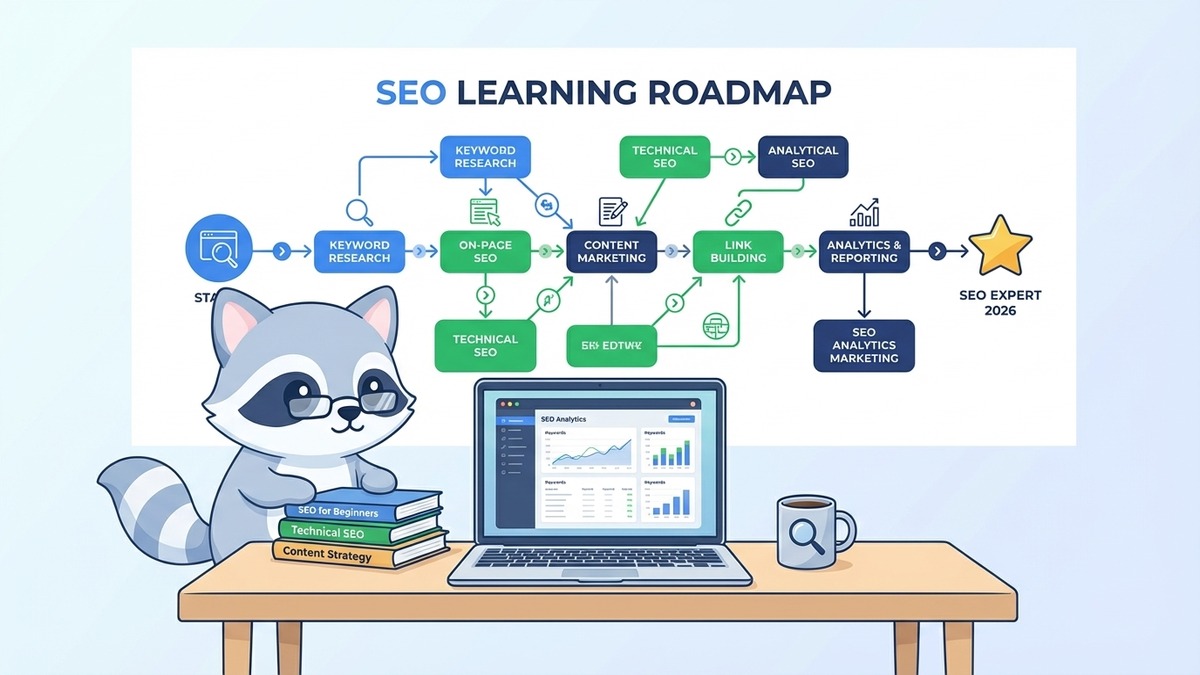
The solution is a structured roadmap with an intentional learning order. Start with fundamentals. Build to intermediate. Reach advanced. Apply throughout.
Before you read a single resource on SEO tactics, read how SEO actually works. Understanding the mechanics, why search engines crawl, index, and rank content the way they do, is the foundation everything else sits on.
Stage 1: The Fundamentals (Weeks 1-4)
At the beginner stage, your goal is understanding what SEO is, how search engines work, and what the core disciplines of SEO are.
What to Learn in Stage 1
How search engines work: Crawling, indexing, and ranking. Google's crawlers (Googlebot) discover pages by following links. They index pages by analysing content. They rank pages against each other using hundreds of signals. This three-step process is the entire conceptual framework of SEO.
Keyword research basics: Keywords are the phrases people type into search engines. Your job is to create content that matches what people search for and satisfies their intent better than competing pages. Learn the difference between informational intent ("how does SEO work"), commercial intent ("best SEO agencies Singapore"), and transactional intent ("hire SEO consultant Singapore").
On-page SEO basics: Title tags, meta descriptions, H1 and heading structure, image alt text, internal linking. These are the elements on your page that communicate to search engines what your content is about.
Off-page SEO overview: Backlinks (links from other websites to yours) are the most important off-page ranking signal. You do not need to master link building in Stage 1, but understand why it matters. For a deeper look at the subject, backlinks are the secret weapon that separates ranking pages from buried ones.
Best Beginner Resources (Free)
Google Search Central Documentation: This is Google's own guide to how search works and how to optimise for it. It is the most authoritative source available and is regularly updated. Start with the "Get Started" section.
Moz Beginner's Guide to SEO: A well-structured, jargon-free introduction covering all the core SEO concepts. This guide has been the recommended starting point for beginners for over a decade and is still accurate in 2026.
Google's "How Search Works": Google's consumer-facing explainer on its own search algorithm. Shorter and more accessible than the Search Central documentation.
Stage 1 Practical Task
Set up Google Search Console on any website you have access to. Even a personal blog with no traffic is fine. Explore every section. Look at the Performance report (what queries is the site ranking for?), the Coverage report (are there any indexing errors?), and the URL Inspection tool. Learning to read data from the tool you will use most frequently is more valuable in Stage 1 than reading more content.
If you need to understand what the common SEO terms mean as you encounter them, keep the SEOExpert glossary bookmarked as a reference.
Stage 2: Building Core Skills (Weeks 5-12)
At the intermediate stage, you should be applying what you learned. You should have a website to practise on (more on this below). You are deepening your understanding of keyword research, learning link building strategy, and doing your first technical SEO audits.
What to Learn in Stage 2
Keyword research in depth: Learn how to use Ahrefs, Semrush, or free alternatives like Google Keyword Planner and Ubersuggest. Understand keyword difficulty scores, search intent classification, and how to identify keyword gaps (topics your competitors rank for but you do not). Learn the difference between head terms (high volume, high competition) and long-tail terms (lower volume, lower competition, often higher conversion rate).
Content strategy and writing for SEO: How to structure an article to rank. How to use H1-H6 hierarchy effectively. How to cover a topic comprehensively enough to satisfy search intent. How to write naturally while including keywords. Learn what E-E-A-T (Experience, Expertise, Authoritativeness, Trustworthiness) means for content quality.
Technical SEO fundamentals: Site speed (Core Web Vitals), mobile-friendliness, XML sitemaps, robots.txt, canonical tags, broken links, redirect chains, and crawl errors. Learn how to use Screaming Frog (free up to 500 URLs) to audit a website's technical health.
Link building basics: How to find link opportunities, how to write outreach emails, and which tactics (guest posting, resource pages, digital PR, broken link building) are appropriate for different websites. Read our dedicated piece on backlinks for a thorough foundation.
Best Intermediate Resources
Ahrefs' YouTube Channel: Ahrefs produces some of the highest-quality SEO tutorial content available. Their "Keyword Research for Beginners" and "On-Page SEO" series are excellent. Free to watch.
Semrush Academy (semrush.com/academy): Free courses covering keyword research, on-page SEO, technical SEO, link building, and content marketing. Each course ends with a certification exam. Certificates are recognised by Singapore employers and digital marketing agencies.
Moz Pro Blog: The Moz blog publishes in-depth SEO analysis and case studies. "Whiteboard Friday" (now a video series) covers one tactical topic per week and is excellent for intermediate learners.
Search Engine Journal: Day-to-day SEO news, algorithm update coverage, and tactical guides. Good for staying current on what is changing in the industry.
Stage 2 Practical Task
Create a small niche website or revamp an existing one. The goal is to have a site where you can practise everything you are learning without risk to a business. Pick a topic you know well (a hobby, a local Singapore niche, a professional interest). Do full keyword research for the topic. Write 10 articles targeting specific keywords. Build the site's technical foundation correctly from the start. Then monitor rankings over 90 days.
This practice site is the single most valuable learning tool available to you. Reading about SEO and doing SEO are fundamentally different experiences. The real learning happens in the doing.
Stage 3: Advanced Skills (Months 4-6 and Ongoing)
At the advanced stage, you can produce results. You understand why pages rank and why they do not. You can diagnose technical problems, build a content strategy, and execute link building campaigns. The advanced stage is less about learning new concepts and more about deepening expertise and staying current.
What to Learn in Stage 3
Advanced keyword research: Topic clustering and pillar page strategy. Entity-based SEO and how Google's Knowledge Graph affects rankings. International SEO for businesses targeting multiple markets.
Advanced link building: Digital PR, data-driven content campaigns that earn links, podcast guesting, and strategic partnerships. Building links at scale without triggering spam penalties.
AI and SEO in 2026: Understanding how Google's AI Overviews work and how to optimise for them. Generative Engine Optimisation (GEO) as a complement to traditional SEO. See our article on GEO services if this is relevant to your work.
Local SEO: Specific optimisation for businesses that serve local markets, including Singapore. Google Business Profile optimisation, local citations, and the local pack ranking factors. Our local SEO services cover this for Singapore businesses at a professional level if you want to see what a complete implementation looks like.
SEO reporting and analytics: Google Analytics 4, Google Search Console, Looker Studio dashboards. How to report SEO performance to stakeholders in terms of business outcomes (traffic, leads, revenue) rather than just rankings.
Best Advanced Resources
Google's Search Quality Rater Guidelines: The document Google uses to train human quality raters. This is the most direct window into what Google actually values in content. Freely downloadable as a PDF. Lengthy but invaluable.
John Mueller's Twitter and YouTube appearances: John Mueller is Google's Search Advocate. His Q&A sessions and video appearances directly address real SEO questions from practitioners. Follow him on X (Twitter) and watch his Search Central recordings on YouTube.
Advanced Ahrefs and Semrush documentation: Once you understand the tools conceptually, dig deep into their advanced features. Ahrefs' Academy and Semrush Academy both have advanced course tracks.
Certifications Worth Getting in Singapore
Certifications do not make you an SEO expert. Practice does. But certifications signal commitment and baseline knowledge to Singapore employers and clients. These are the ones worth your time:
Google Digital Garage - Fundamentals of Digital Marketing: Free. Google-issued certificate. Covers SEO as part of a broader digital marketing curriculum. Widely recognised by Singapore employers.
HubSpot SEO Certification: Free. Focused specifically on SEO strategy and content marketing. The HubSpot name carries weight with marketing decision-makers in Singapore.
Semrush SEO Toolkit Course: Free with a Semrush account. Practical and tool-specific. Good for demonstrating hands-on capability.
Google Analytics 4 Certification: Free. Not SEO-specific but essential for any SEO practitioner who needs to demonstrate ability to measure results.
Singapore-Specific Learning Resources
SkillsFuture Credit: Singapore citizens and PRs can use SkillsFuture Credit for approved digital marketing courses that include SEO content. Many private training providers in Singapore offer WSQ-accredited digital marketing programmes. Check the SkillsFuture website for current approved courses.
IMDA Digital Skills Training: The Infocomm Media Development Authority periodically offers subsidised digital skills programmes for Singapore businesses and individuals. Check imda.gov.sg for current offerings.
Google Activate Singapore: Google periodically runs free digital marketing workshops in Singapore through its Activate programme. These are beginner-friendly and include SEO sessions.
Building a Real Practice Website
The most common piece of advice from working SEO professionals: build a test website and do SEO on it before touching a client's or employer's site.
Your practice site does not need to look professional. It does not need to make money. It needs to be:
- On a real domain (not a subdomain or localhost)
- Indexed by Google
- Producing content you can optimise
- Something you can run for at least 6 months to see results
Content that takes 4-6 months to rank in Google. You need that time on your practice site to see the results of your work. An SEO claim on a CV without a demonstrable example is much less credible than "I built a site about Singapore coffee culture from 0 to 2,000 organic visitors in 6 months using these specific tactics."
The domain and hosting for a practice site costs roughly SGD $30-100 per year. That is the best SEO education investment you can make.
DIY SEO vs. Hiring an Expert: An Honest Framework
Learning SEO yourself is genuinely worthwhile. But there is a difference between being capable of doing SEO and it being the best use of your time.
DIY makes sense if:
- You are an individual creator, blogger, or freelancer with a personal website
- You are a marketer who wants to understand SEO to better collaborate with agencies
- You are testing whether SEO is a viable growth channel before committing budget
- You have 5-10 hours per week to invest in learning and implementation
Hiring an expert makes sense if:
- Your business depends on organic traffic for lead generation or revenue
- You have tried DIY SEO for 6+ months without meaningful results
- The opportunity cost of your time is higher than the cost of professional support
- You need results faster than the typical 6-12 month DIY learning curve
For Singapore businesses in competitive markets (finance, legal, healthcare, property, e-commerce), professional SEO compounds returns significantly faster than DIY. If you run a Shopify store specifically, our Shopify SEO guide covers the platform-specific technical fixes and content strategies that move the needle for Singapore e-commerce brands. The technical setup, content velocity, and link building that a good agency delivers in month 1 would take a DIY learner 6-12 months to replicate.
Our SEO services in Singapore are built for businesses that have moved past the "should I invest in SEO" question and want a team that delivers results.
Staying Current: SEO Changes Constantly
Google makes thousands of algorithm changes per year. Major core updates happen 3-5 times per year and can significantly shift rankings. Staying current is not optional for anyone practising SEO seriously.
Essential reading list for staying current:
- Search Engine Land (searchengineland.com): Breaking news on Google algorithm updates
- Search Engine Roundtable (seroundtable.com): Daily coverage of algorithm update chatter
- Google Search Central Blog: Official announcements from Google
- Ahrefs Blog: Research-backed analysis of ranking factor studies
Spend 20-30 minutes per week reading industry news. When a major update hits, read the analysis from multiple sources before drawing conclusions. Knee-jerk reactions to algorithm updates, like mass-deleting content or overhauling site architecture overnight, often cause more harm than the update itself.
Your SEO Learning Journey Starts Now
The best time to start learning SEO was two years ago. The second best time is now. Search engine traffic compounds over time. Every piece of optimised content you publish, every keyword you rank for, every backlink you earn builds on itself. Starting earlier means compounding longer.
If you are a Singapore business owner or marketer who wants to understand SEO deeply, this roadmap gives you a clear path. If you want to accelerate that path by working with a team that has already walked it, the SEOExpert team is here.
Reach out to us for a free consultation on where your website stands today and what a realistic SEO roadmap looks like for your specific situation.