
The August 2026 spam update finished rolling out on 21 August at 1:49am Pacific, which is 4:49pm Singapore time. Your Search Console data is now safe to read.
Google has not said this update targeted AI content. The SEO industry has decided it anyway.
Reports collected over the past week point at sites running fully automated AI publishing losing rankings between 18 and 21 August. The evidence is thin and anecdotal, but the pattern underneath it deserves your attention.
Because the thing getting punished is not the AI. It is the assembly line.
Key Takeaways
- Rollout completed 21 August 2026. Comparing before and after is now a fair test.
- Google has confirmed nothing about this update targeting AI content. Everything reported so far is anecdote, not proof.
- The reported survivors were sites with real history and real readers, not sites automated from day one.
- Google's actual written policy covers scaled content abuse: mass producing pages to manipulate rankings instead of helping people.
- Google's own research into synthetic spam looks for repeated content templates across clusters of accounts, not individual bad pages.
- If a human reads and edits every piece before it publishes, none of this describes you.
The Rollout Is Finished
Google's Search Status Dashboard records the incident as beginning 18 August at 9:27am Pacific and ending 21 August at 1:49am Pacific. That is three days and change.
This matters for one practical reason. Rankings move erratically mid-rollout, so any diagnosis you made last week was built on unstable data.
Now the window is closed. A before-and-after comparison finally means something.
What The Reports Actually Say
The evidence here is anecdotal and you should treat it that way. Search Engine Journal gathered it from two Japanese SEO accounts on X, a BlackHatWorld forum thread, and a private Facebook group.
The claim: sites publishing automatically through coding agents got filtered and dropped across the board.
The counterclaim, from those same reports: sites that were run by hand first and switched to automation later mostly survived.
The theory offered was accumulated "trust". Search Engine Journal's Roger Montti pushed back on that word, and he is right to.
Google does not keep a trust score. It has signals generated by real users doing real things on your site.
That version of the story is far more useful. The survivors were not protected by age. They were protected by having an audience.
There is counter-evidence too. Some publishers in that Facebook group said their AI content improved after the update.
Small samples, no controls, no conclusion. Anyone selling you certainty this week is guessing.
The Trigger Is Scale, Not The Tool
Google's spam policy has never contained a rule against AI. It contains a rule against scaled content abuse.
The definition turns on purpose: generating many pages primarily to manipulate search rankings rather than to help users. Read Google's spam policies yourself and you will not find language models mentioned.
So the question to ask about your own site is not "did AI write this".
It is "would this page exist if search engines did not". If the honest answer is no, whatever produced it is beside the point.
What Google's Own Research Suggests
One piece of hard evidence sits underneath all the speculation, and it is a research paper. Google published Scalable Detection of Adversarial Synthetic Slop and Coordinated Media Abuse, describing a system called S-CTS.
Big caveat first. That paper is about online video platforms, not web search, and nobody has said it runs on Google Search.
The method is still instructive. Rather than judging one piece of content at a time, it groups accounts into clusters and hunts for the same narrative template repeated across all of them.
It uses text embeddings to catch scripted narratives, and it flags publishing behaviour too fast and too regular to be human.
That lesson holds wherever it gets deployed. Detection is shifting from "is this page bad" toward "is this page one of a thousand near identical pages".
Volume is the fingerprint.
How To Tell If This Was You
Start with dates, not feelings. Open Search Console, compare the seven days before 18 August against the seven days after 21 August, and check whether your drop lines up with the rollout window.
Then check the scope. A sitewide decline across every page group is a different story from ten pages slipping.
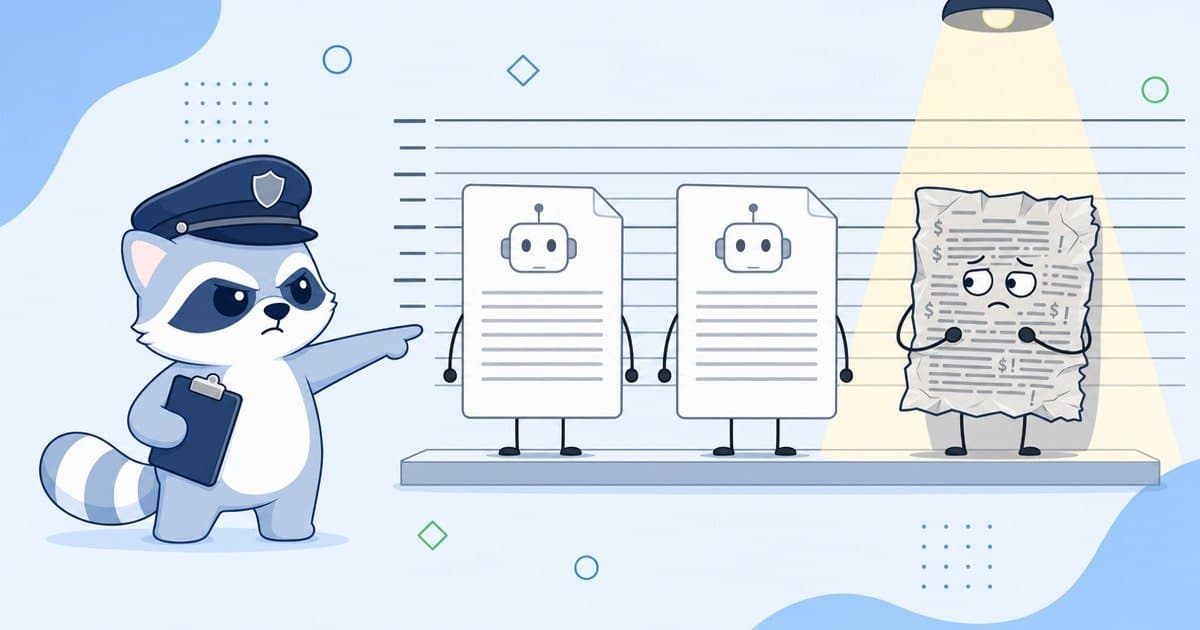
Now run the template test. Pull ten of your pages, read them side by side, and look at the skeleton.
If they share the same section order with the nouns swapped out, that is the pattern the reports describe.
Finally, look at behaviour. Do those pages get returning visitors, enquiries, or anything a real person would leave behind?
Pages that only ever get one impatient visit from a search result have nothing holding them up when enforcement arrives.
What To Change About Your Process
Put a human in the loop before publish, not after the drop. The one publisher in these reports who escaped untouched credited manual checks on every article before it went live.
Publish fewer pieces and go deeper on each. Ten pages someone actually wants to read will outlive two hundred that nobody finishes.
Break the template. Vary the structure, add original data, add opinions a model could not produce on its own.
Then decide what happens to the rest. Improve the pages worth keeping and remove the ones that only ever existed to catch a keyword.
None of this is new advice. It just got expensive to ignore.
If you are trying to work out where your effort should go next, our breakdown of content, backlinks and technical work is the place to start. For the timeline itself, we covered the rollout on the day it launched.
This reaches past Google too. As a GEO agency in Singapore, we watch templated pages disappear from AI answers well before they lose rankings.
Our SEO services cover the audit work behind all of this, and an SEO consultant can walk your Search Console data with you before you touch a single page. Any honest Singapore SEO firm will tell you the same thing: diagnose first, then act.
Want a second opinion on whether your traffic drop was this update or something else? Talk to us.